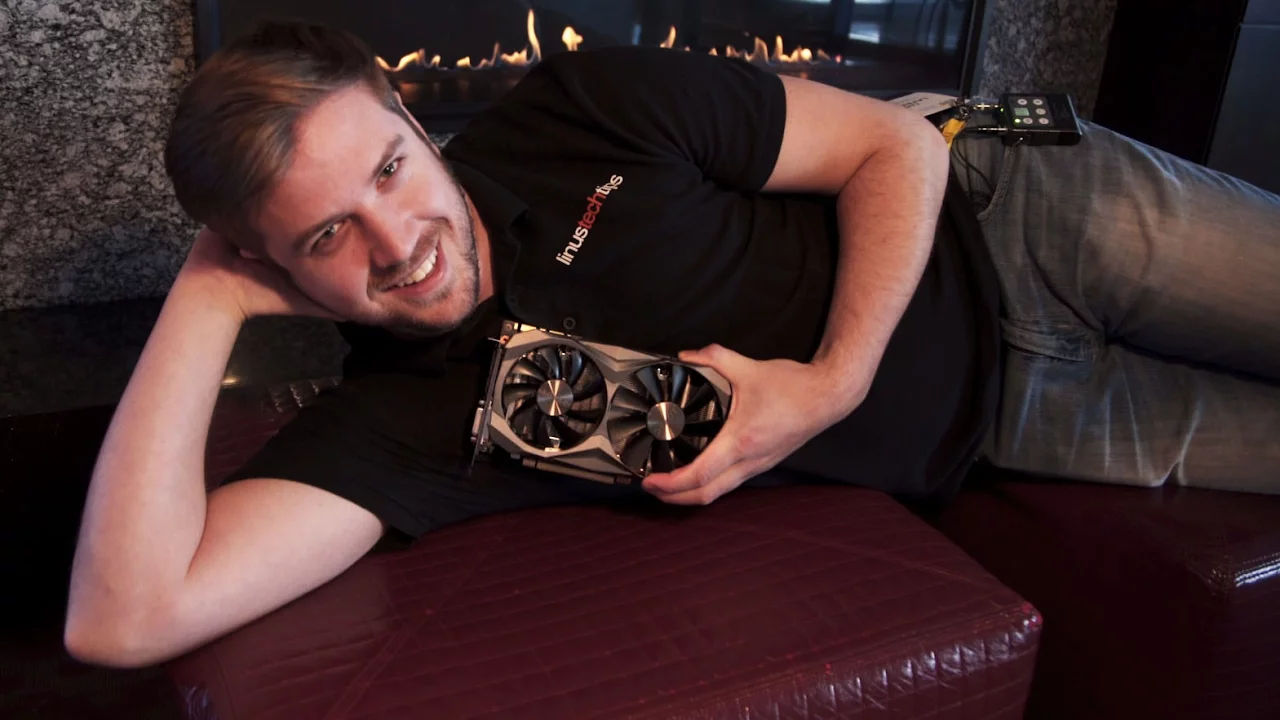
World's Smallest GTX 1080
0 up · 0 down · 0 ratings
Promos
Tiny graphics cards are becoming a bit of a trend... but a 1080? In this form factor? Holy crap. Thanks to Squarespace for sponsoring this video. Head over to squarespace.com and use offer code CES17 to save 10% off your first purchase. Follow: twitter.com @linustech Join the community: linustechtips.com
The video introduces Zotac’s 8.3 inch GTX 1080 mini, showcased at CES 2017 with a focus on its high performance in a tiny form factor. The host explains that the card is essentially a scaled down version of a reference GTX 1080, offering a base clock around 1620 MHz and a boost clock near 1759 MHz, which is modestly higher than the standard reference due to its compact design. Cooling uses two different fan configurations: a 90mm static pressure optimized fan on the left and a 100mm airflow optimized fan on the right, with distinct blade geometries to suit their purposes. The PCB employs a 5+1 power phase design and a standard 180 W TDP, signaling that the card aims to balance compact ITX builds with serious gaming performance. In terms of video outputs, it aligns with the reference card, featuring three DisplayPort 1.4 connectors, one HDMI 2.0 B, and a dual-link DVI connector. The host touches on potential thermals, estimating about 74 degrees under load, and notes white lighting on the card along with both the front shroud and backplate being metal, underscoring a premium aesthetic. Beyond the GPU itself, the video shifts to the VRGO backpack, presenting it as a sleek tether-free VR solution that also functions as a desktop setup. The backpack design includes two hot-swappable battery slots, easy swapping to extend playtime, built-in storage for controllers and cables, and a clip to hang a headset. The host demonstrates converting the backpack into a desktop setup by detaching the backpack module with a simple, repeatable sequence involving a Velcro strap and a dial, then reassembling in reverse for on-the-go VR. Finally, the sponsor advertisement for Squarespace emphasizes their web building tools, highlighting features like commerce modules, responsive design, and 24/7 support, inviting viewers to try a free trial and use a CES-specific promo code. The overall takeaway is that ultra-compact high-end graphics solutions like the Zotac GTX 1080 mini are expanding the possibilities for ITX builds and VR-ready setups, with additional hardware options such as the VRGO backpack broadening how and where users can enjoy future-ready gaming experiences.
Topics · technology · hardware · pcbuilding · virtual-reality · gaming