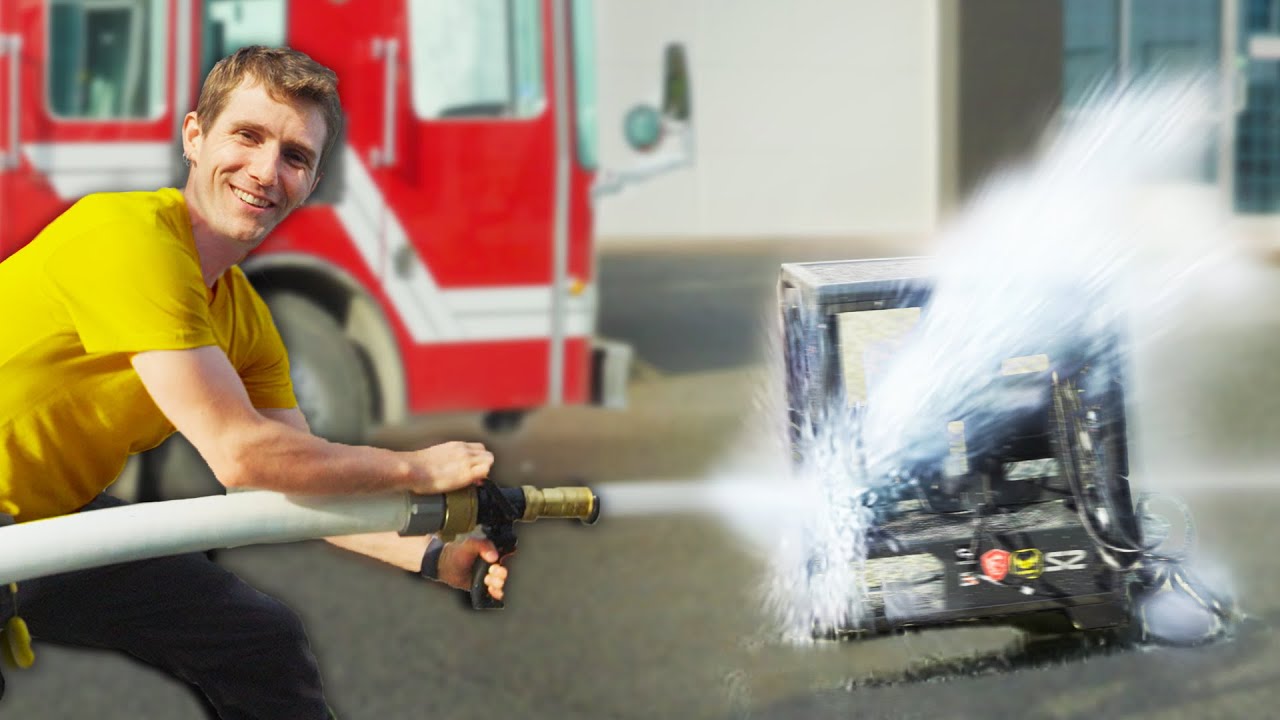
Cooling a PC with a Fire Truck… Literally
0 up · 0 down · 0 ratings
Description
Thank you AMD for sponsoring this video and being a great partner!
Check out their latest gaming offerings below! AMD Ryzen 9 9950X3D CPU: geni.us AMD Radeon RX 9070 Graphics Cards: geni.us AMD Radeon 9070 XT Graphics Cards: geni.us What happens when you connect a Fire Truck to a PC water cooling loop? Well given PC water cooling fittings are rated for about 8psi and the Fire Truck can do over 200psi… I think you can see where this is going. Discuss on the forum: linustechtips.com
Promos
Check out Green Line Hose & Fittings: lmg.gg ► GET OUR MERCH: lttstore.com ► GET EXCLUSIVE CONTENT ON FLOATPLANE: lmg.gg ► GET A VPN: piavpn.com ► SPONSORS, AFFILIATES, AND PARTNERS: lmg.gg Purchases made through some store links may provide some compensation to Linus Media Group. CHAPTERS --------------------------------------------------- 0:00 Intro 1:12 Yup, we bought a Fire Truck 2:55 Converting the hose 5:54 Hooking it up to a PC 9:08 PC # 2 12:11 Big Bertha 16:22 RIP Big Bertha 16:53 Outro
The video kicks off with Linus and team announcing they bought a real fire truck to test a high pressure cooling concept for a PC. They explain the basic idea: using the fire truck’s high pressure water output to push coolant through a PC water cooling loop, something ordinary PC fittings are not designed to handle. The host notes the pump can deliver hundreds of PSI, vastly outperforming typical 8 PSI ratings, and frames the experiment as a playful exploration with real mechanical risk. Early on, they discuss the plan to adapt a fire hose to PC fittings using a Greenline adapter and a pressure gauge to monitor what the system endures. The segment emphasizes safety considerations and acknowledges the sponsorship by AMD, while humorously acknowledging the potential for failure. By the end of the introduction, they are ready to perform the first connection and begin live testing, setting expectations for surprising results and possible hardware damage. The tone remains enthusiastic and experimental, inviting viewers to watch how far the concept can be pushed while noting that this is more about entertainment and curiosity than a guaranteed cooling win. As the testing progresses, the video dives into technical specifics such as the engine power of the fire truck, the documented pump output, and how those figures translate into the PC cooling context. They describe the components involved, including the G82 BAT to 1/4 inch NPT adapter, and highlight the challenges of matching a fire hose to PC hardware without compromising safety or reliability. The team introduces a larger, more robust flow meter and compares different block materials, including metal CPU blocks and thicker acrylic GPU blocks, to assess how surface area and material choice affect flow and heat transfer. They narrate the decision to move from a first generation Corsair block to a sturdier setup with better clamps and hose connections, clearly aiming to minimize leaks while maximizing flow. Throughout, the crew comments on observed temperatures for GPU and CPU, noting initial stability and then surprises as pressures rise. The segment concludes with a sense of cautious optimism about achieving low GPU temperatures through this unconventional cooling method, while acknowledging the inherent risk of damage. Midway, the experiment intensifies as they push the system to higher pressures and reveal visible hardware stress. They monitor a dramatic rise in water temperature due to pump work and friction, and the discussion shifts to how adiabatic heating and friction influence the cooling loop. A key moment arrives when a leak emerges as pressure climbs, forcing the team to switch to a different GPU block and bolt configuration to try and seal the system better. They introduce a new flow meter and a more robust setup, then reassemble with metal-to-metal connections to improve reliability. The team showcases a working CPU block and a still-challenging GPU cooling scenario, reporting temperatures in the 20s to 40s Celsius range under increased flow, while acknowledging that some components may have suffered from stress or leakage. The closing phase reflects on what could be learned from the test, including material choices, connector strength, and the practical limits of using a fire truck as a cooling source, leaving viewers with a vivid sense of both achievement and caution. In the final stretch, the video wraps up with reflections on the results, the performance comparison between the modified fire truck loop and conventional cooling, and what the team would change on a redo. They emphasize that while some components survived the high-pressure test, others failed or leaked, underscoring the importance of robust hardware and proper safety valves in real-world high-pressure cooling systems. They celebrate the AMD sponsorship and pivot to tease related content, including other ambitious cooling experiments and a nod to Ryzen AI hardware. The outro reinforces the playful, experimental spirit of the channel, inviting viewers to explore more technical stunts and to consider the real-world feasibility and risks of extreme cooling ideas. The overall takeaway is a blend of curiosity, engineering curiosity, and a reminder that high-risk experiments can yield surprising insights while also demanding respect for hardware limits and safety.
Topics · Science & Technology · Engineering · Hardware · DIY · PC Modding · Engineering Experiment · Technology Review
Questions answered
- What is the main idea behind cooling a PC with water from a fire truck, and why is it risky?
- The idea is to use the fire truck pump’s high pressure to drive coolant through a PC water cooling loop, potentially achieving much higher flow than standard fittings allow. It is risky because PC fittings and blocks are rated for low pressure, leakage and high pressure can damage components, and there is a risk of injecting heat and causing hardware failure.
- What safety measures are discussed or implemented during the test?
- They mention using a pressure gauge, a blast shield, GFCI protection, and safer hose clamps, but also note the lack of relief valves and the hazards of high-pressure water on electronics, highlighting the need for caution and safety awareness.
- What were the observed results in terms of temperatures and performance?
- Initial results showed cooling potential with GPU temps dipping into the 20s to 40s Celsius as flow increased, while CPU remained hot or steady at times. Leaks and component stress occurred at higher pressures, indicating limits to reliability under extreme flow.