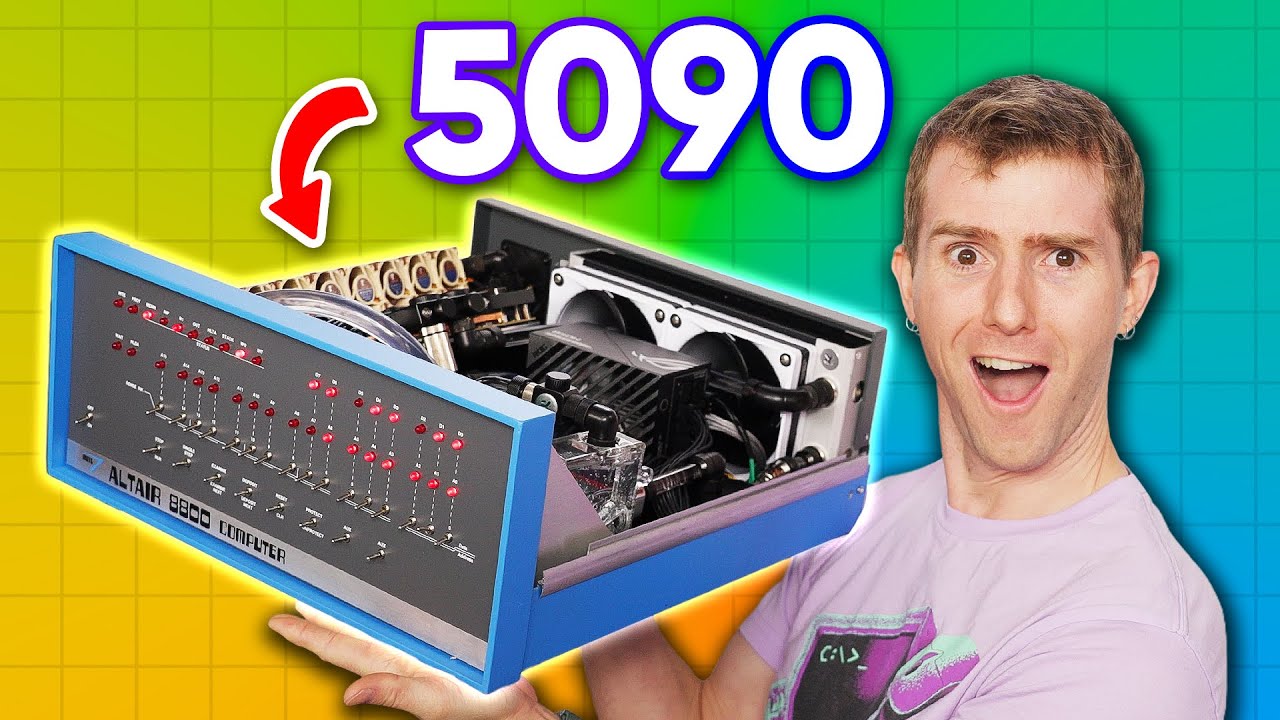
Bill Gates Paid Me to Upgrade his FIRST Computer
0 up · 0 down · 0 ratings
Promos
Thanks to Microsoft for sponsoring this video! Learn more about Microsoft Build 2025 at: build.microsoft.com Microsoft partnered with us to celebrate its 50th birthday. And what better way to celebrate than to build a sleeper build in their PC from the great 1970s, the Altair 8800. Not only can you play Oblivion Remastered thanks to the RTX 5090, you can also use the Altair 8800 as it was meant to be. Discuss on the forum: linustechtips.com Adwater & Stir Altair-Duino Pro Emulator Kit: lmg.gg AMD Ryzen 7 9800X3D CPU: geni.us ASRock B650E Phantom Gaming Motherboard: geni.us ASUS ROG Loki 850W 80+ Platinum PSU: geni.us Asus ROG Astral GeForce RTX 5090 OC Graphics Card: geni.us HYTE THICC FP12 Fans: geni.us Noctua NF-A4x20 FLX Fans: geni.us ► GET OUR MERCH: lttstore.com ► GET EXCLUSIVE CONTENT ON FLOATPLANE: lmg.gg ► GET A VPN: piavpn.com ► SPONSORS, AFFILIATES, AND PARTNERS: lmg.gg Purchases made through some store links may provide some compensation to Linus Media Group. CHAPTERS --------------------------------------------------- 0:00 Intro 2:12 Altair 8800 history lesson 3:52 Let the modifications begin 4:58 Kill the bit 5:35 The goods inside 8:48 It needs so much cooling 10:00 Back to building 12:40 EPIC watercooling montage 13:03 IT'S ALIVE 14:53 OH NO OH NO OH NO 15:52 Ok we good now 17:19 YOU can play with this PC! 17:46 Outro
The video begins by placing the Altair 8800 in a broader historical context, explaining how transistor advances made microcomputers possible for home use and how the Altair 8800 became a foundational kit for hobbyists. The hosts recount the 50th anniversary collaboration with Microsoft, framing the project as a sleeper PC build that mirrors the original machine while packing modern performance. They emphasize the challenge of marrying retro design with contemporary hardware, including a full custom water cooling loop, tight spatial constraints, and a chassis that preserves the vintage aesthetic. The crew discusses the decision to use an Altair Duino 3.0, a lookalike chassis with an Arduino, to safely emulate the original’s functions while enabling modern upgrades. They detail the selection of components like AMD’s Ryzen 9800X3D, the ASRock B650E motherboard, and a high-end RTX 5090 GPU to deliver both nostalgic feel and contemporary gaming prowess. The narrative covers the practical engineering steps, including mounting points, back-panel adjustments, and careful cable management, all aimed at maintaining a sleeper look while handling significant heat. In parallel, the video presents a montage of the water cooling installation, the evaluation of thermals, and the evolving setup as it nears completion. The final result is showcased as a dual experience: the classic Altair experience alongside modern gaming performance, with Oblivion Remastered running thanks to the RTX 5090 for a visually rich demonstration. They invite viewers to try the build at the Microsoft Build Conference and reflect on the balance between homage and modern practicality, concluding with thanks to Microsoft for the sponsorship and a nod to future sleeper builds that harken back to the early days of personal computing.
Topics · technology · hardware · retro-computing · education
Questions answered
- What is the Altair 8800 and why is it significant to this build?
- The Altair 8800 was one of the first widely available microcomputers, built in the 1970s, and served as a launching point for personal computing. In the video, it provides the historical reference for Microsoft’s origins and informs the sleeper design that blends retro chassis with modern hardware.
- What components were chosen for the modern upgrade, and why?
- The build uses an AMD Ryzen 9800X3D CPU, an ASRock B650E motherboard, 32 GB of fast DDR5 memory, and an RTX 5090 GPU, selected to deliver high performance while fitting into the retro chassis with careful cooling and space management.
- How is cooling handled in a sleeper design?
- A full hardline water cooling loop is used, including a slim radiator setup and a robust CPU cooling block, with magnetic cable management and strategic mounting to maximize surface area while preserving a low-profile sleeper look.
- Where can viewers interact with or see this build in person?
- The video promotes a showcase at Microsoft’s Build Conference in Seattle, inviting attendees to interact with the Altair Arduino 3.0 and experience both retro programming challenges and modern gaming performance.