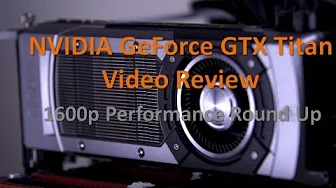
GeForce GTX Titan 1600p Performance Review Linus Tech Tips
0 up · 0 down · 0 ratings
Description
Titan vs Ares 2 - It's the battle of Mount Olympus! But seriously, these are some wicked graphics cards in hot games like Crysis 3 & Far Cry 3 at high resolution 2560x1600. ENJOY! All graphics cards in our tests are OVERCLOCKED. See our settings here: docs.google.com Download the graphs in the video here: docs.google.com
Channels and socials
Check out our Titan test bench setup here: youtube.com Read more & join our community forum: linustechtips.com Buy it now at NCIX: ncix.com
GeForce GTX Titan makes a strong entrance in Linus Tech Tips' 1600p performance review, showcasing its position as the fastest single GPU card available at the time. The video frames the Titan around high resolution gaming on large format displays, emphasizing its 6 GB of memory and its goal to balance high performance with manageable acoustics, temperatures, and power consumption. Early benchmarks focus on Crisis and Far Cry 3 to illustrate how Titan stacks up against multi-GPU setups like Aries 2 and GTX 660 Ti SLI, highlighting that the Titan often leads in raw single-GPU performance while still being mindful of price and efficiency. The host compares Titan to competing configurations, noting that while dual-GPU solutions can edge out Titan in some scenarios, Titan's single-GPU simplicity and driver stability provide compelling value, especially for high-resolution gaming and multi-monitor setups. The narrative also covers practical takeaways for different use cases, including surround gaming and compact builds, making clear that the Titan shines in scenarios where VRAM and single-GPU bandwidth matter, but may not always deliver a dollar-for-dollar advantage over capable multi-GPU alternatives for every game at 2560x1600. By the end, the video positions Titan as a strong option for enthusiasts who want top-tier single-GPU performance, high memory headroom, and flexibility for future high-resolution configurations, while acknowledging the rapid evolution of multi-GPU and driver optimization landscapes.
Topics · science and technology · video game hardware · computer hardware reviews · graphics cards · high resolution gaming
Questions answered
- What makes the GeForce GTX Titan stand out as a single-GPU solution at 1600p?
- The Titan combines a large 6 GB frame buffer, strong raw performance, and careful thermal and power design to deliver high frame rates at 2560x1600 with a single GPU, often outperforming similar single-GPU competitors and remaining competitive with dual-GPU configurations in some games.
- How does Titan compare to Aries 2 and GTX 660 Ti SLI across the tested titles?
- In several titles Titan leads or matches the performance of dual-GPU setups like Aries 2 and GTX 660 Ti SLI, but in some cases the dual-GPU solutions pull ahead, illustrating strong driver and game-optimization effects and the importance of selecting the right configuration for each title.
- For which scenarios is Titan the most sensible choice according to the video?
- Titan is most sensible for high-resolution single-monitor or small-form-factor builds where memory bandwidth and density matter, and for multi-monitor or surround setups where its single-GPU simplicity and headroom can offer advantages over more complex multi-GPU configurations.