7 Gamers, 1 CPU - Ultimate Virtualized Gaming Build Log
0 up · 0 down · 0 ratings
Promos
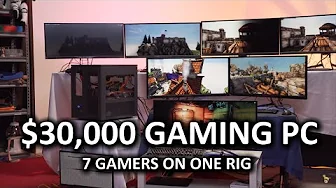
Ever dreamed of what you could do with a $30,000 computer? Turns out the answer is "a lot". In our case, we created 7 discrete gaming systems capable of running concurrently and completely independently of each other - all running in a single tower. All the hardware in this video was provided by the respective manufacturers, but Kingston is the one who stepped up and footed the bill for us to spend the MASSIVE amount of time it took to bring this project to life. HUGE props to them: kingston.com Parts List and Discussion: linustechtips.com Support us: linustechtips.com Join our community forum: bit.ly twitter.com @LinusTech Intro Screen Music Credit: Title: Laszlo - Supernova Video Link: youtube.com iTunes Download Link: itunes.apple.com Artist Link: soundcloud.com Outro Screen Music Credit: Approaching Nirvana - Sugar High youtube.com Sound effects provided by freesfx.co.uk Other Music Credits: Title: I.Y.F.F.E. & Auratic & Au5 - Sweet iTunes Download Link: itunes.apple.com Listen on Spotify: open.spotify.com
The video presents an extreme hardware project: seven independent gaming environments running on a single tower. It kicks off by outlining the ambitious goal of delivering a full high-end gaming experience to seven separate virtual machines using two Intel Xeon E5 2697 V3 processors, for a total of 14 physical cores and 56 threads. The host motherboard chosen is the Asus Z10PE WS, capable of supporting dual CPUs, seven GPUs, and abundant storage, with features like an onboard VGA for the unraid console and a robust array of SATA and M.2 options. Kingston provides major memory and storage support, supplying 256 GB of ECC DDR4 memory and 8 TB of SSDs to ensure fast, reliable pools for the VMs. The case selection, a Case Labs S8, is explained as a necessity to fit the extended ATX board, accommodate water cooling, and house multiple drives, while also delivering a striking black and orange aesthetic and aluminum construction for manageability and heat dissipation. The build dives into cooling and power challenges, detailing the custom water cooling loop designed for nine blocks total (two CPU blocks and seven GPU blocks). EK Water Blocks contributes with a seven-block connector that links the GPUs into a single, modular cooling block, allowing all cards to be cooled in one sweep. Two thick XC triple 120 mm radiators and Noctua fans provide the cooling headroom, and the team pivots to a multi-pump configuration after discovering a single-pump setup would not suffice for the nine blocks. GPU choices pivot away from high-power models due to power constraints, with the AMD R9 Nano ultimately selected for its efficiency and compact form, enabling full PCIe slot accessibility and easier maintenance. The software stack remains largely aligned with the previous dual-CPU project, using Unraid for pooled storage and a RAID 10 array of Kingston KC400 SSDs to maximize reliability and speed for all seven VMs, while a practical approach to USB device mapping keeps peripherals functional across machines. Testing and verification are emphasized as critical given the scale, with early bios tweaks to enable 4G decoding and to ensure the boot sequence targets the USB Unraid drive. Real-world results reveal impressive performance: idle power sits around 250 watts, and loaded power consumption reaches about 1,500 watts while running Unigen Heaven across all seven VMs. Crucially, the team demonstrates a convincing gaming experience across 34-inch Predator X34 monitors, achieved at 3440x1440 ultrawide resolution with frame rates commonly between 60 and 100 FPS, depending on the VM. A final takeaway notes the practical, albeit expensive and impractical, nature of such a rig, paired with reflections on how this project proves the viability of virtualization for high-end gaming within a single chassis, while acknowledging its limited everyday applicability.
Topics · hardware · virtualization · gaming
Questions answered
- What hardware enables seven simultaneous gaming VM instances on one tower?
- Two Intel Xeon E5 2697 V3 processors, an Asus Z10PE WS motherboard, seven GPUs with a custom EK seven-block connector, two thick radiators, multiple pumps, Kingston ECC memory, and a RAID 10 SSD array managed by Unraid.
- How is storage organized for reliable multi-VM performance?
- Eight Kingston KC400 1 TB SSDs are configured in a RAID 10 array under Unraid to provide pooled storage with high reliability and speed for all seven virtual machines.
- What are the power and performance outcomes of the build?
- Idle power around 250 W, loaded power around 1,500 W, and playable frame rates from 60 to 100 FPS across the seven VM instances at 3440x1440 ultrawide, depending on the workload.