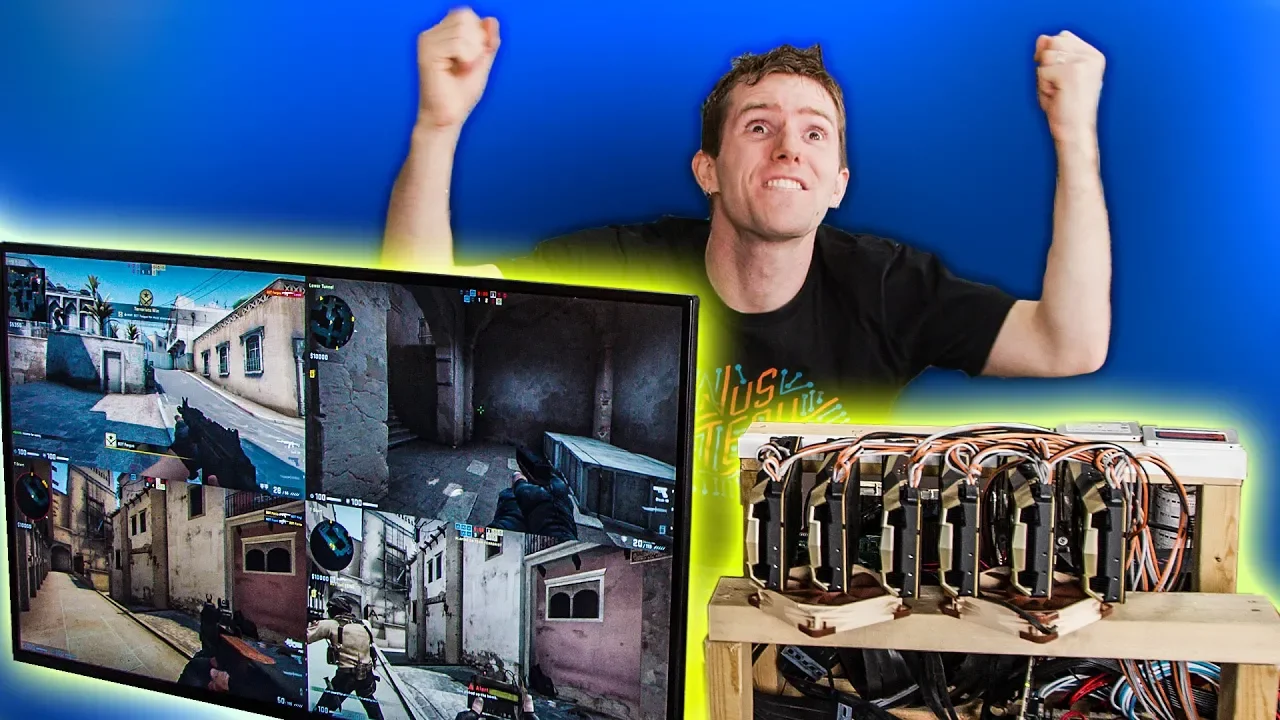
The $100,000 PC LIVES! - 6 Editors 1 CPU Pt. 5
0 up · 0 down · 0 ratings
Description
Check out the Massdrop x Sennheiser HD 6XX Headphones at dro.ps
Promos
Check out the Thermaltake A500 case on Amazon at lmg.gg Buy Intel Xeon on Amazon: geni.us Buy keyboards on Amazon: geni.us Discuss on the forum: linustechtips.com Our Affiliates, Referral Programs, and Sponsors: linustechtips.com Get Private Internet Access today at geni.us Linus Tech Tips merchandise at lttstore.com Linus Tech Tips posters at crowdmade.com Our Test Benches on Amazon: amazon.com Our production gear: geni.us Twitter - twitter.com Facebook - @LinusTech Instagram - @linustech Twitch - twitch.tv Intro Screen Music Credit: Title: Laszlo - Supernova Video Link: youtube.com iTunes Download Link: itunes.apple.com Artist Link: soundcloud.com Outro Screen Music Credit: Approaching Nirvana - Sugar High youtube.com
The episode tracks a large collaborative PC hardware project featuring six editors and a single CPU, focusing on pushing a high-end workstation setup to the limit. Early on the team identifies persistent virtualization crashes tied to motherboard PCIe bifurcation and slot reliability, noting that certain slots either do not function or split lanes improperly. They introduce a TYAN dual LGA 3647 motherboard as an alternative with 11 PCIe slots, 12 memory slots, and 10 gigabit networking, a direct response to the bifurcation problem. The hosts also review a Thermaltake A500 case and discuss moving from ASUS to other components while keeping the same overarching goal: a robust multi-VM editing and processing environment. They describe the connection architecture including external PCIe risers, a daughter board for USB 3 controllers, 10 gig networking ambitions, and a plan to boot with Intel Xeon CPUs due to prior hardware limitations. The setup aims to give each VM its own dedicated USB 3 controller, reduce bottlenecks, and support rapid ingest for editing tasks, all while managing power, cabling, and space constraints in a makeshift test bench environment. By the halfway point, the team begins testing the six workstations, confirms one VM boots and the Sentinel device is recognized, and frames the next steps for stabilizing GPU drivers and expanding to 8K editing with Optane boot drives. Finally, they reflect on the iterative process, acknowledge the budget-driven compromises, and set expectations for future stages including higher end networking and storage improvements, all while keeping humor and camaraderie intact among the crew. The episode ends with a forward-looking note on achieving stability and expanding productivity benchmarks across the six workstations, hinting at a future live-capability test for 8K workflows and shared storage scenarios.
Topics · technology · hardware · computing · pc-build · video-production
Questions answered
- What motherboard started as an alternative to handle the 11 PCIe slots and improve stability?
- A TYAN dual LGA 3647 socket motherboard with 11 PCIe slots and 12 memory slots was introduced as an alternative to address bifurcation and slot reliability.
- What is the project’s strategy for avoiding USB bottlenecks across multiple virtual machines?
- The plan is to give each VM its own dedicated USB 3 controller via an external PCIe riser and a USB controller daughter board to prevent shared USB bandwidth from becoming a bottleneck.
- What was a key hardware issue that caused virtualization crashes earlier in the project?
- Bifurcation of PCIe slots and slot reliability issues were identified as the root cause of virtualization crashes on the initial hardware.