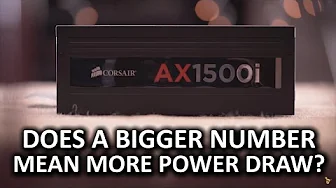
High Wattage PSUs - Do they consume more power?
0 up · 0 down · 0 ratings
Channels and socials
If the number on the sticker is bigger, will the number from your wall be as well? Let's find out! Crunchyroll link: crunchyroll.com Intel link: linustechtips.com Answer the strawpoll: strawpoll.me Pricing & discussion: linustechtips.com Support us: linustechtips.com Join our community forum: bit.ly twitter.com @LinusTech Intro Screen Music Credit: Title: Laszlo - Supernova Video Link: youtube.com iTunes Download Link: itunes.apple.com Artist Link: soundcloud.com Outro Screen Music Credit: Approaching Nirvana - Sugar High youtube.com Sound effects provided by freesfx.co.uk
The video investigates whether really high wattage power supplies actually consume more power from the wall than lower wattage units when used in a PC with a mid to high end GPU and CPU. The presenter sets up a testing rig with several PSUs spanning 450 W, 750 W, 1200 W, and 1500 W, and runs a mix of stress tests including IDA64 system stability test and FurMark to drive the load. He describes the measurement method: stabilizing the load for a few minutes, reading the wall wattage, and comparing results across units while noting each power supply’s 80 Plus efficiency tier. Early in the video he outlines the planned test sequence and acknowledges the role of efficiency curves in the results, explaining that higher wattage units may not always draw more power at typical usage levels. He also teases future workshop-style experiments and invites viewer input on what to test next, signaling an ongoing series focused on practical hardware questions. As the tests proceed, the discussion centers on how efficiency curves translate to real-world wall power consumption. The 450 W bronze-rated unit shows a certain wattage draw, while the higher-end 750 W gold, 1200 W platinum, and 1500 W titanium units reveal varying results that challenge the assumption that bigger is always hungrier. The narrator explains that efficiency is not a simple slider; it depends on load, the curve sweet spot, and whether the power supply is operating near its optimal efficiency region. He emphasizes that a high-wattage PSU can be surprisingly efficient if used around its peak region and that bronze units may still perform well under the right conditions. The overview culminates in practical guidance: to save on electricity, match the PSU to the expected load and aim for the device’s sweet spot on the efficiency curve rather than simply choosing the highest wattage. The video also reinforces its educational purpose by inviting feedback and suggesting viewers test other configurations to verify the findings, making the topic accessible and actionable for PC builders and enthusiasts.
Topics · Technology · Computing · Hardware · Energy Efficiency
Questions answered
- Do higher wattage PSUs inherently consume more power from the wall under typical PC loads?
- Not necessarily. The video shows that wall power consumption depends on the efficiency curve of the PSU and the load level. Higher wattage units can be more efficient at their peak operating point, reducing power draw, while lower wattage units may be less efficient at certain loads. The key is to align the PSU with the expected load to sit near the efficiency sweet spot.
- What should a builder consider when choosing a PSU for electricity efficiency?
- Consider the device's expected load, the PSU's efficiency rating at relevant loads, and how close you will run the PSU to its efficiency sweet spot. A higher wattage unit may not always be better for power savings if you operate far from its peak efficiency, and a mid-range unit well matched to your typical load can deliver better real-world energy use.