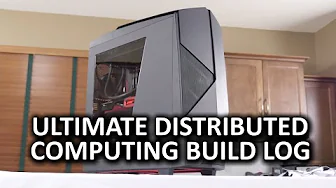
ULTIMATE Distributed Computing Build Log
0 up · 0 down · 0 ratings
Channels and socials
Folding @Home and Boinc are both great programs, and our forum has an amazing team for each... So we wanted to show off what we consider to be the ULTIMATE distributed computing PC! This build log was brought to you by NZXT! Folding @Home link: fah-web.stanford.edu System components list: linustechtips.com Support us: linustechtips.com Join our community forum: bit.ly twitter.com @LinusTech Outro Screen Music Credit: Approaching Nirvana - Sugar High youtube.com Title: Televisor - Find That Someone (feat. Richard Judge) Video Link: youtube.com Beatport Download Link: pro.beatport.com Label Channel: youtube.com Title: Grabbitz - Friends (with Faustix) Video Link: youtube.com Beatport Download Link: pro.beatport.com Label Channel: youtube.com Title: F.O.O.L - Knight Video Link: youtube.com Beatport Download Link: pro.beatport.com Label Channel: youtube.com Title: F.O.O.L - Bounty Hunter Video Link: youtube.com Beatport Download Link: pro.beatport.com Label Channel: youtube.com
The video opens with a clear intent to transform a high-end gaming build into a distributed computing powerhouse. It explains Folding@Home and BOINC as platforms that distribute workloads across many computers to tackle diseases and research questions, highlighting Alzheimer’s, Huntington’s, Parkinson’s, cancer, pulsar discovery, and mathematical proofs as examples of the problems these projects address. The presenter emphasizes that the system will be pushed to extreme levels, using an Intel Core i7 5960x, an Asus Rampage V Extreme motherboard, and a noctis 450 case to forge a machine capable of sustained distributed computing work. Early on, the video frames the build as both a performance showcase and a practical node for research, not merely a showpiece. The explanation anchors the project in the broader community, noting team standings and the intent to contribute effectively to ongoing research efforts. Concrete context about the software roles sets the stage for the rest of the build and the intended usage pattern. By the end of this segment, viewers understand that the machine is designed to blend top-tier hardware with distributed computing software for ongoing projects. The second stretch of the video dives into specific hardware selections and assembly details. The Rampage V Extreme is praised for stability and copper heat pipes, while the noctis 450 case is described as a hybrid between aggressive aesthetics and flexible cooling potential, including underglow lighting. The choice of an extended ATX board in a mixed ITX/mATX/ATX chassis is acknowledged as ambitious, with the host explaining how cable routing and airflow considerations were resolved. Cooling is a major focus, installing dual NZXT Kraken x61 140 mm coolers and planning for up to three 120 mm or two 140 mm configurations. RAM is set at 16 GB of DDR4 to support a wide variety of tasks, and a robust 1200 W PSU is selected to handle heavy load from multiple GPUs. The narrative walks through drive choices, featuring Kingston SSDs for fast storage, while noting that large-scale storage isn't the primary concern for a dedicated distributed computing node. Overall, this section covers the careful balance between performance, aesthetics, and practicality, underscoring that the system is engineered for reliability under 24/7 operation. In the final phase, the build is powered up and put to work. Windows is installed in RAID 0, and the presenter emphasizes that no overclocking is employed initially, with a cautious stance on overclocking due to the always-on nature of distributed computing tasks. The video then outlines expected software usage, showing Folding@Home as a major component, with Boink as a complementary project to diversify workloads. The host points to community resources, including Linus Tech Tips forums, for optimal configuration guidance and project management, and shares initial performance observations from the GPU and CPU loads. After enabling project configurations and tuning, the machine is set to run while the team tracks progress through links in the description. The closing remarks thank sponsors and invite viewers to explore purchase options and the ongoing progress of the project, presenting the build as a culmination of high-end hardware and collaborative distributed computing efforts.
Topics · hardware · pc_build · distributed_computing · technology · case_modding
Questions answered
- What is the main purpose of the ULTIMATE Distributed Computing Build Log?
- To demonstrate how a high-end PC build can be configured as a distributed computing node for Folding@Home and Boink, enabling researchers to utilize home hardware for large-scale projects.
- Why was the Asus Rampage V Extreme and noctis 450 chosen for this build?
- The Rampage V Extreme provides stability and quality components, while the noctis 450 offers a strong case with cooling potential and aesthetic appeal that matches the build’s black and red theme.
- What are the initial software steps after assembling the hardware?
- Install Windows in RAID 0, set up Folding@Home and Boink with appropriate project configurations, and monitor performance to optimize throughput before running long-term workloads.