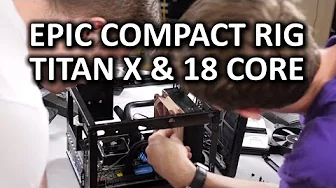
The MOST Compact Gaming PC - Titan X & 18 Core Xeon CPU in a Shoebox
0 up · 0 down · 0 ratings
Channels and socials
The fastest, most compact gaming (or anything really!) PC system ever built!? This is one SICK compact machine. Luke and I cram two SSDs, a Titan X, an 18 core Xeon CPU, and 32GB of RAM into an ITX motherboard and a case the size of a shoebox! Pricing & discussion: linustechtips.com Support us: linustechtips.com Join our community forum: bit.ly twitter.com @LinusTech Intro Screen Music Credit: Title: Laszlo - Supernova Video Link: youtube.com iTunes Download Link: itunes.apple.com Artist Link: soundcloud.com Outro Screen Music Credit: Approaching Nirvana - Sugar High youtube.com
The video presents an ambitious, ultra-compact high-performance PC build driven by the goal of packing serious power into a shoebox-sized ITX chassis. The crew begins by outlining the core objective: maximize power per cubic inch while maintaining gaming capability, using an ASRock X99 ITX motherboard, a Titan X GPU, an 18-core Xeon CPU, and dual 2.5-inch SSDs within a SilverStone Sugo SG13 case. They discuss the unusual motherboard socket shape, the challenge of non-standard mounting holes, and how the included cooler may or may not fit. The team also evaluates power supply choices, considering an AX760i and Corsair options, and contemplates cable management strategies using modular, sleeved cables to keep the cramped interior tidy. The overview foreshadows the surprises to come, including an unexpected CPU twist intended to boost performance while preserving compactness. The opening segment sets the stage for a dense, technically focused build log that blends form factor constraints with high-end hardware ambitions. In the midsection, the hosts reveal the surprising core decision: instead of sticking with the original 5960x, they swap in a formidable 18-core 36-thread Xeon E5 v3 processor, noting its strong multi-thread performance and sustained clock. They demonstrate the space contest by attempting to mount the Titan X and the Xeon in the ITX chassis, discussing the physical fit as the components span the socket and case dimensions. The discussion shifts to RAM choices, balancing dual-channel limits against the desire for maximum capacity, and they reveal a plan to upgrade RAM with Kingston ECC modules to reach 32 GB, while evaluating the feasibility of quad-channel memory in an ITX setup. The crew also experiments with cooling options, trying to adapt an H100i-style mounting plate and evaluating the practicality of water cooling within the shoebox. They highlight that every component, from the area around the M.2 drive to the power delivery, must be engineered to coexist in the restricted space. As assembly progresses, the video documents the intense, hands-on wiring and mounting process, including unconventional mounting tactics, improvised fasteners, and careful cable routing to maintain airflow. The front panel, power supply, and GPU are all squeezed into the tiny chassis with a mix of ingenuity and trial-and-error, and the hosts reflect on the dense, “frame-like” nature of the final build. When the system is finally assembled, they acknowledge the heavy cables and potential bulges but celebrate the dense, functional layout that still leaves room for air intake at the front and exhaust at the rear. The closing portion pivots to performance testing, where thermal results are discussed, noting the Titan X’s throttling in a restricted airflow, while the Xeon CPU surprisingly maintains cool temperatures under load. They share benchmark results from Cinebench and a multi-threaded WPrime run, concluding that the hardware delivers impressive 4K gaming performance and CPU throughput for a mini-ITX-oriented system, and invite viewers to discuss the feasibility and appeal of such an extreme compact rig. The video ends with a call to engage the audience on the forum for deeper discussion, further build ideas, and sponsor information, leaving fans with a memorable demonstration of compact PC engineering at its most audacious. Overall, the video showcases a bold engineering challenge, combining a titan GPU and an 18-core Xeon into a shoebox-sized ITX chassis, and it documents the constraints, decisions, and testing required to evaluate whether such a compact build can scale to real-world gaming and compute workloads. The team emphasizes practical takeaways, including cable management tricks, airflow considerations, and the interplay between component sizing, cooling, and power delivery. By balancing ambition with careful measurement, the video provides a vivid case study in high-density PC design, inviting enthusiasts to weigh the trade-offs between portability and performance while highlighting that only meticulous planning makes such a compact powerhouse viable.
Topics · technology · computing · hardware · diy · gaming
Questions answered
- What was the main goal of the shoebox PC build and what were the key components chosen to achieve it?
- The goal was to maximize power in the smallest possible space. Key components included an ITX motherboard (ASRock X99 ITX AC), a Titan X GPU, an 18-core 36-thread Xeon processor, 32 GB of DDR4 RAM, and dual SSDs in a SilverStone SG13 case, with a focus on compact cooling and a high-efficiency power supply.
- How did the team address the cooling and spatial challenges of this extreme compact build?
- They experimented with liquid cooling compatibility using an H100i-style mounting approach, evaluated radiator orientation and clearance, and discussed airflow with front intake and rear exhaust. They also attempted to manage cables tightly and used various mounting techniques to fit the CPU cooler, GPU, and multiple drives within the shoebox-sized chassis.