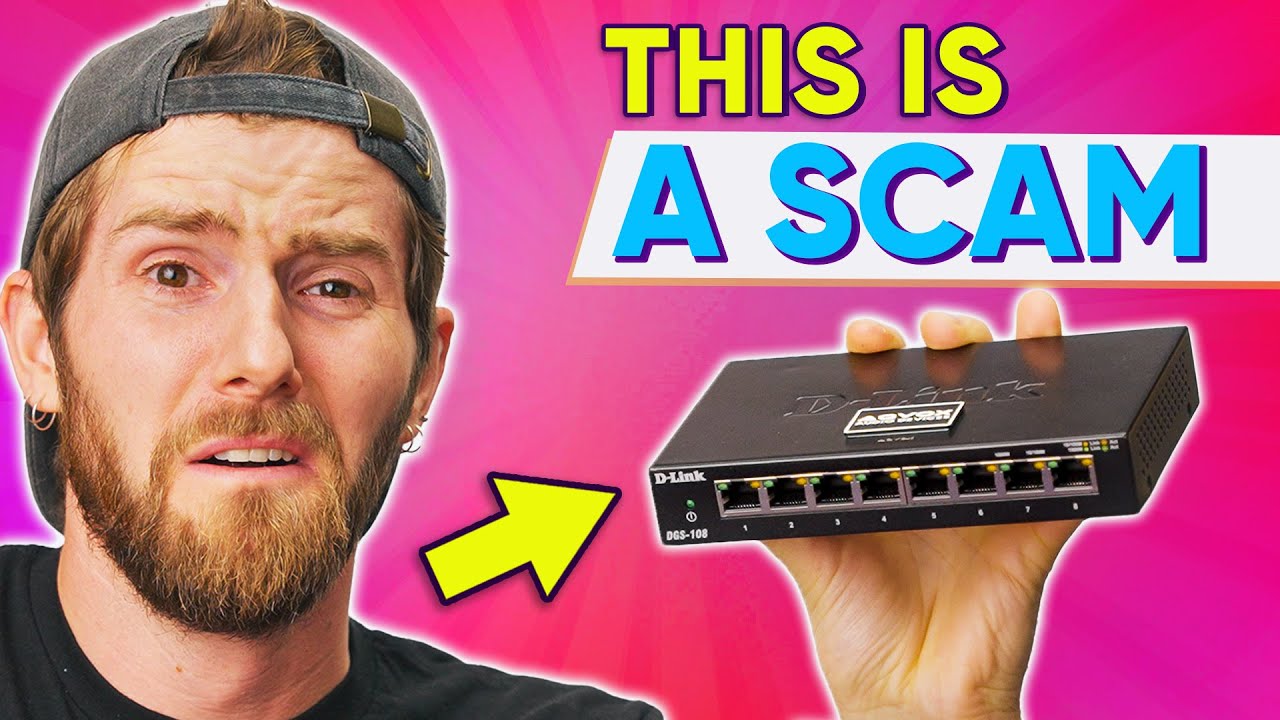
It’s time for some hard truth - Aqvox "Audiophile" Network Switch
0 up · 0 down · 0 ratings
Description
Communicative effectively with the right tone at work! Sign up for an account and get 20% off Grammarly Premium: grammarly.com
Promos
Check out SignalRGB and sync all your RGB peripherals at bit.ly Every industry has its fair share of people and companies aiming to perfect the craft... but that aim has lead to a number of shady snake oil solutions that don't actually improve anything. Today, we look at one of those. Discuss on the forum: linustechtips.com Buy a D-LINK DGS-108 Network Switch: geni.us Buy a JDS Labs Element 3 Dac & Amp: lmg.gg Buy the Abyss AB1266 Phi TC Headphones: lmg.gg Purchases made through some store links may provide some compensation to Linus Media Group. ► GET MERCH: lttstore.com ► SUPPORT US ON FLOATPLANE: floatplane.com ► AFFILIATES, SPONSORS & REFERRALS: lmg.gg ► PODCAST GEAR: lmg.gg FOLLOW US --------------------------------------------------- Twitter: twitter.com Facebook: @LinusTech Instagram: @linustech TikTok: @linustech Twitch: twitch.tv MUSIC CREDIT --------------------------------------------------- Intro: Laszlo - Supernova Video Link: youtube.com iTunes Download Link: itunes.apple.com Artist Link: soundcloud.com Outro: Approaching Nirvana - Sugar High Video Link: youtube.com Listen on Spotify: spoti.fi Artist Link: youtube.com Intro animation by MBarek Abdelwassaa @mbarek_abdel Monitor And Keyboard by vadimmihalkevich / CC BY 4.0 geni.us Mechanical RGB Keyboard by BigBrotherECE / CC BY 4.0 geni.us Mouse Gamer free Model By Oscar Creativo / CC BY 4.0 geni.us CHAPTERS --------------------------------------------------- 0:00 Intro 1:41 What is this thing? 2:57 Their claims 6:14 Testing their claims 11:09 Teardown 15:04 Why it doesn't work 17:39 Why people are still buying it
The video opens with a framing that seeks to debunk the idea that an expensive audiophile oriented device, the Aqvox SE network switch, can meaningfully improve audio quality. The host lays out the premise that audiophiles chase tiny improvements in clarity and noise, often through devices marketed as performance boosters, and introduces the Aqvox switch as an example of a product with lofty claims and high price. He compares its external appearance and packaging to a common D-Link switch, pointing out superficial similarities such as stickers and branding, and questions whether any meaningful hardware modifications justify the cost. The host then previews a testing plan that includes blind listening tests using high-end audio gear and a Deezer streaming service to evaluate perceived differences between the Aqvox switch and a baseline $30 switch. He emphasizes a skeptical, evidence-based approach and promises to reveal what the product page claims versus what the teardown shows. The opening section establishes the underlying thesis: signals in a digital network are complex, but the essential properties of modern streaming make big improvements from a consumer network switch unlikely, especially given encryption and error correction protocols in use. By the end of the intro, the video sets expectations for a detailed teardown and a data-driven conclusion rather than marketing rhetoric. In the first major section, the reviewer examines the product’s claims in detail, quoting the official pages that promise internal low-noise regulation, jitter reduction, and other enhancements. He notes the presence of a modified external power supply and a sealed enclosure, suggesting these are designed to give the appearance of real modification without substantial proof. The discussion shifts to practical testing plans, including two NAS systems feeding the same client computer through different switches, and a blind listening setup with two tracks and two cables labeled blue and purple. The host also introduces a practical constraint of testing a streaming service like Deezer at high quality. Throughout, the narrative maintains a skeptical tone toward marketing language and emphasizes the need for empirical confirmation rather than relying on testimonials or glossed-up product pages. This segment culminates in a commitment to reveal the actual changes made to the Aqvox switch and to contrast them with the default D-Link unit. In the teardown and inspection portion, the video dives into the hardware, showing screws that appear glued in place and a sealed board indicating minimal internal access. The crew observes a clock oscillator and questions the legitimacy of any “jewel” decoration implying a crystal oscillator, highlighting how superficial alterations can mislead buyers. They document the handling of heat sinks and glue, and remark that many components appear unmodified from the reference design, reinforcing the notion that the Aqvox device has not substantially changed the underlying switch. A key moment is the plan to verify whether any components were desoldered or replaced; early evidence suggests the changes are cosmetic or minimal, with trade-secret rhetoric used to avoid disclosure. The testers conclude that the marketing narrative does not align with the observable hardware modifications, underscoring the broader message that many claimed enhancements in the audiophile space may be illusory. The segment ends by tying the teardown results to the broader claim that consumer expectations in audio fidelity are often driven by perception rather than measurable improvement. In the section on testing rationale and results, the host explains digital signal integrity and the role of error correction protocols in modern streaming and local playback. He argues that because data is transmitted as ones and zeros, and since TCP and HTTPS transport include robust error detection and encryption, a consumer network switch cannot meaningfully alter the audible output of a digital audio stream. The test setup is described in detail: two NAS systems host identical files on separate subnets, both connected to the same NIC but routed through different switches, with audiophile-grade headphones and DACs used for listening. The highlights of the listener feedback show a wide range of impressions, with many testers reporting no perceivable difference, while a minority perceive minor variances that are difficult to replicate reliably. The host emphasizes that even when testers feel a difference, factors such as placebo, expectations, or concurrent upgrades can influence perception, and thus caution is warranted in interpreting subjective results. The closing notes reiterate that the combination of digital transmission, encryption, and standard network hardware makes large sonic gains from a modest switch unlikely, and that the most credible conclusions come from controlled blind testing rather than marketing claims. The final portion synthesizes the findings and discusses industry implications. The host articulates several reasons why integrators and retailers may push high-priced, “audiophile” switches, including profit margins and consumer psychology, while stressing that credible science and controlled testing do not support the claimed benefits. He offers practical guidance for consumers: focus on proven components like quality DACs, proper cabling, and reliable sources rather than expensive network appliances, and be wary of marketing hype that sounds technically plausible but lacks demonstrable evidence. The video then pivots to a sponsor segment that discusses Grammarly Premium and tone optimization for professional communication, framing it as a parallel to seeking clarity and honesty in evaluating product claims. The closing takeaway is clear: skepticism and evidence-based testing should guide purchases in high-end audio, with the aim of achieving real, measurable improvements rather than chasing perceived miracles. The host thanks viewers and points to related content that explores similarly high-priced cables and accessories.
Topics · technology · audio · science communication · consumer electronics
Questions answered
- Do Aqvox SE modifications justify the price compared to a standard switch?
- No substantial hardware changes were found; the teardown suggests little to no functional modification beyond branding, with the device based on a cheaper switch and sealed with glue and stickers.
- Can a network switch improve audio quality for streaming or local playback?
- According to the video, no; digital streams include error correction and encryption, and a basic 3W, $30 switch cannot optimize or alter the audible output in a meaningful way.
- What was the outcome of the blind listening tests?
- Test subjects generally could not reliably tell a difference between the Aqvox switch and the baseline switch, indicating no perceivable audio improvement under blinded conditions.