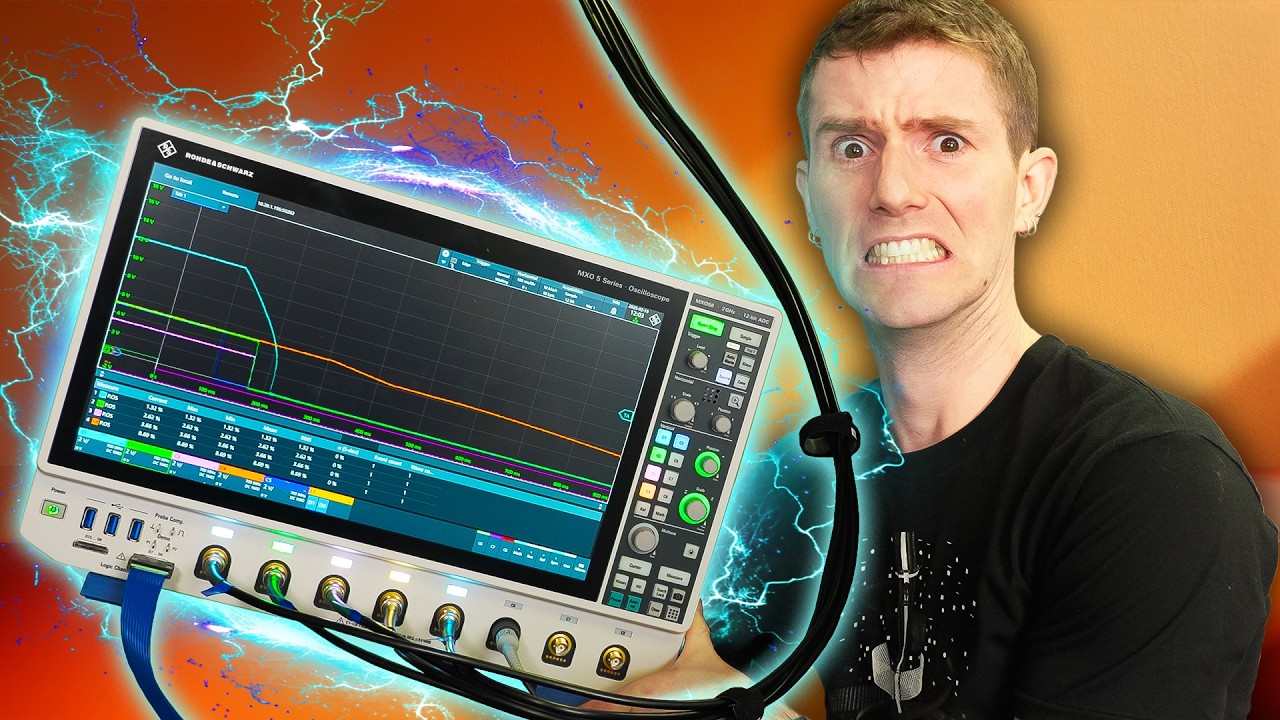
You can have this or a full-time butler - R&S MXO 5 Oscilloscope
0 up · 0 down · 0 ratings
Promos
motiongrey.com Buy a MotionGrey Ergo 2 sit-to-stand desk using the link above, and get an exclusive 15% off that’s stackable with any existing offer they may have! The R&S MXO 5 Oscilloscope delivers high-end measurement capabilities, and LTT Labs has been using it to test computer power supplies. Linus and Lucas dive into its quirks and features to see if it’s a must-have for professionals or just overkill. Let’s find out! PSU Circuit: floatplane.com Purchases made through some store links may provide some compensation to Linus Media Group. Want us to unbox something? Make a suggestion at lmg.gg ► GET MERCH: lttstore.com ► GET A VPN: piavpn.com ► GET EXCLUSIVE CONTENT ON FLOATPLANE: lmg.gg ► SPONSORS, AFFILIATES, AND PARTNERS: lmg.gg CHAPTERS --------------------------------------------------- 0:00 Intro 1:02 Unboxing and accessories 3:17 SSD and storage 4:35 "Standard lab oscilloscope" 5:12 Exterior features and cooling 7:39 The controls and interface 8:25 Sponsor 8:51 Demonstration 9:52 Digital signal decoding demo 13:00 Real-world power supply testing 14:00 Automating power supply tests 15:15 Brownout testing and results 17:35 ATX compliance and power supply failures 19:10 Timing tests and voltage regulation 21:14 Ripple testing and why it matters 22:08 Power-down behavior and shutdown timing 22:35 Price discussion and conclusion 23:00 Credits
The video opens with Linus and Lucas introducing a high end oscilloscope, the R&S MXO 5, framed as a tool so capable that it could be likened to having a full time butler for electronics work. They walk through the box contents, discussing probes, grounding accessories, and the philosophy of high bandwidth measurement, noting that the MXO 5 can sample millions of signals per second and reveal voltage changes over time. The unboxing section emphasizes practical workflow: how the probes are used, how compensation for probe capacitance is performed, and how the unit can be mounted or connected in various lab setups. The conversation then pivots to the physical hardware, the inclusion of an SSD in the chassis, and the significance of the internal memory expansion for storing long waveform histories, with Lucas explaining why high-quality storage can matter for long term data retention. As they explore the front and back panels, they compare this model to more expensive lab scopes and acknowledge that the MXO 5 sits in a sweet spot for detailed PSU testing while still being approachable for non-scarcity environments. In the mid section of the video, the team demonstrates the oscilloscope’s capabilities with a live setup. They connect eight analog channels and several digital channels to a PSU test bench, showing how the device can automatically decode SPI signals and identify communication patterns. Lucas walks through the app and protocol menus, setting clocks, triggers, and decoding options to reveal device communications in real time. They highlight the software-driven automation that lets the scope configure itself for a test sequence, enabling long, hands-off measurements while the operators focus on higher level diagnostics. The demonstration also emphasizes the utility of the MXO 5 for reverse engineering tasks, such as decoding a Soviet keyboard link, and how it can be used to verify that a device’s sensors return correct signals. Further into the demonstration, the team dives into practical Power Supply Unit testing, covering brownout scenarios, ripple analysis, and timing measurements. They show how the oscilloscope records voltage dips during brief power interruptions and how the Power Good signal correlates with motherboard behavior during brownouts. Lucas explains how ripple on the 12V rail, while seemingly small, can affect downstream components and shorten component life by stressing capacitors, then demonstrates how to capture and graph these events for analysis. The discussion touches ATX compliance, the realities of field results versus official certification, and the importance of safety-mechanism testing, noting that the lab prioritizes documenting failures and safety responses. In closing, they compare the MXO 5’s capabilities to general benchtop scopes and discuss price, value, and the context in which this instrument is most useful, including a reminder about their sponsor and affiliate links. The final stretch emphasizes real-world workflows and takeaways. Linus and Lucas reflect on how the MXO 5’s automation and multi-channel decoding capabilities streamline PSU validation, enabling longer, more detailed measurements without constant manual intervention. They discuss the tradeoffs between ultra-fast, high-end rigs and the MXO 5’s balance of performance and cost, noting that for many lab and repair scenarios this scope delivers essential insights such as accurate timing between voltages, voltage rise times, and sustained ripple levels. The hosts describe practical lab tips, like matching probe compensation to wiring and the importance of minimizing lead length to avoid skewed results, and they encourage viewers to consider the MXO 5 for professional testing workflows. The video closes with a candid recap of what the MXO 5 can and cannot do, an acknowledgement of its price range, and a nod to sponsorship while inviting viewers to explore more tests and results on Linus Tech Tips’ Lab channels.
Topics · lab equipment · electronics testing · measurement instruments · power supply testing · bench tools
Questions answered
- What makes the R&S MXO 5 suitable for PSU testing compared to cheaper oscilloscopes?
- The MXO 5 offers high bandwidth, multiple channels, advanced triggering, automatic decoding of digital protocols, long waveform storage, and automated test sequences, which together enable thorough, repeatable PSU tests and diagnostics that are difficult or time consuming with lower-end scopes.
- How does the oscilloscope help with brownout and ripple testing?
- It records voltage drops during brownouts, measures the 12V rail and other rails, captures Power Good signals, and analyzes ripple on the output, providing insights into stability and component stress under real-world conditions.
- Can the MXO 5 decode serial protocols like SPI automatically?
- Yes, the device supports automatic decoding of digital protocols such as SPI, with user-selectable pins, clocks, triggers, and decoding outputs for easy interpretation.
- Is this device practical for hobbyists or mainly for professionals?
- While it is a high-end instrument, the video demonstrates that it can be valuable for both professionals and advanced hobbyists who need detailed measurements, automation, and long-term waveform history.
- What is a key takeaway about testing safety mechanisms from the video?
- A key takeaway is that the lab emphasizes documenting safety mechanism behavior and failure modes, and uses the oscilloscope to observe how power supplies respond to fault conditions to inform safer, more reliable designs.