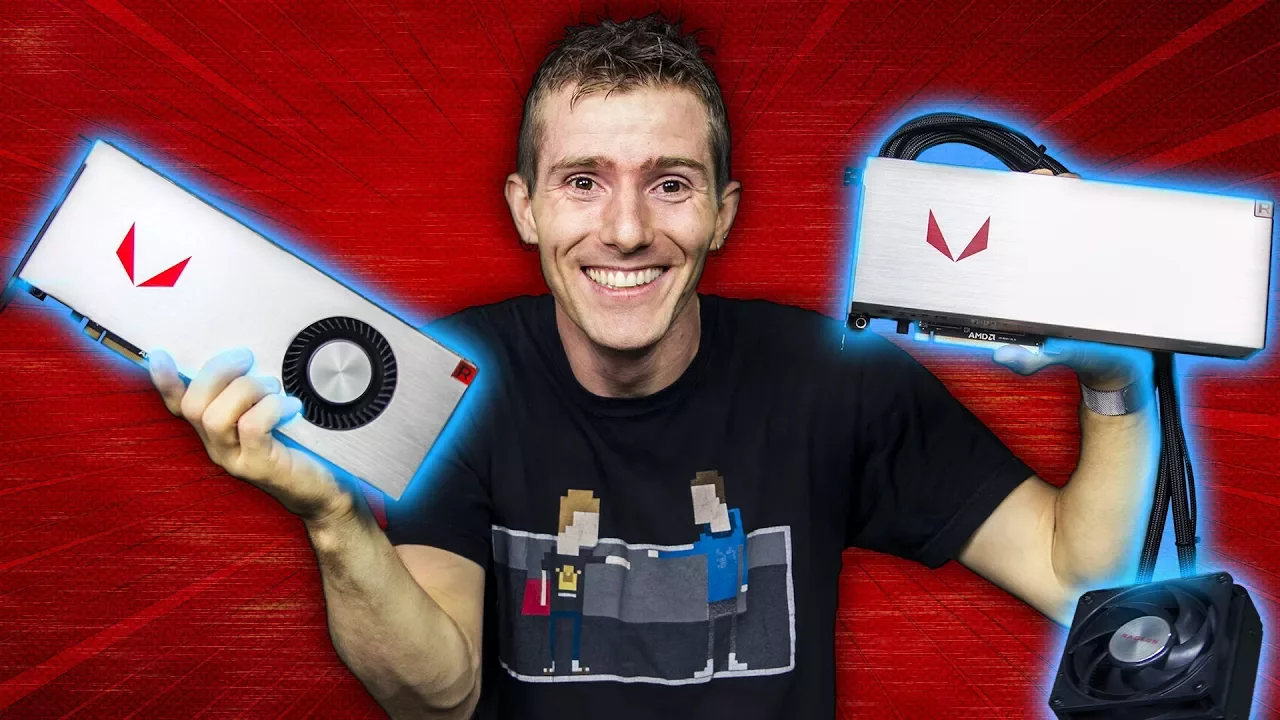
RX Vega 56 & 64 are HERE! Are they HOT or NOT?
0 up · 0 down · 0 ratings
Promos
AMD's new RX Vega graphics cards have FINALLY arrived, but can they live up to the hype, or are they just hot air? Share your mouse and keyboard between multiple computers with Synergy! Save 50% here: symless.com Buy the RX Vega 64: On Amazon: geni.us On Newegg: geni.us Buy the RX Vega 64 Liquid Cooled: On Amazon: TBD - Not up yet On Newegg: geni.us Or buy a GTX 1080 instead: On Amazon: geni.us On Newegg: geni.us Buy the RX Vega 56: On Amazon: TBD - Not up yet On Newegg: TBD - Not up yet Or buy a GTX 1070 instead: On Amazon: geni.us On Newegg: geni.us Discuss on the forum: linustechtips.com Our Affiliates, Referral Programs, and Sponsors: linustechtips.com Linus Tech Tips merchandise at designbyhumans.com Linus Tech Tips posters at crowdmade.com Our production gear: geni.us Twitter - twitter.com Facebook - @LinusTech Instagram - @linustech Twitch - twitch.tv Intro Screen Music Credit: Title: Laszlo - Supernova Video Link: youtube.com iTunes Download Link: itunes.apple.com Artist Link: soundcloud.com Outro Screen Music Credit: Approaching Nirvana - Sugar High youtube.com Sound effects provided by freesfx.co.uk
The video opens with a comparison tease between current high end Nvidia options and AMD’s newly released RX Vega line, specifically asking if Vega is worth the wait and how it stacks up against the established 1080 and 1070 series. The host introduces Vega 56 and Vega 64 as the consumer versions of the Frontier Edition, noting differences such as memory configurations, clock speeds, and the inclusion of HBM2 memory. A key architectural detail is highlighted: Vega introduces the draw stream binning rasterizer (DSBR), a tile-based rendering approach AMD claims will improve performance with minimal developer effort. Throughout the initial setup, the host outlines the tested lineup including Vega 56 (air and liquid cooled), Vega 64 (air and liquid cooled), and Nvidia counterparts, placing emphasis on both gaming and productivity benchmarks. We see the testing scope cover mainstream gaming platforms across red and blue teams to provide a balanced view, with early observations showing Vega 64 variants leading in some productivity tasks while struggling in power efficiency and high-end gaming scenarios. The narrative then shifts to performance outcomes, where the Vega 64 Liquid Cooled variant dominates in several synthetic and gaming tests, but power consumption and cooling requirements are nontrivial drawbacks. The host discusses price-to-value considerations, noting bundles and game promotions as potential value add, yet acknowledges that high end Vega models may be expensive relative to Nvidia competition. The conclusion frames Vega as a competitive option for high-resolution gaming and multi-monitor setups, while suggesting Nvidia’s Volta generation may set the next performance bar, leaving Vega positioned as a credible but not transformative choice for enthusiasts. The video also briefly segues into Synergy software as a practical aside for users with multiple computers, underscoring seamless cross-machine input and data sharing as a notable utility. Overall, the verdict stresses that Vega delivers meaningful competitive performance, particularly in productivity workloads, but its gaming dominance is nuanced by power, price, and the looming arrival of future Nvidia architectures.
Topics · Technology · Hardware · Graphics Cards · PC Gaming
Questions answered
- What are the main Vega models evaluated in the video and how do they compare to Nvidia’s GTX/1080 series?
- The video evaluates RX Vega 56 and RX Vega 64 in air and liquid cooled variants, comparing them to Nvidia’s GTX 1070 and GTX 1080, with a focus on gaming performance, productivity benchmarks, and power usage.
- What is the DSBR feature mentioned in the Vega architecture and why does it matter?
- DSBR, or draw stream binning rasterizer, is a tile based rendering approach AMD introduced with Vega that AMD claims can improve performance with less developer effort, benefiting gaming performance across titles.