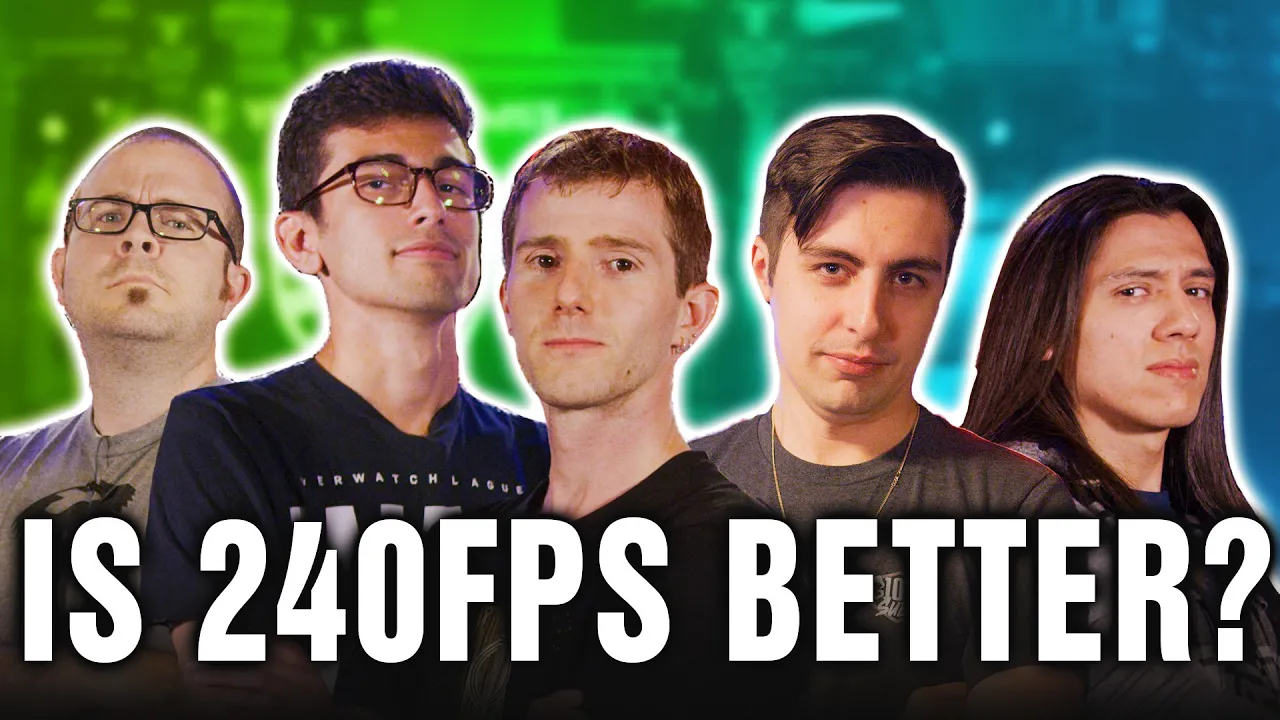
Does High FPS make you a better gamer? Ft. Shroud - FINAL ANSWER
0 up · 0 down · 0 ratings
Promos
Thanks to Nvidia for sponsoring this video! For more information on how high frames and refresh rate help in competitive gaming visit nvidia.com To get the best GeForce graphics card for competitive gaming visit frameswingames.com Subscribe to GeForce YouTube! youtube.com #FramesWinGames @NVIDIAGeForce Want to see how you stack up in our test suite? Download the maps from the workshop! Reflex Aim Trainer: bit.ly Doors and Flow State Test: bit.ly Flick shot test: Map code - 4TR99 Linus Shooting Gallery: bit.ly Thanks to the Santa Ana Esports Arena for hosting us! Learn more about their awesome facility at esportsarena.com Shroud: mixer.com Grimmmz: twitch.tv Corey: twitch.tv PaulsHardware: youtube.com
The video documents a comprehensive on‑location experiment to determine whether higher frame rates and refresh rates actually improve gaming performance, featuring Shroud, Grimmmz, Corey from PaulsHardware, and input from Nvidia. The team places three identical PC setups side by side, each with the same CPU and monitor but different GPU and frame rate configurations, ranging from 60 Hz with a GTX 750 to 144 Hz with a GTX 1650, and 240 Hz with an RTX 2060 Super. The testing regime includes five combined tests spanning synthetic reaction time tasks, in-engine aiming challenges, and a human opponent flow state test to gauge how improvements translate to real play. They also use high speed cameras and a custom training map to capture precise data on reaction times, aiming accuracy, and crosshair alignment, aiming to quantify the exact benefits of higher FPS and Hz. The participants include a mix of casual and professional players, with Linus and guests debating the perceptual and mechanical differences across the tested configurations. The tests begin with raw reaction time trials, where players indicate readiness and then react to a green signal, providing a baseline for reflexes independent of game context. The team then introduces more realistic tasks, such as a robotic double‑doors sniper drill and a flick shot gallery, to reveal how latency, input delay, and on‑screen updates influence performance at each refresh rate. Across the rounds, players report that higher frame rates and Hz reduce perceived input lag and improve visibility of fast moving targets, though the magnitude of the benefit varies by task and by the player’s experience level. The final test stage brings Shroud into a head‑to‑head style challenge against a human opponent in a long hallway, rotating between tests and computers to minimize learning effects and isolate hardware impact. After collecting and reviewing data, the team concludes that while 60 Hz is significantly limiting, the jump from 144 Hz to 240 Hz shows the most pronounced and consistent gains in many tasks, particularly those requiring rapid flick shots and dynamic tracking. They also acknowledge that dedicated practice and game sense matter enormously; hardware alone cannot transform a casual gamer into a professional, though the right combination of GPU power, a high refresh rate display, and trained reflexes can meaningfully elevate performance. In sum, the video argues that high FPS and Hz do not automatically make someone the best gamer, but they do improve the information available to the player and can meaningfully enhance performance, especially for those who train and compete regularly. The host closes by teasing a potential part three, hinting at even higher frame rates and the next evolution in competitive gaming hardware and testing. Key takeaways across the session include: 60 Hz with older GPUs yields noticeably slower response and accuracy; 144 Hz offers tangible improvements in reaction and flick timing; 240 Hz produces the most consistent gains, particularly in fast flick and flow state tests; and even for expert players, the practical benefits depend on the game type, training, and how much the user relies on muscle memory versus real-time data. The experiments also emphasize that perceived improvement is a mix of hardware capability and cognitive adaptation, with the most dramatic differences appearing in tasks that require rapid visual updates and precise timing. Finally, the video frames the conclusion with a practical stance: upgrading to high FPS and Hz is advantageous and demonstrably helpful for competitive play, but it is not a magic solution that makes average gamers into champions without skill, strategy, and practice.
Topics · Science & Technology · Gaming · Performance
Questions answered
- Does higher FPS and Hz automatically make you a better gamer?
- No, higher FPS and Hz provide more up to date visual information and reduce input latency, which can improve performance, especially in fast, reactive tasks. However, game sense, practice, and strategy remain crucial, and the benefits vary by game type and individual skill.
- What was the testing setup and scope?
- Three nearly identical PCs were tested: 60 Hz with a GTX 750, 144 Hz with a GTX 1650, and 240 Hz with an RTX 2060 Super. The tests included synthetic reaction time tasks, in‑engine aiming tests, and a human opponent flow state challenge, all recorded with high speed cameras to measure precise timing and aiming data.
- What were the main findings about 60 vs 144 vs 240 Hz?
- 60 Hz performed the worst across tasks. The jump to 144 Hz produced noticeable improvements in reaction and aiming reliability, while 240 Hz yielded the most consistent gains, particularly in flick shots and dynamic target tracking, though the magnitude of benefit depended on the task and the player.