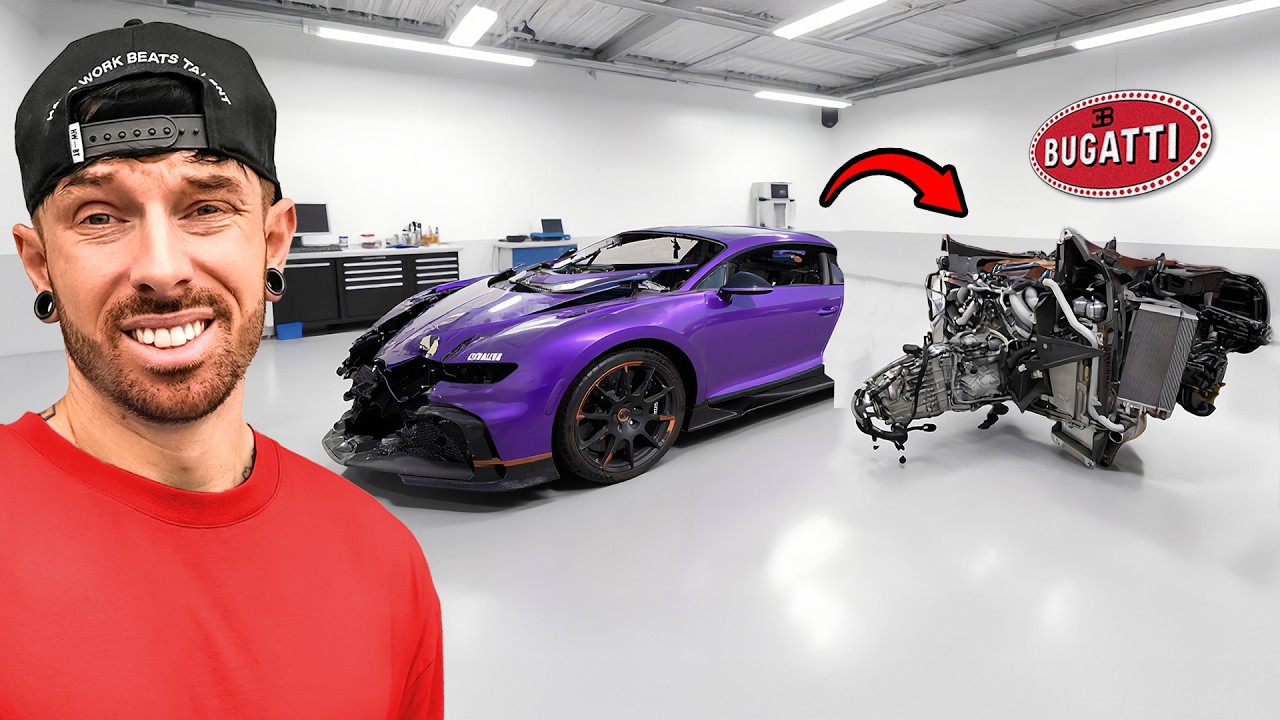
ATTEMPTING THE JOB BUGATTI TOLD ME WAS IMPOSSIBLE
0 up · 0 down · 0 ratings
Promos
Check if your car was damaged with carVertical - using code MAT for 20% off - carvertical.com After Alex crashed his $6m Bugatti Chiron Pursport he asked if i would rebuild it for him. I agreed to do it but Bugatti refused to help us or provide any parts for the repair. I previously found damage to the gearbox which means we have to drop the engine on the bugatti to investigate, but the CEO of bugatti responded to us and told us that removing the engine can only be done in 2 places in the world by trained technician's. But i had no choice to attempt it myself.
ALL MA MERCHANDISE
Channels and socials
FOR MORE CONTENT
CHECK OUT MY SECOND CHANNEL
Follow Me Here Aswell
Notes
Today we dive into an audacious rebuild project that many would call impossible. The video opens with the creator declaring an intention to take apart a Bugatti Chiron Pur Sport in a non-traditional setting, a garage rather than Bugatti’s own service bays. The host recounts how the car, a crashed $6 million example, was recovered after insurance payout and later returned to him for a repair challenge. We are immediately thrust into a world where the typical barriers for a high-end supercar repair are tested: parts access is restricted, official support is limited, and the team must assess damage that could determine if the car is repairable at all. The first problem is the gearbox damage, seen as a potential showstopper, and the plan to separate the car into front and rear sections as a means to inspect the gearbox more closely. The host explains that Bugatti’s own claims of how the vehicle must be handled appear to limit what can be done in a standard workshop, prompting a bold attempt to perform the separation with no specialized tools beyond a garage toolkit. The dynamic between the host and his collaborator Tony is established early as a mix of humor, stubborn determination, and methodical problem solving, underscoring the DIY spirit of the project. The video methodically documents the initial disassembly steps, starting with removing the rear quarters and uncovering a cascade of bolts that secure the rear to the front sections, while lighting up the carbon fiber components and the precision of the engineering involved. The narrative emphasizes how, despite warnings that such work requires trained technicians in only a few places worldwide, the team pushes forward, testing their own limits and learning on the go. The first major milestone is the removal of the rear wing, panels, and other components that reveal the internal structure; the host notes the clever design that allows parts to be detached with relatively fewer bolts than expected, while acknowledging the risk and the scale of the task. The crew then shifts attention to critical safety and engineering challenges, including draining hydraulic fluids, disconnecting massive air and coolant lines, and extracting the battery with care, all while keeping track of delicate, high-end components. The video also highlights the emotional and educational aspects of the project: the hosts discuss the potential for victory if they succeed, as well as the potential consequences if they fail, all framed by the larger goal of enabling a repair that traditional channels have deemed impossible. As the disassembly unfolds, the team artfully documents the discovery of design decisions that enable a front-to-back separation, emphasizing the role of bolts, bolts, and more bolts in a car designed to be disassembled only with specialized equipment. The narrative occasionally interjects commentary about the value of knowledge and the ingenuity required to reconfigure a machine built to be sealed and exclusive, culminating in the dramatic moment when the rear section is finally separated from the front, revealing the engine, gearbox, and a broken aluminum mount that has become the central obstacle to repair. The video closes with a reflective assessment of what was learned, recognizing that while some parts can be salvaged, others will require new fabrication or advanced scanning technology, potentially from Black Horse Automotive’s 3D scanning capabilities. The host reinforces the message that persistence, testing, and creative problem solving can challenge what is considered “impossible,” and invites viewers to follow the series for ongoing progress and the next phase of the repair, hinting at future content and collaborations. The final sentiment is one of cautious optimism, acknowledging both the extraordinary difficulty of the task and the empowerment that comes from attempting something that others say cannot be done, with a promise of continuing updates and a call to subscribe for the next installment.
Topics · autos & vehicles · engineering · diy & how-to · car restoration · motorsport
Questions answered
- Why is removing the engine necessary to inspect the gearbox in this Bugatti Chiron rebuild?
- Removing the engine provides access to the gearbox and its mounting system, which are otherwise difficult to inspect in place due to the car’s design and the way components are routed and bolted together.
- What major challenges do the builders face when trying to separate the front and rear sections?
- They must navigate a web of bolts, specialized fasteners, hydraulic lines, coolant lines, air lines, electrical looms, and safety-critical components that tie the front and rear sections together, all while avoiding damage to high-value parts.
- What is the role of the titanium bolts in this process?
- The titanium bolts are integral fasteners that hold critical sections together; loosening and managing these bolts is essential to separating the rear from the front and eventually removing the engine and gearbox.
- What does the team consider about the possibility of repairing or replacing broken components?
- They weigh options like repairing the damaged aluminum mount, possibly fabricating new parts via scanning and 3D printing, and potentially sourcing or fabricating components otherwise unavailable from Bugatti.