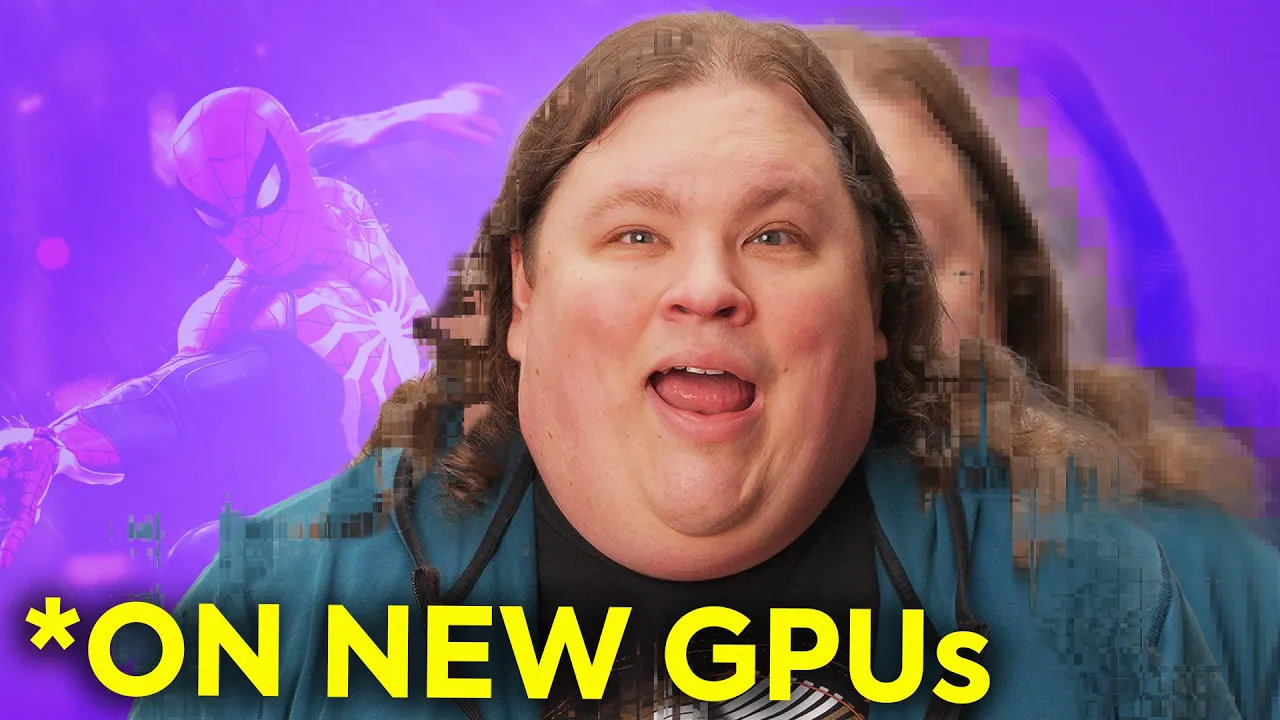
Double your FPS for FREE!*** - Nvidia DLSS 3.0
0 up · 0 down · 0 ratings
Description
Thanks to Mine for sponsoring this video! Discover where your data is, and take it back at bit.ly Get Unlimited Data for $25/month at l.boostmobile.com Nvidia’s new DLSS 3.0 promises smoother gameplay by doubling your FPS – But how can it do that, and can its fake frame generation possibly look any good? And is it worth buying an RTX 4090 for? Discuss on the forum: linustechtips.com
Check out Comrade Stinger's Async Timewarp demo: drive.google.com
Promos
Check out Comrade Stinger's YouTube channel: youtube.com 2kliksphilip's YouTube channel: youtube.com Growling Sidewinder's YouTube channel: youtube.com Boost Mobile's T&Cs: For new customers only: port-in or non-port. For 1 line, $25 per month with AutoPay. Customers who do not enroll in AutoPay pay $35/month. Plan available only on certain networks. Unlimited Data, Talk & Text + 30GB of 5G/4G Data. Customers who use more than 30GB of data during a billing cycle on a line will have speeds reduced. 5G service requires a 5G capable device. 5G not available in all areas. Avail for select devices for activation on the Boost Mobile Network. Requires Boost Mobile service plan. Account holder responsible for monthly payment for all lines & its add-ons. ► GET MERCH: lttstore.com ► SUPPORT US ON FLOATPLANE: floatplane.com ► AFFILIATES, SPONSORS & REFERRALS: lmg.gg ► PODCAST GEAR: lmg.gg FOLLOW US --------------------------------------------------- Twitter: twitter.com Facebook: @LinusTech Instagram: @linustech TikTok: @linustech Twitch: twitch.tv MUSIC CREDIT --------------------------------------------------- Intro: Laszlo - Supernova Video Link: youtube.com iTunes Download Link: itunes.apple.com Artist Link: soundcloud.com Outro: Approaching Nirvana - Sugar High Video Link: youtube.com Listen on Spotify: spoti.fi Artist Link: youtube.com Intro animation by MBarek Abdelwassaa @mbarek_abdel Monitor And Keyboard by vadimmihalkevich / CC BY 4.0 geni.us Mechanical RGB Keyboard by BigBrotherECE / CC BY 4.0 geni.us Mouse Gamer free Model By Oscar Creativo / CC BY 4.0 geni.us CHAPTERS --------------------------------------------------- 0:00 Intro 1:05 DLSS 3.0? It's not really DLSS. 2:31 Visual quality: Spider-Man Remastered 4:35 Input frame rate matters 5:38 Visual quality: F1 22 7:12 Input latency 8:30 4K120 A/B/C testing 10:52 4K60 A/B/C testing 12:38 4K30 Native vs 4K60 DLSS 3.0 13:10 Don't write off DLSS 3.0 14:12 Why I'm optimistic about the future 15:20 Conclusion
Nvidia DLSS 3.0, or more precisely deep learning frame generation, is presented as a method to dramatically increase perceived frame rates by inserting generated frames between real frames. The video starts by establishing the premise that frame rates can be doubled without traditional upscaling, but notes that the feature is currently limited to RTX 40 series GPUs and requires Reflex tech and an optical flow model on tensor cores. It then explains the core idea behind frame generation, emphasizing that it is not simply lowering resolution but generating new frames to smooth gameplay. The host also acknowledges early bugs and artifacts, framing them as expected in an early technology that will improve over time, while arguing that the benefits can outweigh the drawbacks in many gaming scenarios. The discussion pivots from a technical explanation to practical testing across two games Spider-Man Remastered and F1 22, focusing on visual quality, input latency, and real-world usability at various frame rates. The narrative concludes with a balanced verdict: for high FPS, DLSS 3.0 can add frames with minor artifacts, while at lower frame rates the tradeoffs become more noticeable, but the technology remains promising for expanding accessibility to higher settings on mid-range hardware. Finally, the video looks ahead to broader potential uses, such as decoupled input and VR-inspired reprojection ideas, which could enable smoother gameplay on even lower hardware in the future, and ends with sponsor information and a plug for further experimentation.
Topics · technology · gaming · performance · hardware
Questions answered
- What is DLSS 3.0 frame generation and how does it differ from previous DLSS versions?
- DLSS 3.0 uses an optical flow model and AI-generated frames inserted between real frames to increase perceived FPS without upscaling; it can double frame rate by generating new frames rather than just rendering at a higher resolution.
- Which games were used to test DLSS 3.0 in the video and what were the main findings?
- Marvel's Spider-Man Remastered and F1 22 were tested. Spider-Man Remastered showed smoothness improvements with some artifacts like ghosting and shimmer, particularly during transitions; F1 22 exhibited artifacts in UI and tires at lower FPS but benefited from higher perceived responsiveness at higher FPS.
- What are the latency implications of using DLSS 3.0 frame generation?
- The full DLSS 3.0 package adds some latency because of the extra processing, with measurements showing a range roughly from a few milliseconds up to around 13 ms in CPU-bound scenarios, which can be between native 4K latency and DLSS 2.0 performance depending on the setup.
- Is DLSS 3.0 suitable for competitive gaming?
- DLSS 3.0 is not ideal for strictly competitive shooters due to potential input latency and artifact risks, but at higher frame rates it can provide a very smooth experience and could be acceptable in single-player or less latency-sensitive titles.