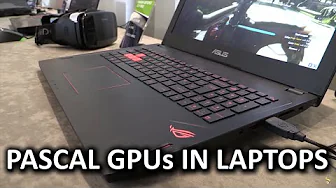
Laptop graphics cards are DEAD
0 up · 0 down · 0 ratings
Channels and socials
Thanks to Braintree for supporting our channel. To learn more, and for your first $50,000 in transactions fee-free, go to braintreepayments.com Nvidia brought Luke out to London for a pretty significant announcement about their laptop-ready Pascal graphics line-up... Massdrop link: dro.ps Buy GTX 1060 on Amazon: geni.us Discuss on the forum: linustechtips.com Affiliates, referral programs, & sponsors: linustechtips.com Join our community forum: bit.ly twitter.com @LinusTech Intro Screen Music Credit: Title: Laszlo - Supernova Video Link: youtube.com iTunes Download Link: itunes.apple.com Artist Link: soundcloud.com Outro Screen Music Credit: Approaching Nirvana - Sugar High youtube.com Sound effects provided by freesfx.co.uk
Nvidia used a London reveal to switch the narrative from mobile graphics rumors to a concrete lineup of desktop-class GPUs in laptops. The video outlines that the 1080, 1070, and 1060 would all appear in laptops without the M suffix, signaling a shift toward desktop-grade performance in portable form factors. Technical specs are shared for each model: the 1060 with 6 GB of memory, around 1280 CUDA cores, and a boost clock near 1670 MHz; the 1070 with 8 GB and roughly 2048 CUDA cores at about 1645 MHz; and the 1080 matching desktop capabilities with 2560 CUDA cores, 8 GB of memory, and a 1733 MHz boost. The presenter notes power delivery details such as dual-stage power controllers and potential factory overclocks, while cautioning that voltage controls remain limited. While the M suffix is being dropped and these are marketed as desktop editions in laptops, Nvidia confirms these will be differentiated by B-specs and a few laptop-specific constraints. A live stage overclock demo of a 1080 in a laptop is shown, indicating the potential for higher performance without a bulky chassis. The segment also highlights features like VR readiness and improvements to G-Sync with high refresh rate panels, suggesting a compelling future for gaming laptops. Overall, the presentation emphasizes that the convergence of desktop GPUs with portable form factors could redefine what users expect from gaming laptops, while promising further tests and comparisons in the office setting to validate real-world performance. In the later portion, the host discusses benchmarking plans and the limitations of the event tests, noting that they could not test GTX 1060 laptops as intended and that the chosen games were not the most demanding for modern hardware. Benchmark notes indicate 1080p testing with high presets, but comparisons were constrained by different CPU configurations between devices, making direct benchmarking apples-to-apples challenging. The presenter remains optimistic about the trajectory, mentioning that desktop-grade graphics in laptops could blend thin, light designs with substantial power. He also hints that more comprehensive benchmarking comparisons will follow once additional laptop samples are available in the office. The tone remains enthusiastic about the architectural shift, balanced by caveats about testing scope and the need for real-world verification. The takeaway is a strong forward-looking stance: expect more capable laptops, more desktop-grade GPU options, and clearer performance metrics as OEMs ship thinner machines with higher-end graphics."
Topics · hardware · computing · gaming · laptops
Questions answered
- What new GPU lineup did Nvidia announce for laptops during the London event?
- Nvidia announced laptop versions of the desktop-class GPUs: GTX 1080, GTX 1070, and GTX 1060, with no M suffix and laptop-specific configurations.
- Will laptop GPUs have the same power limits as their desktop counterparts?
- The laptop GPUs are designed to be close in performance to desktop variants but have laptop-specific power, cooling, and signaling differences, with TDPs aligned to mobile expectations and some factory overclock options in select models.