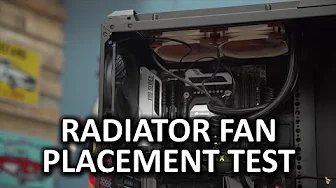
Radiator Fan Configuration: Does It Matter? - The Workshop
0 up · 0 down · 0 ratings
Channels and socials
Push? Pull? Fans on top? Fans on the bottom? Does any of it really matter? Let's find out! Strawpoll link: strawpoll.me Crunchyroll link: crunchyroll.com Corsair link: linustechtips.com Pricing & discussion: linustechtips.com Support us: linustechtips.com Join our community forum: bit.ly twitter.com @LinusTech Intro Screen Music Credit: Title: Laszlo - Supernova Video Link: youtube.com iTunes Download Link: itunes.apple.com Artist Link: soundcloud.com Outro Screen Music Credit: Approaching Nirvana - Sugar High youtube.com Sound effects provided by freesfx.co.uk
The Workshop investigates radiator fan configurations using an Corsair H100i GTX and two Noctua NF-F12 fans across several setups. The video walks through multiple tests, first with two fans pushing air up through the radiator, then two fans pulling air down, followed by combinations with two sets of fans and finally a vertical two-layer arrangement. In each configuration, the host notes the ambient room temperature and the CPU core temperature to judge whether different airflow directions materially affect cooling. The results show only minor variations in core temperatures across configurations, with max differentials staying within a few degrees Celsius. The host emphasizes static fan speeds during tests to isolate airflow direction as the main variable, and comments on practical considerations like cost, noise, and Dust Management when adding more fans. The final takeaway is that for most users, radiator fan orientation matters far less than avoiding obviously conflicting airflow paths, and the simplest, dust-friendly setup tends to be effective. The episode ends with a practical verdict that the best overall approach is pulling air up through the radiator from the bottom, to keep dust in a removable location, while acknowledging that adding extra fans yields diminishing cooling returns relative to the added cost and complexity.
Topics · science & technology · computer hardware · cooling · diy & maker
Questions answered
- Do radiator fans need to be arranged in a specific orientation to maximize cooling?
- According to the tested configurations, orientation has limited impact on cooling performance, and there is no single setup that dramatically outperforms the others outside of pathological or conflicting airflow paths.
- Is adding more fans worth the extra cost for modest gains?
- Not typically; while two additional fans can improve cooling slightly, the benefit is small relative to the cost and dust management considerations.