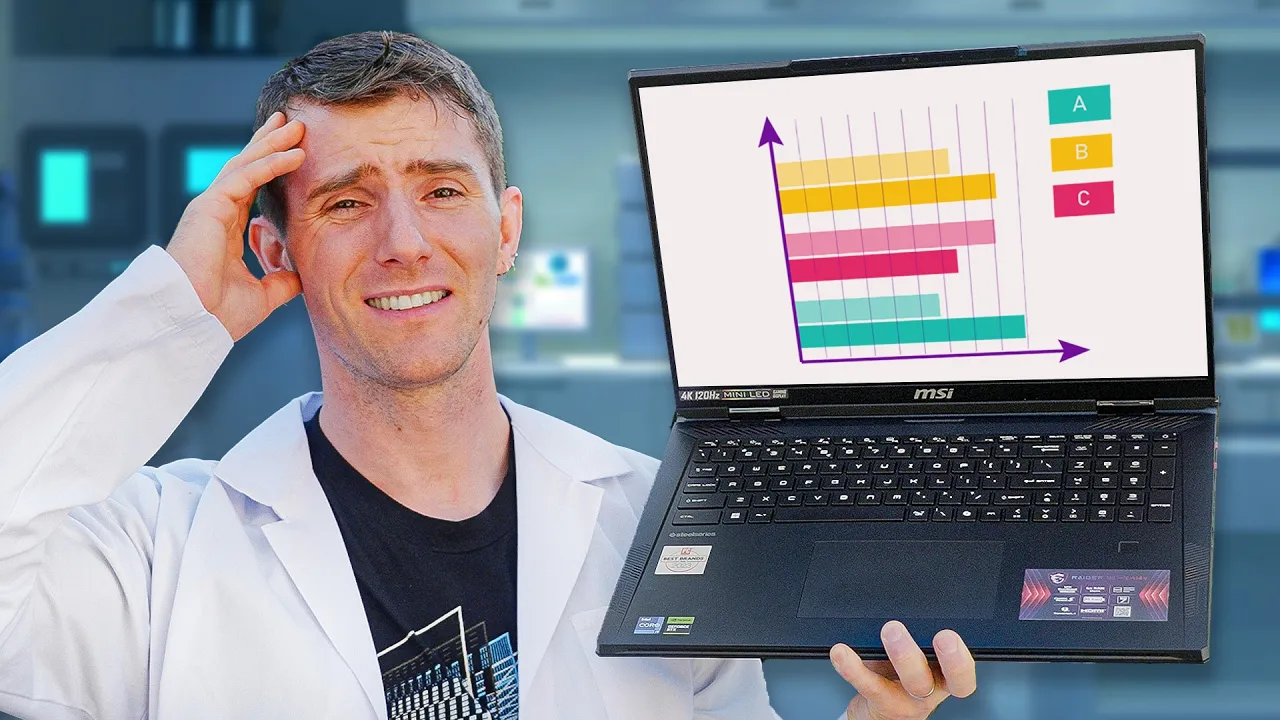
Why it took TWO YEARS to Build a Laptop Test Lab
0 up · 0 down · 0 ratings
Description
Thanks to MSI for sending us the laptops and sponsoring this video!
Check out the MSI laptop 20th-anniversary exclusive deals (save up to USD $1,000) at msi.gm Buy Titan 18HX with $800 off (limited time only) at msi.gm Save $300 (limited time) on Stealth 18 AI Studio at msi.gm Get your Raider 18 HX now at msi.gm Laptops are difficult to test thanks to how many components they have. After just two years, the lab is confident in their methodologies and we’re so close to being ready. Come check it out. Also
Promos
check out our LABS website here lttlabs.com Discuss on the forum: linustechtips.com Purchases made through some store links may provide some compensation to Linus Media Group. ► GET MERCH: lttstore.com ► GET EXCLUSIVE CONTENT ON FLOATPLANE: lmg.gg ► GET A VPN: piavpn.com ► SPONSORS, AFFILIATES, AND PARTNERS: lmg.gg ► EQUIPMENT WE USE TO FILM LTT: lmg.gg ► OUR WAN PODCAST GEAR: lmg.gg FOLLOW US --------------------------------------------------- Twitter: twitter.com Facebook: @LinusTech Instagram: @linustech TikTok: @linustech Twitch: twitch.tv MUSIC CREDIT --------------------------------------------------- Intro: Laszlo - Supernova Video Link: youtube.com iTunes Download Link: itunes.apple.com Artist Link: soundcloud.com Outro: Approaching Nirvana - Sugar High Video Link: youtube.com Listen on Spotify: spoti.fi Artist Link: youtube.com Intro animation by MBarek Abdelwassaa @mbarek_abdel Monitor And Keyboard by vadimmihalkevich / CC BY 4.0 geni.us Mechanical RGB Keyboard by BigBrotherECE / CC BY 4.0 geni.us Mouse Gamer free Model By Oscar Creativo / CC BY 4.0 geni.us CHAPTERS --------------------------------------------------- 0:00 Intro 0:33 Step 1 1:07 Endurance Test 2:28 Why LABS 3:28 Laptop Weight Classes 4:50 Gaming Benchmarking 7:29 Thermals 9:13 Noise Test 10:42 Speakers 11:02 Display 13:26 Keyboard 13:55 WiFi 14:30 Outro
LTT Labs spent two years developing a comprehensive laptop test lab to deliver real world, repeatable performance data. The video outlines why testing laptops is exceptionally complex, since every component from CPU to display affects overall usability. They emphasize the need to remove software bloat during testing to avoid skewing results and to reset devices to a clean state before measurements. The host walks viewers through an end-to-end workflow that includes physical inspection, default power profiles, and a controlled testing environment to establish a reliable baseline. The aim is to create a methodology that reflects ordinary consumer use, rather than relying on manufacturer biased or cherry-picked benchmarks. By the end of this segment, it’s clear the lab is still evolving, but the foundation is in place to produce independent, repeatable results that matter to buyers. In the middle portion, the video dives into how endurance and battery life are tested, including low brightness, reduced display dpi, and disabling RGB to simulate typical use. They describe placing laptops in a 20 degree environmental chamber and running overnight endurance tests with a mix of 720p video playback and logging hardware information. The team discusses the importance of labeling weight classes and performing a quick Out-of-Box Performance mode test before any heavy workloads. They illustrate how stress tests and gaming benchmarks, powered by Markbench, yield reliable data across CPU and GPU tasks and help identify faulty units early. The host also explains why MSI laptops are shown as sponsorship examples while independent results will still be published on lttlabs.com. The narrative reinforces that the ultimate goal is a robust, broadly acceptable assessment framework rather than one-off numbers. The latter portion centers on the actual testing apparatus and data interpretation. They showcase the Titan 18HX and other MSI devices while highlighting power envelopes, thermal behavior, and sustained clock speeds as the critical metrics for real-world performance. The team walks through thermal testing in the environmental chamber, using Cinebench for CPU load and Furmark for GPU load, with additional mixed workloads to simulate real gaming bursts. They discuss the value of measuring sustained performance rather than peak clocks, especially for throttling-prone laptops. There is also exploration of noise, acoustics, and display testing, including color accuracy, brightness, and HDR performance. Even though some components like final EMC chamber and full Wi-Fi testing are still in progress, the video conveys a clear path toward a completed, auditable lab with public reporting. Finally, the video looks to the future and the broader mission of LTT Labs. The team envisions expanding test coverage to include charging curves, power analysis modules, and thermal imaging to visualize heat flow in real time. They acknowledge design delays but reassure viewers that progress is continuing, with a plan to publish finished methodologies and full lab results. The host closes by linking the lab work to MSI devices and other lines that promise strong performance, alongside the Lab’s ongoing effort to test every product before it reaches consumers. Viewers are invited to follow updates on the LTT Labs site and floatplane channel for deeper dives and datasets. Overall, the message is hopeful and pragmatic: building a trustworthy lab takes time, but the payoff is a more informed buying experience for laptop shoppers.
Topics · science and technology · hardware testing · laptops · gaming hardware
Questions answered
- What is the primary reason Linus Tech Tips spent two years building their laptop test lab?
- To create a comprehensive, independent, and repeatable testing framework that accurately reflects real-world use and overcomes inconsistencies in manufacturer benchmarks.
- What does the team consider more important than peak performance clocks when evaluating laptops?
- Sustained clock speeds and thermal behavior over time, since throttling and cooling performance determine real-world usability more than brief peak spikes.