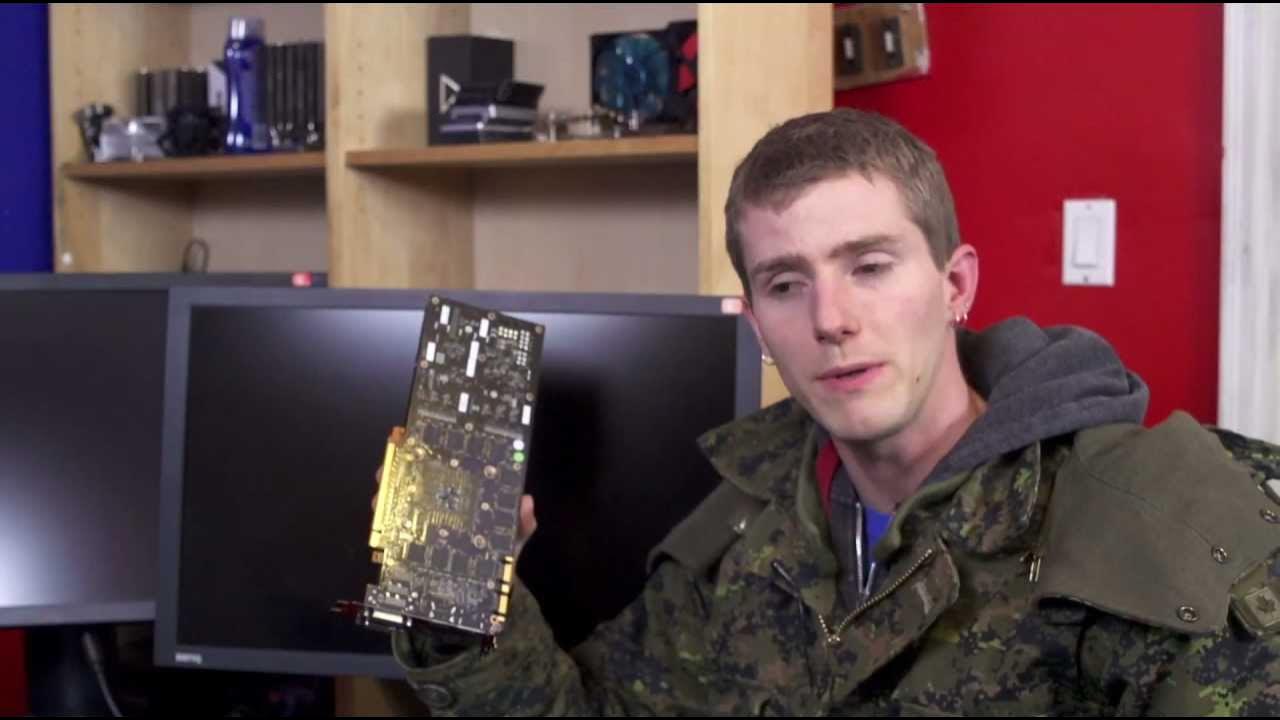
GeForce GTX Titan NVIDIA Surround Performance Review Linus Tech Tips
0 up · 0 down · 0 ratings
Description
This card with its 6GB of VRAM is BUILT for surround gaming, but perhaps the surround games are quite ready for it... All graphics cards in our tests are OVERCLOCKED. See our settings here: docs.google.com Download the graphs in the video here: docs.google.com
Channels and socials
Check out our Titan test bench here: youtube.com Read more & join our community forum: linustechtips.com Buy it now at NCIX: ncix.com
Linus Tech Tips evaluates the GeForce GTX Titan in a surround gaming context, focusing on how a single-GPU solution performs across multiple high-resolution setups. The host emphasizes Titan’s strengths, notably its 6 GB of VRAM which is advantageous for 3 monitor surround gaming, while also noting its limitations such as driver maturity and the challenge of scaling performance against multi-GPU contenders. Early in the review, the testing rig is described: a 3930K @ 4 GHz with 16 GB RAM, all GPUs overclocked, and testing conducted on three 1920x1200 displays to simulate a wide display array. The video explains that while Titan’s 6 GB frame buffer helps with memory-heavy titles, the actual gameplay results vary widely by title and by whether the game scales well with a single GPU versus dual-GPU configurations. The narrative then moves through a suite of games used to assess real-world performance, including Crisis, Crisis 3, Far Cry 3, Skyrim, Battlefield 3, Metro 2033, Witcher 2, and others, drawing explicit comparisons between Titan and AMD/NVidia multi-GPU options. Across titles, Titan frequently leads in Crisis 3 and Battlefield 3, while in Crisis, AMD’s dual-GPU Aries 2 can sometimes outperform single-GPU Titan depending on the title and settings, illustrating that driver optimization and game-specific support heavily influence outcomes. The host also highlights practical considerations such as noise, power, heat, and the potential cost-effectiveness of multi-GPU setups versus a single powerful card, concluding that Titan occupies a unique niche for high-resolution surround gaming, with excellent raw performance, significant memory headroom, and quiet operation. The review closes with guidance on potential surround configurations, the value proposition of Titan, and a nod to future 4K displays as a more demanding testbed for memory and bandwidth, implying Titan’s footprint could become even more relevant as displays push beyond 6K or 4K in the coming years.
Topics · hardware review · gaming benchmarks · surround gaming · graphics cards
Questions answered
- What is the Titan primarily best at in this review?
- The Titan excels in high-resolution surround gaming due to its 6 GB of VRAM and strong single-GPU performance, particularly in titles like Crisis 3 and Battlefield 3.
- How does Titan compare to dual-GPU solutions in the tests?
- Titan often outperforms single-GPU cards but may be challenged by certain dual-GPU setups like the Aries 2 in some games; in others, driver optimization determines the advantage more than raw hardware power.
- Does surrounding gaming with Titan suggest a cost-effective upgrade path?
- Titan can be a compelling choice for high-end surround gaming due to memory headroom and quiet operation, though in some cases a well-optimized dual-GPU solution might offer better value depending on the title and resolution.