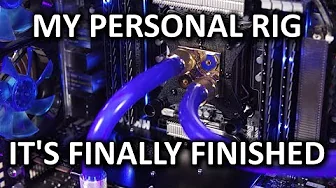
Personal Rig Update 2012 Part 17 - IT'S FINALLY DONE! Project Summary & Deluxe Tour
0 up · 0 down · 0 ratings
Channels and socials
It's half an hour of me talking about the process of building up my beast machine and the most B-roll glamour footage we've ever shot of anything... Using our new recording setup (natively recorded in 4K RAW and downsampled to 1080p prores) Heh. I called my APOGEE HD an APOGEE GTZ!!! Clearly had been a very long day... Sponsor link: linustechtips.com Component List: linustechtips.com Join our community forum: bit.ly twitter.com @LinusTech Intro Screen Music Credit: Adhesive Wombat -
Check out his channel here: youtube.com Outtro Screen Music Credit: Approaching Nirvana - Sugar High youtube.com
This video is a comprehensive, in-depth showcase and finalization of a multi-year personal computer build, culminating in what Linus terms the Deluxe Tour of his custom rig. The opening section establishes context for the project, noting the long development timeline and the reasons for prior delays, including shutter issues with LED strips and a decision to upgrade to new 4K RAW recording equipment. Linus proceeds to walk through the core components, explaining his choices for the CPU lineup with a focus on balance between high-end performance and practical use cases such as gaming, content creation, and professional workloads. He emphasizes the workstation-class motherboard, IO expansion capabilities, and the intent to achieve reliability and upgradeability over chasing the latest consumer trends. The RAM discussion centers on a specific kit with mixed compatibility, acknowledging the compromises made for aesthetics and custom LED features, while also noting future upgrade potential and the practicalities of working within the X79 platform. The video then moves into the heart of the rig: the graphics subsystem, where a GTX Titan handles heavy lifting, SLI considerations (and why quad Titan setups were deemed impractical for his use), and the integration of a custom water cooling loop with a swifttech Apple GTZ centerpiece that has been personalized with powder coating and aftermarket mounting hardware for color and cohesion with the case. Linus dives into the power delivery, sleeving, and wire management, revealing techniques to reduce bulk and improve cable routing around a large, modded TJ07 chassis. Throughout, he highlights the advantages of a large, heat‑efficient cooling solution, including a D5 pump and a multi‑fan radiator array with a focus on noise perception and airflow direction inside the case. As the tour progresses, the video covers eight solid-state drives mounted behind the case, the storage strategy, and the decision to maintain a robust RAID zero array despite acknowledged risk. The optical drive, once a marquee feature for HD DVDs and Blu-ray reading, remains as a nostalgic yet practically inert element, retained due to hardware availability and the physical constraints of the front bay. Linus details the custom side panel solution, replacing a damaged glass panel in a way that preserves both aesthetics and structural integrity, albeit with a few “ghetto” fixes that add to the character of the build. He devotes attention to the case itself, explaining the sentimental value of the TJ07, its unmatched single-piece aluminum chassis, and the tradeoffs between that classic design and newer options. The video also touches on the front IO reconfiguration, the Velcro‑based radiator mounting, and a few clever fixes that keep the system clean and usable despite extensive modification. The final segments consolidate the philosophy behind the build: prioritizing upgradeability, serviceability, and personal meaning over chasing the latest trend, with occasional reflections on the Star Citizen launch timeline and the potential for future GPU swaps or platform updates. The closing remarks invite viewer feedback, thank supporters, and provide transparency about samples versus purchases, reinforcing the hybrid nature of a YouTuber‑powered build project where community support and product partnerships influence the journey as much as the creator’s own ideas. In sum, the video is not just a technical walkthrough but a narrative about perseverance, craftsmanship, and the joy of a personal project that evolves over years. It blends practical build details with personal anecdotes, giving viewers a clear sense of what went into the rig, why certain design decisions were made, and how the final result stands as both a functional workstation and a story of time, effort, and passion. The Deluxe Tour serves as a capstone that ties together the hardware choices, cable management ingenuity, cooling philosophy, and the enduring value of a build that is as much about the journey as the destination.
Topics · technology · hardware · pc_building · custom_case_modding
Questions answered
- What CPUs were considered for the build and which was recommended for different workloads?
- Linus recommended the 4770K for gaming and general tasks, the 4570K for 4 threads and gaming, and the 4930K for heavy content creation and professional workloads that can leverage more cores.
- Why did the author choose a workstation-class motherboard over consumer options?
- The motherboard choice was driven by the desire for reliability, more PCIe expansion, better onboard features, and overclocking capabilities, avoiding the instability some consumer boards exhibited.
- What is the main reason for the eight SSD RAID zero array, despite its risk?
- The array provides extreme throughput and performance for the personal rig, with nightly backups and careful data management to mitigate potential data loss.
- What cooling hardware forms the core of the loop?
- A SwiftTech Apple GTZ gold-plated block, a D5 pump, True Silver compression fittings, and multiple radiators including a front and bottom setup with custom airflow management.
- Why is the optical drive kept in place despite being largely obsolete?
- It is retained for historical reasons, as a unique HD DVD Blu-ray reader/writer combo that justified itself at the time of purchase, and because the user had limited replacement hardware available.
- How does Linus address cable management in such a large build?
- He uses a mix of Velcro mounting, back-panel rerouting, and custom adapters to minimize cable bulk and keep the system approachable for upgrades.
- Are the components used in the video all paid for by Linus or supplied as samples?
- The video distinguishes between samples and purchases, explicitly naming which items were provided by sponsors or manufacturers and which were paid for by Linus.