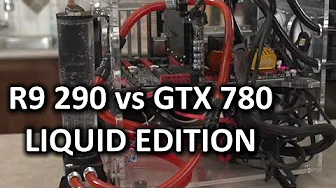
Water Cooled R9 290 vs GTX 780 Showdown
0 up · 0 down · 0 ratings
Channels and socials
The R9 290 vs the GTX 780 has been an... incomplete story due to the lack of availability of non-reference R9 290s up until now. We sought to find out how these two cards would compare to each other when thermal limits were removed from the calculation and they could go head to head with custom liquid cooling! Sponsor link: linustechtips.com Pricing & availability: linustechtips.com Join our community forum: bit.ly twitter.com @LinusTech Intro Screen Music Credit: Adhesive Wombat -
Check out his channel here: youtube.com Outtro Screen Music Credit: Approaching Nirvana - Sugar High youtube.com
The video conducts a head-to-head comparison between a water-cooled R9 290 and a GTX 780 to evaluate how removing thermal limits affects performance, with a focus on overclocking results and real-world gaming implications. The presenters explain that both cards face throttling when heat and power limits are reached, and they explore how liquid cooling can unlock additional headroom. They describe the experimental setup, including dual liquid cooling loops for CPU and GPU, a high-widelity test bench, and the decision to run both cards at their maximum overclocks while mitigating variables to isolate GPU thermal performance. Early in the test, the team notes that expectations were high for the R9 290 to dominate the GTX 780, given price and historical performance, but actual results reveal meaningful nuances in clock speeds, temperature behavior, and power usage when cooled with water. The results show both cards operating at surprisingly modest under-load temperatures with water cooling, and the study highlights how cooling solutions alter the typical performance landscape in practical scenarios. In the end, the video emphasizes value and performance trade-offs, including how prices and mining demand at the time influenced perceived value, and it encourages viewers to consult the provided charts and links to draw their own conclusions about which card offers better performance per watt and per dollar under liquid cooling conditions.
Topics · technology · hardware · gpu · gaming
Questions answered
- What was the main goal of removing thermal throttling in this comparison?
- To determine how each graphics card performs when cooled with liquid cooling, without the limiting effects of heat and power throttling, and to assess the true performance potential of the R9 290 and GTX 780.
- How did water cooling affect clock speeds and performance for the GTX 780 and R9 290 in this test?
- The GTX 780 saw roughly a 10% improvement in overclocked performance, while the R9 290 improved by about 7%, indicating that liquid cooling can unlock additional headroom for both cards.
- What was the conclusion regarding value and pricing for these cards in the context of water cooling?
- Despite initial expectations that the R9 290 would win on price, its later pricing at $500 made it a tie with the GTX 780, which carried higher power consumption and heat; the GTX 780 was favored for value under the tested conditions.