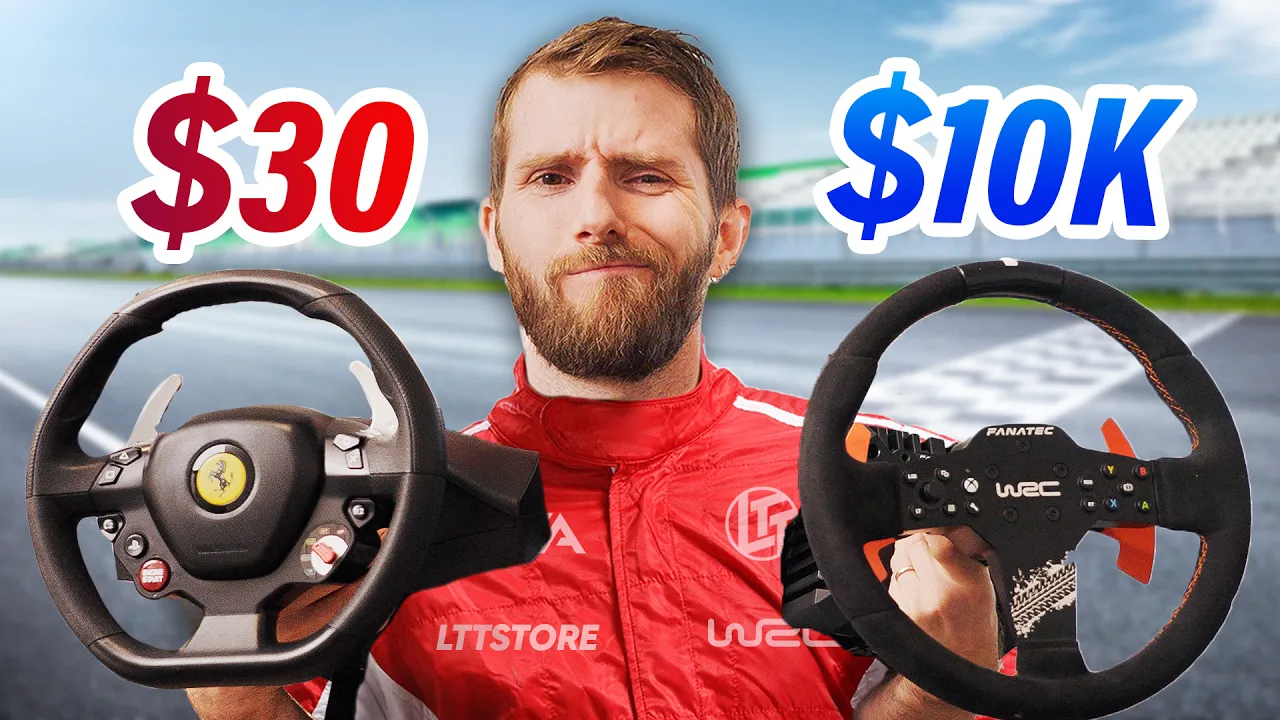
Don't Waste your Money - $30 vs $10,000 Racing Setup
0 up · 0 down · 0 ratings
Promos
Alex wanted to build himself a new racing setup for his. So when we were given a chance to test out EA Sports WRC, we had to see how it held up to a budget racing wheel and our ultimate setup. Discuss on the forum: linustechtips.com Some of the hardware we used: Next Level Racing GTLite Pro Foldable Racing Cockpit: geni.us Logitech G27 Racing Wheel (on eBay): ebay.us Next Level Racing Lite Free Standing Monitor Stand: geni.us Logitech K400 Plus Wireless Touch Keyboard: geni.us ANNX/MUGE RACING USB Handbrake: geni.us Fanatic CSL DD Ready2Race WRC Bundle: lmg.gg Sony DualSense Controller: geni.us ThrustMaster T80 Ferrari 488 GTB Edition: geni.us Purchases made through some store links may provide some compensation to Linus Media Group. ► GET MERCH: lttstore.com ► GET EXCLUSIVE CONTENT ON FLOATPLANE: lmg.gg ► SPONSORS, AFFILIATES, AND PARTNERS: lmg.gg ► EQUIPMENT WE USE TO FILM LTT: lmg.gg ► OUR WAN PODCAST GEAR: lmg.gg FOLLOW US --------------------------------------------------- Twitter: twitter.com Facebook: @LinusTech Instagram: @linustech TikTok: @linustech Twitch: twitch.tv MUSIC CREDIT --------------------------------------------------- Intro: Laszlo - Supernova Video Link: youtube.com iTunes Download Link: itunes.apple.com Artist Link: soundcloud.com Outro: Approaching Nirvana - Sugar High Video Link: youtube.com Listen on Spotify: spoti.fi Artist Link: youtube.com Intro animation by MBarek Abdelwassaa @mbarek_abdel Monitor And Keyboard by vadimmihalkevich / CC BY 4.0 geni.us Mechanical RGB Keyboard by BigBrotherECE / CC BY 4.0 geni.us Mouse Gamer free Model By Oscar Creativo / CC BY 4.0 geni.us CHAPTERS --------------------------------------------------- 0:00 Intro 1:25 The Basic 3:55 Driving the Basic Setup 5:15 PS5 Controller 7:10 Alex's Rig 9:44 Adorable Chiweenie Cameo 14:55 Linus Knows Cars Good 16:55 Driving Alex's Setup 20:38 "Upgrading" the Handbrake 22:56 THE ULTIMATE 24:40 Testing the Ultimate Setup 29:13 Which Setup was the Best?
This video from Linus Tech Tips explores the question of how much you need to spend to get a satisfying sim racing experience, using EA Sports WRC as the test bed. The hosts build and compare a spectrum of setups starting from a $30 wheel on a modest PC up to a full blown ultimate rig with high end peripherals. The initial segment demonstrates how easy it is to assemble a very basic wheel setup, including a Thrustmaster T80 Ferrari Edition and a makeshift pedal arrangement, with the goal of showing what you can get for almost nothing. They then contrast this with a PS5 controller and discuss the pros and cons of each input method, including comfort, ergonomics, and available feedback. The video emphasizes that even a minimal wheel can be playable, but the absence of force feedback makes precision and immersion far more challenging, especially for newcomers. Throughout, the team inserts light humor and self deprecation while anchoring the discussion with practical performance notes from their early tests. They also tease a more elaborate mid-tier build for Alex, driven by the goal of combining affordable components with meaningful upgrades. As the testing environment evolves, the crew details the mid-tier setup, centered around a Next Level Racing GT Lite Pro cockpit and a G27 wheel that dates back over a decade. They discuss mounting, cable management, and mounting hardware, including some improvised spacers and a VESA-based mounting solution. The segment underscores a core theme: value is not just about sticker price but about how cohesive the setup feels in practice. The drivers experiment with a real game session, adjusting seating position, monitor height, and field of view to approximate a realistic rally cockpit. They acknowledge that the G27’s USB 2 compatibility and lack of modern features put constraints on the experience, but emphasize that it still yields a meaningful baseline for comparison. The discussion shifts toward how accessibility and room footprint influence what works for most people at home. The drivers then step into a higher-end scenario, featuring a Fanatec CSL DD bundle and more capable wheels, pedals, and a dedicated handbrake, aiming to illustrate how performance scales with equipment. They critique the ergonomics and force feedback that come with different peripherals, noting how modern force feedback wheels dramatically improve feel and control compared to the entry-level gear. They test on a 1080p system with a GTX 1060 to verify that a broad audience can still enjoy the experience without top-tier hardware, highlighting the importance of stable frame rates and perceivable feedback. A key takeaway is that upgrading to a wheel with genuine force feedback is worth the investment for serious enthusiasts, even if it costs substantially more than the base setup. They also touch on the role of actual driving data and road feel, explaining how force feedback helps a driver anticipate traction and cornering behavior beyond visual cues alone. In the later sections the team upgrades Alex’s rig further, setting up triple monitors, a more sophisticated seat, and a shifter/handbrake solution, while also integrating a PC that can push higher graphics settings. They reveal the compromises that come with building a realistic rally simulator at home, including the complexity of cable routing, monitor alignment, and software configuration. The hosts discuss the benefits of supporting hardware ecosystems from brands like Fanatec and Heusinkveld, and they explore how dynamic elements like motion platforms (D-Box) can replicate real car dynamics, including weight transfer and road texture. The narrative blends practical DIY solutions with a candid acknowledgement that such a setup can be prohibitively expensive for most people, while still illustrating the potential depth and immersion of a top-tier rig. The final verdict leans toward a pragmatic approach: buy what you can, upgrade progressively, and consider resale value if you are unsure about long-term commitment. The closing analysis frames the ranking of gear by improving immersion and control, rather than by chasing the most expensive hardware available. The wheel-without-force-feedback option sits at the bottom for realism, while a modern force feedback wheel dramatically improves responsiveness and enjoyment. They place the ultimate setup well above the baseline in terms of tactile feedback, stability, seat comfort, and the sense of presence in the game. The video ends by reiterating the core message: choose a setup that matches your budget and space, enjoy the experience, and be prepared to iterate if you find a future upgrade that better suits your goals. If you’re curious about EA Sports WRC, they remind viewers that the game is available on multiple platforms and invite fans to explore the gear links in the description to replicate the tested configurations. The overall tone remains playful yet informative, aiming to give viewers a practical sense of value across a wide range of hardware choices while not shying away from the realities of high-end SIM setups.
Topics · gaming · hardware · reviews · simulation