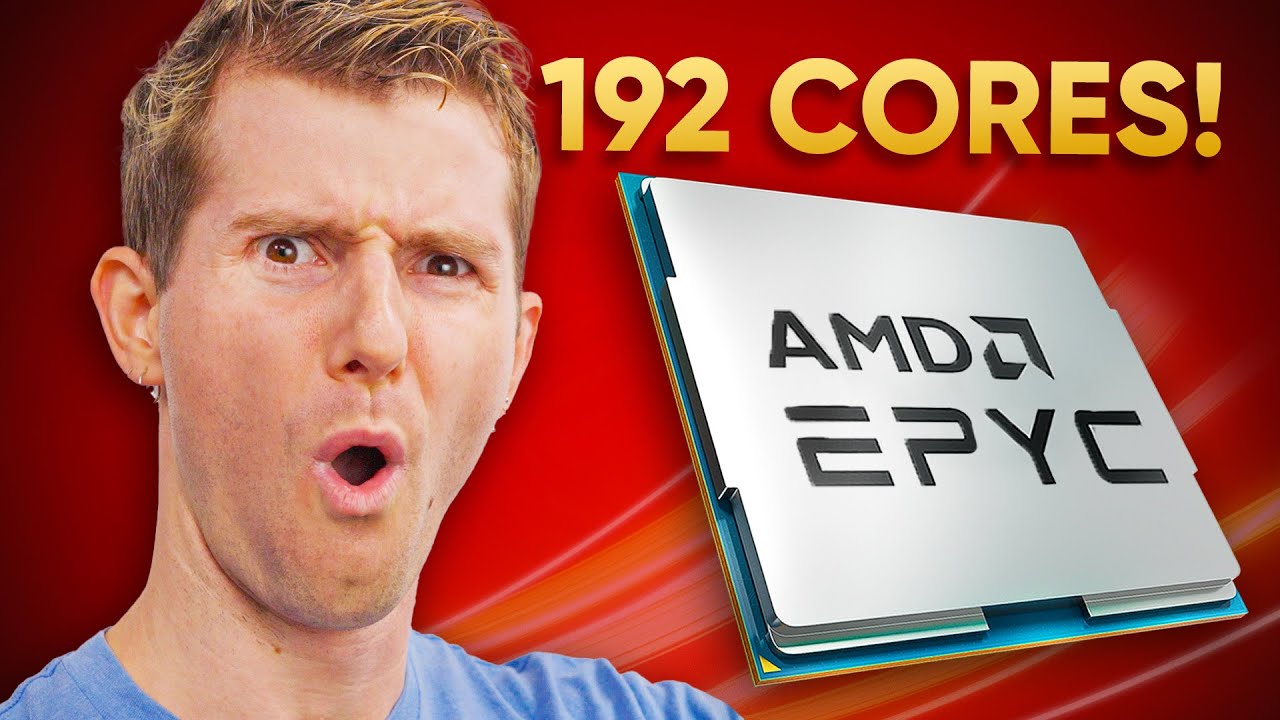
The fastest CPU in the world
0 up · 0 down · 0 ratings
Description
Thanks to Supermicro for sponsoring this video! You can
Check out LTTStore black Friday deals at: lmg.gg Discuss on the forum: linustechtips.com
Promos
Check out the AMD EPYC 9965 CPU: geni.us Buy a Kioxia CM7-R 15.3TB Gen5 NVMe SSD: geni.us Buy a Sapphire Pulse Radeon RX 7900 XTX Graphics Card: geni.us ► GET OUR MERCH: lttstore.com ► GET EXCLUSIVE CONTENT ON FLOATPLANE: lmg.gg ► GET A VPN: piavpn.com ► SPONSORS, AFFILIATES, AND PARTNERS: lmg.gg Purchases made through some store links may provide some compensation to Linus Media Group. CHAPTERS --------------------------------------------------- 0:00 Intro 1:12 The 500W CPU 2:50 Our Supermicro server 6:27 Installing storage 8:09 But will it boot? 8:37 Yes, but it's so, so loud 9:48 Look at all those cores!' 13:16 Of course, we have to game 15:19 Running Passmark 18:21 How did they do it? 19:55 Running Y-Cruncher 21:25 Creating some virtual machines 25:40 Outro
Channels and socials
check out their H14 AMD servers at: youtube.com supermicro.com Last year, AMD launched a 128-core CPU, and we thought, "It can't get better than this, can it?" Well, we were proven wrong, as now AMD has its all-new AMD EPYC 9965 equipped with a staggering 196 cores.
The video introduces the AMD EPYC 9965, a server-class CPU with 192 cores and 384 threads, positioning it as the fastest CPU in the world for enterprise workloads. The host explains the sheer scale of the chip, noting a 500 W Thermal Design Power and the dense configuration that enables massive parallelism for data center tasks. The segment covers the hardware platform used to house the processor, including Supermicro’s hyperscale 2U to 4U chassis, the memory subsystem with up to 12 TB of 6400 MT/s ECC RAM, and the Gen5 PCIe lanes that keep all components well connected. They detail the cooling and power considerations necessary to support such power-hungry components, including dual 2000 W power supplies and robust socket retention. The build showcases the practicalities of deploying such a processor in a real server environment, including BIOS validation, memory population, and the challenges of booting a system with this many cores. Throughout, the host contrasts Zen 5 architecture improvements with previous generations, highlighting architectural features like NextGen Branch Prediction, wider execution paths, AVX-512 support, and claims of IPC uplift that translate into real-world server and HPC performance advantages. The video then pivots to practical workloads like virtualization with Proxmox, memory-heavy benchmarks, and synthetic tests such as PassMark and Y-Cruncher to illustrate the chip’s capabilities, along with candid notes on gaming performance and workload fit for a CPU of this caliber. In closing, the host reflects on the market implications, the value proposition for data centers, and the continuing AMD versus Intel competition in the race for the world’s fastest processor, emphasizing that price, power, and rack-space considerations ultimately shape real-world adoption.
Topics · technology · data-center · hardware · ai · servers · enterprise-computing
Questions answered
- What makes the AMD EPYC 9965 uniquely capable for data center workloads?
- It packs 192 cores with 384 threads, a 500 W TDP, Zen 5 architecture with AVX-512, broad PCIe 5.0 connectivity, and a large memory channel count, enabling strong parallel compute, virtualization, and AI workloads in enterprise environments.
- Can a single motherboard/chassis realistically support this CPU?
- Yes, but only with a purpose-built server platform, robust cooling, and a compatible BIOS; standard desktop or consumer boards are not suitable for a 500 W CPU in a typical chassis.
- Does the video demonstrate gaming performance for this CPU?
- Gaming performance is shown to be feasible but not the primary focus; the chip is positioned for server, virtualization, and HPC tasks where many cores and memory bandwidth matter more than gaming frame rates.