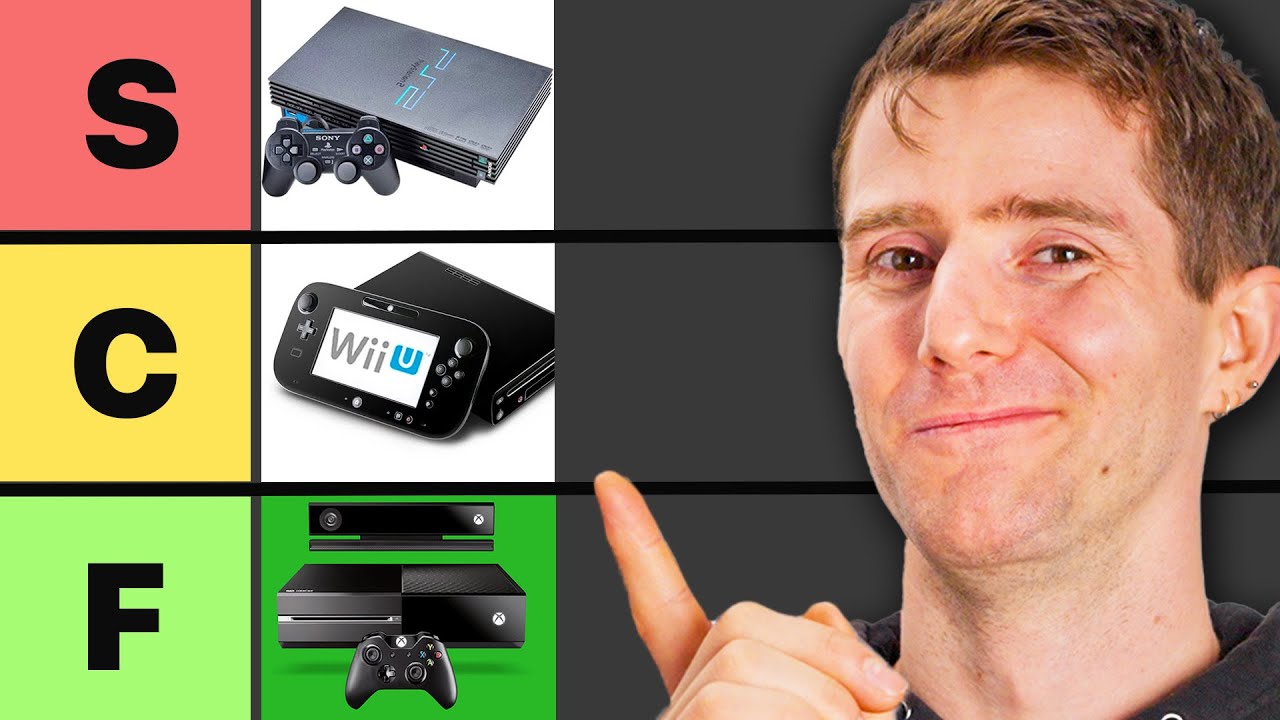
Game Console Tier List
0 up · 0 down · 0 ratings
Promos
Visit squarespace.com and use offer code LTT for 10% off Save 10% and Free Shipping at Ridge by using offer code LINUS at ridge.com Console Wars never change.. and we want to enlist on the side of Gamers. Tier Lists are a great way to rate gaming machines and there are PLENTY of rankings to go around. What PlayStation is the greatest of all time? What Xbox sits atop of the rest? Why is Nintendo always changing their naming? Discuss on the forum: linustechtips.com Buy a PS5: geni.us Buy a PS4: geni.us Buy a Nintendo Switch OLED: geni.us Buy an Xbox Series X: geni.us Buy an Xbox Series S: geni.us Purchases made through some store links may provide some compensation to Linus Media Group. ► GET MERCH: lttstore.com ► GET EXCLUSIVE CONTENT ON FLOATPLANE: lmg.gg ► SPONSORS, AFFILIATES, AND PARTNERS: lmg.gg ► EQUIPMENT WE USE TO FILM LTT: lmg.gg ► OUR WAN PODCAST GEAR: lmg.gg FOLLOW US --------------------------------------------------- Twitter: twitter.com Facebook: @LinusTech Instagram: @linustech TikTok: @linustech Twitch: twitch.tv MUSIC CREDIT --------------------------------------------------- Intro: Laszlo - Supernova Video Link: youtube.com iTunes Download Link: itunes.apple.com Artist Link: soundcloud.com Outro: Approaching Nirvana - Sugar High Video Link: youtube.com Listen on Spotify: spoti.fi Artist Link: youtube.com Intro animation by MBarek Abdelwassaa @mbarek_abdel Monitor And Keyboard by vadimmihalkevich / CC BY 4.0 geni.us Mechanical RGB Keyboard by BigBrotherECE / CC BY 4.0 geni.us Mouse Gamer free Model By Oscar Creativo / CC BY 4.0 geni.us CHAPTERS --------------------------------------------------- 0:00 Nintendo 8:38 Sega 13:57 Xbox 18:56 Atari and "Friends" 22:08 Playstation 31:31 Outro
Game Console Tier List uses a narrative format that walks through several generations of game consoles, prioritizing historical impact, library strength, and the in-era tech choices that defined each system. The host begins by situating Nintendo as potentially the most influential console maker, then moves through early platforms like the Color TV series and the NES, highlighting how hardware scrolling and strong third‑party support shaped the 8‑bit era. He emphasizes that while many early systems are seen as obsolete today, their historical importance anchors their ranking, and he flagships the NES as a pivotal step from infancy to childhood in console gaming. The Super Nintendo era is presented as a refinement of the formula, where games like F‑Zero and Super Mario World showcase the platform’s maturity and breadth, earning an S‑tier label for its era. The segment then shifts to Nintendo’s mid‑generation decisions, including the decision to stick with cartridges for the N64 and the later GameCube’s emphasis on development ease and a strong library, which is the antecedent to a broader discussion of Nintendo’s evolving strategy across generations. Throughout the Nintendo portion, the host also comments on control schemes and how they influenced game design, noting the Wii as a fun, mass‑market success despite its gimmicks, and attributing the Wii U’s failure to branding confusion and limited first‑party pacing. The narrative then expands to Sega’s house of cards in the 90s, detailing the SG‑1000 and Master System line, the controversial CD‑add‑ons, the 32X, and the Saturn’s uneven performance outside Japan, while acknowledging the Dreamcast’s ahead‑of‑its‑time potential and its enduring library of titles. The discussion continues with Microsoft’s Xbox era, highlighting the original Xbox as the most powerful machine of its time and the 360 as a milestone for online services and multi‑platform leadership, followed by the Xbox One’s missteps and the strategic pivot toward services like Game Pass. Sony’s PlayStation arc is developed in depth, culminating in the PS2’s status as the best‑selling console of all time, its unmatched library, and backward compatibility that reinforced its mass appeal; the PS3 is acknowledged for its rocky start but later redemption through software optimization of the Cell processor, while the PS4 is celebrated as a straightforward, gaming‑first platform. The host also nods to ongoing questions about current‑gen strategy and the importance of a robust software ecosystem, while sprinkling sponsorship messages and call‑outs for fans to discuss their own favorites in the comments. The overall structure blends historical milestones with concrete examples, offering a measured, research‑driven take on why certain consoles endure in the collective memory and in contemporary collectability, while remaining transparent about missteps and market dynamics that influenced each tier. The narrative closes with a reflective note on what makes a console endure beyond its hardware, pointing to factor such as game libraries, backward compatibility, and accessibility for players across generations. The host acknowledges the evolving landscape with modern platforms, while reaffirming the value of tier lists as a tool for organizing retro and modern gaming memory. The segment ends with a teaser about future lists and an invitation to audiences to contribute their own rankings and reasons, reinforcing that tiering is a conversation rather than a final decree about value or superiority.
Topics · gaming · history · technology · hardware · review · curation · education · entertainment
Questions answered
- Why is the PlayStation 2 ranked as the top console of all time in this list?
- The PlayStation 2 is ranked highly due to its immense library of games, backward compatibility with PS1 titles, and strong market performance, which together created a lasting impact and broad appeal across generations.
- What justified the S tier for the Super Nintendo in this ranking?
- The SNES earned S tier for its refined technology, strong first‑party and third‑party libraries, standout titles like Super Mario World and The Legend of Zelda, and its lasting influence on platforming and RPG scenes.
- Why did the Dreamcast receive a B rather than an A or S?
- The Dreamcast is placed at B because, despite a strong launch library and ahead‑of‑its‑time features, Sega’s broader hardware strategy collapsed, limiting long‑term market impact despite its enduring titles.
- How does backward compatibility influence rankings in this tier list?
- Backward compatibility is a key factor because it preserves access to prior generations' libraries, contributing to value, ease of transition for players, and the perceived longevity of a console.
- What is the rationale for the Xbox 360 receiving an S tier in this video?
- The Xbox 360 is praised for its online delivery ecosystem, strong multi‑platform performance, and a solid library, which together established a high standard for its generation.
- Why is the PlayStation 3 discussed as a rocky start but later redeemed?
- The PS3 faced a difficult initial pricing and architecture, but Sony improved performance and secured compelling exclusives, leading to a more favorable view of its later lifecycle.
- Do handhelds appear in this ranking, and how are they treated?
- Handhelds are acknowledged as a category with their own implications, and the creator invites discussion about handheld tier lists, indicating interest in separate, detailed treatment of portable systems.