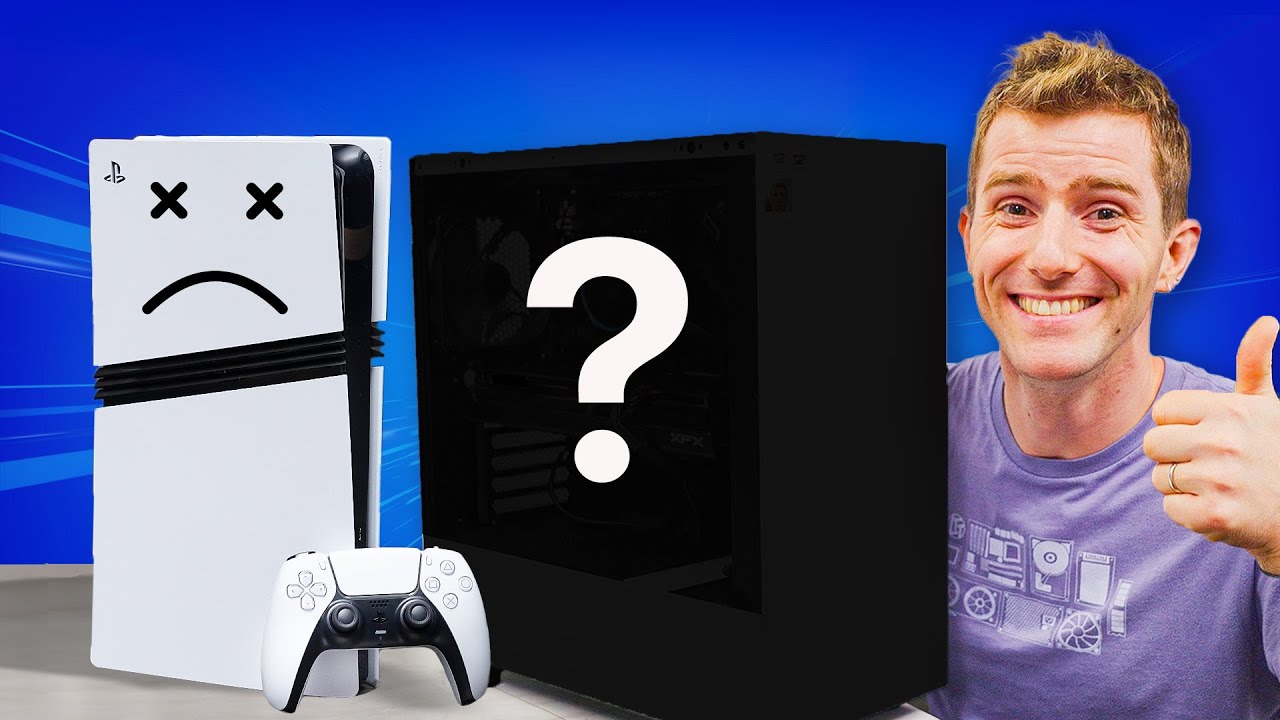
Building a PC to BEAT the PS5 Pro!
0 up · 0 down · 0 ratings
Description
Check out Ridge’s holiday sale at ridge.com It took us 3 years to build the PS5 Killer and now we’re conspiring to murder the Pro in less than a week. It can’t be that hard, right? That $200 price bump EVERYONE is angry about gives us A LOT of extra budget when it comes to assembling our brand new PS5 PRO KILLER… Better GPU? What about a new Platform for our Ram and CPU? Discuss on the forum: linustechtips.com Reminder that pricing in the video is for USED parts, and these are links to NEW listings:
Check out the NZXT H510 Mid-Tower PC Case: geni.us
Check out the Samsung 990 Pro 2TB NVMe SSD: geni.us
Promos
Thanks to MANSCAPED for sponsoring today's video. Get 20% Off + Free International Shipping with promo code LTT20 or visit manscaped.com
Check out the Sony PS5 Pro Game Console: geni.us (Canada: geni.us ) Purchases made through some store links may provide some compensation to Linus Media Group. ► GET OUR MERCH: lttstore.com ► GET EXCLUSIVE CONTENT ON FLOATPLANE: lmg.gg ► GET A VPN: piavpn.com ► SPONSORS, AFFILIATES, AND PARTNERS: lmg.gg CHAPTERS --------------------------------------------------- 0:00 I’LL FRIGGIN DO IT AGAIN 1:24 Notice us, Mark Cerny 2:42 The Mission 3:06 The Build Begins 7:00 The GPU 8:15 The Cost Comparison 9:15 Gaming vs the PS5 Pro 17:25 What should YOU get?
Building a PC to BEAT the PS5 Pro! is a deep dive into assembling a mid-range PC using used parts to outperform Sony's PS5 Pro at the same price point. The video opens by addressing critics and clarifying that the team will not simply drop in a faster GPU, but will instead optimize across the entire build to maximize value per dollar. The host outlines the core strategy: use a modern but inexpensive CPU like the Intel Core i5-12400F, pair it with a cost-effective Z-series/6xx motherboard, and select a GPU with strong raw performance that can outpace the PS5 Pro while staying within budget. They justify secondhand components to stretch the budget further, but acknowledge tradeoffs like potential reliability and warranty concerns. Throughout, the team compares the resulting PC’s performance to the PS5 Pro in terms of visual fidelity and frame rate, showing side-by-side gameplay and discussing natural differences such as resolution, upscaling, and motion artifacts. The narrative moves from planning to execution, then to a live performance test where they tweak settings to balance frame rate, HDR, and upscaling quality, ultimately presenting two near-equal gaming experiences at 60 FPS with different tradeoffs. They also dissect the value proposition of the PS5 Pro versus a budget-friendly PC build, including cost, game library, online play, and future upgradability, before wrapping up with viewer Q&A style conclusions and sponsor plugs. In the CPU and motherboard section, the video explains choosing two core paths: sticking with Intel or moving to a blue-team AMD alternative. They justify the i5-12400F choice due to price-to-performance, noting it can outperform the PS5 Pro’s CPU in gaming tasks at a lower cost, even with a two-core deficit. The ASRock B660 motherboard used in the build is highlighted as an extremely affordable option, sometimes found for under $40, though the team notes drawbacks like fewer PCIe slots and the need to work with used hardware. They emphasize RAM choices as a cost saver, opting for a 16GB kit from G.Skill Ripjaws and explaining why DDR4 can still be viable in a budget build. The host discusses storage strategy, upgrading to a WD Black SN850X 2TB to hit Sony’s storage benchmarks, while keeping costs in check with an affordable case from NZXT and a modest yet reliable Corsair PSU, framing the build as a pragmatic balance between cost and reliability. In the GPU discussion, the team picks an XFX Speedster Quicksilver 7800 XT as the centerpiece, arguing its raw performance would outpace the PS5 Pro despite lacking some of the console’s newer upscaling features, and they transparently calculate a total around $655 for the core system, leaving room for peripherals or software. They also acknowledge the possibility of chasing even lower costs by hunting for used parts, suggesting a hypothetical $535 baseline and discussing where those savings could be allocated for Wi-Fi and other accessories. The overall message is clear: the PC option represents a flexible upgrade path and better long-term value for many gamers, even if it requires more effort and risk than buying a dedicated console. When it comes to performance and visuals, the video presents a methodical, iterative comparison between the PS5 Pro and the PC build. They run a side-by-side test in a Rift Apart-style scenario, tuning up settings like resolution, FSR, and PSR modes to maximize image quality while preserving 60 FPS. The team notes motion artifacts with PSR and the limitations of FSR on certain scenes, concluding that PS5 Pro still holds an edge in optimization for some scenes, while the PC build can closely follow with careful tuning. They discuss HDR implementation, Windows versus GPU-driven HDR behavior, and the impact of firmware and driver support on image fidelity. The result is a nuanced verdict: in many scenes the PC can achieve near parity with the PS5 Pro at the same budget, but certain optimizations and motion handling can tilt the experience in favor of the console in some frames. The discussion then transitions to broader consumer value, weighing the cost of a new PS5 Pro against a mixed-spec PC approach, including potential savings from used parts and the long-term upgradability that a PC offers. The closing segment frames the choice as context-dependent: for 1080p gaming, a PC build can be an excellent value; for true 4K efficiency and a turnkey experience, PS5 Pro remains compelling, especially if you value a simple library and plug-and-play setup. Finally, the video ends with sponsor mentions and a tease to watch another video comparing the original PS5 killer PC against the PS5 Pro for further context and analysis.
Topics · gaming hardware · consumer technology · science & technology · computer hardware · gaming performance
Questions answered
- What CPUs and motherboards were chosen for the PC killer build and why?
- The video uses an Intel Core i5-12400F and a budget ASRock B660M-HDV motherboard to maximize price-to-performance and enable a cost-effective, upgrade-friendly platform.
- Which GPU was selected and what was the rationale?
- The XFX Speedster Quicksilver 7800 XT was chosen for its higher raw performance to beat the PS5 Pro, trading some cutting-edge features for strong gaming power at a similar price point.
- How did the builders handle storage to meet PS5 Pro benchmarks?
- They used a WD Black SN850X 2TB NVMe SSD to approach Sony’s suggested storage capacity and performance for gaming workloads.
- What was the final verdict on PS5 Pro versus the budget PC?
- In many scenarios the budget PC approached parity with the PS5 Pro, but the console still holds advantages in optimization and turnkey usability; the decision depends on the user’s needs and willingness to manage a build.
- What role did used parts play in the cost strategy?
- Used parts were central to stretching the budget, enabling a higher-end GPU and storage within a tight total budget, though at the expense of potential warranty and reliability concerns.