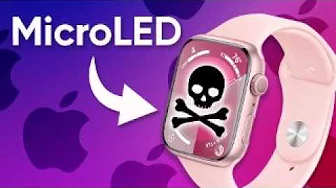
Why Apple Killed a $3 Billion Investment
0 up · 0 down · 0 ratings
Promos
Check out the MSI MPG MT201DR Monitor Arm at msi.gm MicroLED was supposed to be the next big thing in display tech, and even replace OLED...so where the heck is it? Leave a reply with your requests for future episodes. ► GET MERCH: lttstore.com ► GET A VPN: piavpn.com ► GET EXCLUSIVE CONTENT ON FLOATPLANE: lmg.gg ► SPONSORS, AFFILIATES, AND PARTNERS: lmg.gg FOLLOW US ELSEWHERE --------------------------------------------------- Twitter: twitter.com Facebook: @LinusTech Instagram: @linustech TikTok: @linustech Twitch: twitch.tv
The video revisits the rise and stalled trajectory of microLED technology, focusing on why Apple reportedly invested about $3 billion into microLED for the Apple Watch and then canceled those plans around early 2024. It explains that while microLED promised hard benefits over OLED, such as longer lifespan, higher brightness in dark scenes, and perfect black levels due to self-emissive pixels, the practical realities proved far more challenging. Manufacturing is central to the issue: placing billions of tiny subpixels with extreme precision is error prone, and even a single dead subpixel can create a dud device. Costs are also driven up by wafer-level production challenges, where tiny pixels and the need to maximize yields from expensive wafers make mass production difficult. The presenter contrasts microLED with competing approaches like quantum dots and OLED, noting that OLEDs remain bright and energy-efficient enough for many uses today, while quantum dots offer a potential path around some of microLED’s manufacturing headaches. The discussion then broadens to where microLED might still fit, such as very bright applications like AR glasses, and how companies are repurposing microLED fabrication capabilities for other uses like optical interconnects instead of consumer displays. The segment underscores that the initial dream of microLED as a universal display solution is evolving, with OLED and quantum dot technologies continuing to mature and fill many roles once imagined for microLED. In conclusion, the video frames Apple’s cancellation as a sign of the broader complexity of bringing microLED from a bold promise to a practical, scalable technology, while acknowledging that new display paradigms may still emerge in niche uses rather than as a broad replacement for OLED.
Topics · technology · science · business · education
Questions answered
- Why did Apple cancel its microLED plans for the Apple Watch despite a multi-billion investment?
- The video attributes the cancellation to manufacturing difficulties, high costs, and the fact that current high-end OLED displays already meet brightness and battery-life needs, diminishing the urgency for microLED in that form.
- What are the main technical hurdles facing microLED adoption?
- Key hurdles include the precise placement of billions of tiny subpixels, risk of dead pixels, wafer cost and yield challenges, and the efficiency problems of red and blue subpixels at very small sizes.
- Are there any potential niches where microLED could still win out?
- Yes, applications requiring extreme brightness such as augmented reality glasses or specialized lighting and signaling contexts, where microLED advantages could be more pronounced than in mainstream displays.