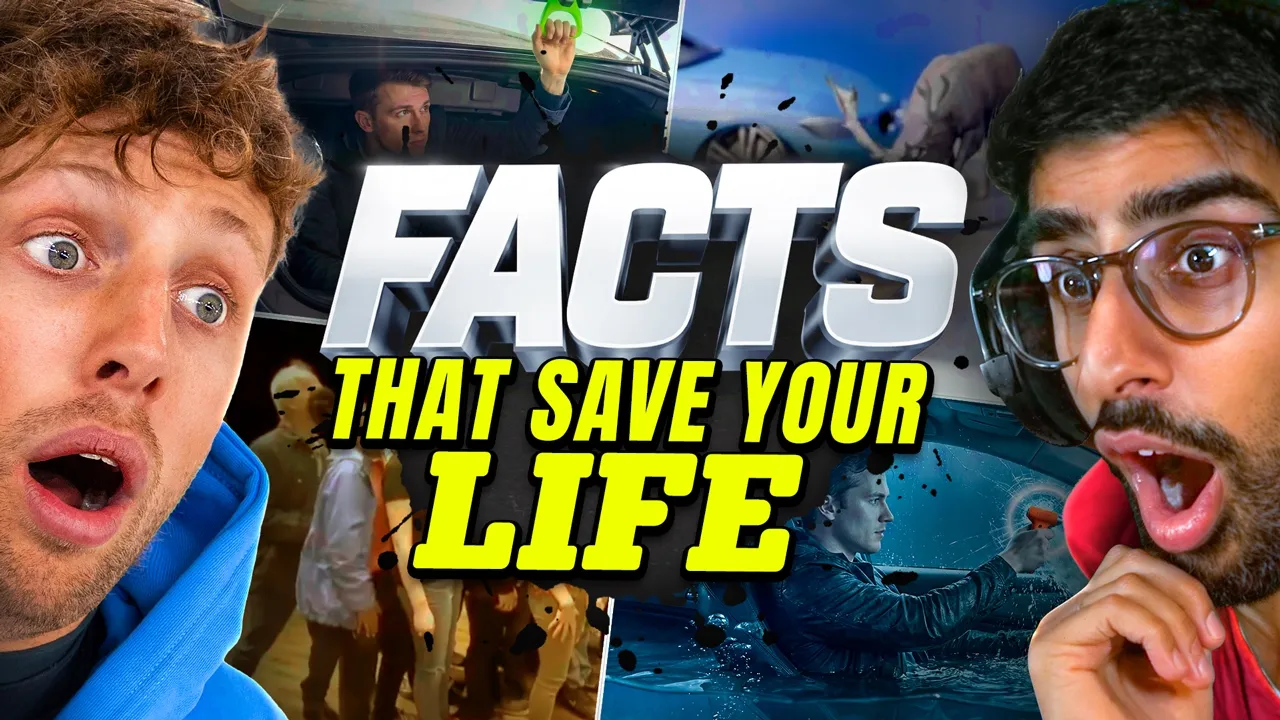
Facts That Might Save Your Life One Day
0 up · 0 down · 0 ratings
Channels and socials
What should we react to? Tell us here: forms.gle : Order food NOW at: eatsides.com : Access exclusive content at: sideplus.com : XIX Vodka: xixvodka.com : Subscribe to our Reacts Channel: youtube.com
: Sidemen Clothing: sidemenclothing.com Subscribe to our 2nd Channel: youtube.com : Sidemen Instagram: @Sidemen : Sidemen Twitter: twitter.com #SidemenReacts #Reacts
Facts That Might Save Your Life One Day dives into a rapid-fire collection of real world situations and practical tips that could influence life-or-death outcomes. The video opens with a discussion on how to survive a falling elevator, emphasizing the correct approach of lying flat to distribute impact forces and noting that jumping is counterproductive. The hosts acknowledge modern elevator safety features but still present the core survival technique as a star part of the segment, blending explanations with humorous banter and audience-friendly commentary. Throughout the episode, the duo catalogues a sequence of high-stakes scenarios, from escaping a trapped car trunk to recognizing when to break a car window during a flood, all framed with an approachable, if-fast-paced, delivery style that keeps the audience engaged while they absorb concrete steps. In the middle portions, the discussion broadens to dangerous but plausible situations such as dealing with crowds in dense venues, stabilizing yourself and others in a crush, and how to maximize chances of escape when visibility and mobility are limited. The presenters illustrate simple, memorable stances to protect the chest and lungs in crowded settings, and they recount real-life show experiences to underscore why staying calm and using space can prevent injury. They also cover more technical tips like how to identify an emergency trunk release, the correct sequence to exit a sinking car, and the importance of waiting for water pressure to equalize before breaking glass when air becomes trapped inside. These segments balance practical instruction with relatable humor, reinforcing the idea that preparedness is accessible and actionable. Towards the end, the video highlights evolving communication technologies that enhance safety, including satellite-based emergency messaging and how phones can connect to nearby emergency networks even without traditional service. The hosts connect these technologies to everyday life, noting that staying connected can be the difference between rescue and danger in remote or disaster scenarios. The closing moments reaffirm a broader message: while no single tip guarantees safety, knowing a few evidence-based responses and maintaining situational awareness can markedly improve outcomes in diverse emergencies. The overall tone blends curiosity, skepticism about common misconceptions, and a celebratory nod to human ingenuity in safety engineering, leaving viewers with a practical toolkit and the motivation to learn more about personal safety.
Topics · safety · education · emergency preparedness · entertainment · how-to · lifestyle
Questions answered
- What is the recommended position to adopt if a elevator is falling and you cannot escape in time?
- Lie flat on your back to distribute the impact force across a larger surface area, reducing the risk of severe injury.
- How should you react if your car starts sinking after a collision or rollover?
- Try to roll down windows if possible, wait for water pressure to equalize before breaking glass, and if necessary escape through the sunroof or a window after unfastening the seat belt; in some cases breaking the tail light to draw attention may help, but prioritize safe egress.
- What emergency technology can help you reach aid when there is no mobile service?
- Satellite-based emergency messaging in newer phones can send GPS location and alerts, even without cellular service, via direct links to satellites.