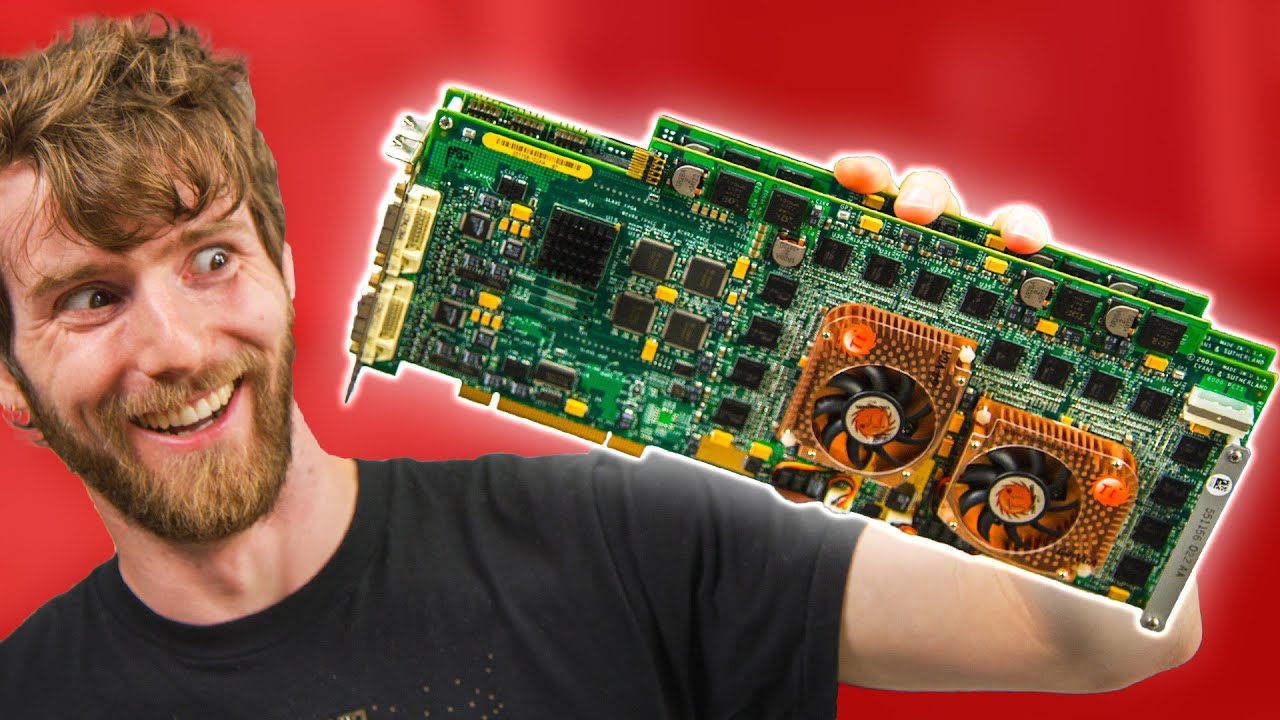
This MONSTER Video Card has 4 GPUs... and it's from 2004! - E&S SimFUSION 6500q
0 up · 0 down · 0 ratings
Promos
Evans & Sutherland aren’t a big name in computing today, but that wasn’t always the case – Meet the simFUSION 6500q, a QUAD Radeon 9800 XT GPU from 2003! Discuss on the forum: linustechtips.com ►GET MERCH: lttstore.com ►SUPPORT US ON FLOATPLANE: floatplane.com ►LTX EXPO: ltxexpo.com AFFILIATES & REFERRALS --------------------------------------------------- ►Affiliates, Sponsors & Referrals: lmg.gg ►Private Internet Access VPN: lmg.gg ►MK Keyboards: lmg.gg ►Nerd or Die Stream Overlays: lmg.gg ►NEEDforSEAT Gaming Chairs: lmg.gg ►Displate Metal Prints: lmg.gg ►Epic Games Store (LINUSMEDIAGROUP): lmg.gg ►Amazon Prime: lmg.gg ►Audible Free Trial: lmg.gg ►Our Gear on Amazon: geni.us FOLLOW US ELSEWHERE --------------------------------------------------- Twitter: twitter.com Facebook: @LinusTech Instagram: @linustech Twitch: twitch.tv FOLLOW OUR OTHER CHANNELS --------------------------------------------------- Techquickie: lmg.gg TechLinked: lmg.gg ShortCircuit: lmg.gg LMG Clips: lmg.gg Channel Super Fun: lmg.gg Carpool Critics: lmg.gg MUSIC CREDIT --------------------------------------------------- Title: Laszlo - Supernova Video Link: youtube.com iTunes Download Link: itunes.apple.com Artist Link: soundcloud.com Outro Screen Music Credit: Approaching Nirvana - Sugar High youtube.com Monitor And Keyboard by vadimmihalkevich / CC BY 4.0 lmg.gg Mechanical RGB Keyboard by BigBrotherECE / CC BY 4.0 lmg.gg Mouse Gamer free Model By Oscar Creativo / CC BY 4.0 lmg.gg
This video dives into Evans & Sutherland's SimFUSION 6500q, a remarkable graphics solution from 2003 that appears to house four GPUs on a single enclosure. The host explains that the card is a dual-layered, two-card sandwich that combines AGP and PCI interfaces, bridged together to yield a quad-GPU configuration. They detail the OpenGL-based focus of E&S's simulation hardware, and how ATI’s original designs forewent end-user Crossfire or SLI release in favor of a bespoke, enterprise-grade solution. The narrative includes insights from Layne Christensen, a former E&S engineer, who describes the hardware and the collaboration with ATI to enable multi-GPU rendering long before consumer quad setups existed. We learn about the practical constraints of the era, including the lack of multi-GPU driver support, the unique mid-board bridge, and the decision to ship the hardware to customers in rack-mounted clusters rather than as a consumer product. Finally, the video tests the card with era-correct software and benchmarks, revealing that despite its novelty, the four-GPU setup did not simply scale like modern PCIe-based multi-GPU systems and that PCI/AGP bandwidth sharing limited performance. The result is a historically rich look at a pioneering but impractical technology that foreshadowed yet was superseded by later PCIe-enabled multi-GPU ecosystems, underscoring how engineering ingenuity sometimes outpaces mainstream adoption. The four-GPU concept is framed not as a gaming powerhouse but as an enterprise-grade tool designed for synchronized render workloads across a cluster. The hosts reconstruct the configuration from Layne’s notes and the original user manual, building a test bench that mirrors the SimFUSION 6500q’s two-card, quad-GPU arrangement. They comment on the unusual BIOS behavior that restricts display modes to certain resolutions, and they explore how OpenGL rather than Direct3D defined the GPU’s software alignment. The teams attempt to run classic OpenGL titles and 3D benchmarks, acknowledging the limitations of XP-era drivers and the absence of widely available consumer-grade support. Throughout, the video emphasizes the historical significance of multi-GPU strategies that predate modern standards, while also showing the practical difficulty of keeping such a system stable and usable today. The conclusion ties the story to the rise of PCIe-based multi-GPU solutions, noting that the SimFUSION platform represents both a pinnacle of bespoke engineering and a transition point toward more standardized, scalable graphics technology.
Topics · technology · hardware · history · simulation · storage · computing · openGL · graphics
Questions answered
- What is the SimFUSION 6500q and how does it achieve four GPUs on one card?
- The SimFUSION 6500q is a quad-GPU setup built from two separate graphics cards that are bridged together with AGP and PCI connectors, effectively creating four Radeon 9800 XT GPUs linked to render workloads.
- Why was this product not sold to consumers and how was it used?
- It was an enterprise grade simulator platform, intended for rack-mounted cluster configurations rather than consumer PCs, and customers would deploy multiple nodes with synchronized rendering and outputs.
- What were the limitations of this multi-GPU arrangement?
- The system faced bandwidth and bus-sharing constraints of AGP and PCI, lacked consumer driver support for multi-GPU configurations, and required bespoke hardware integration rather than off-the-shelf solutions.
- How does this historical setup relate to modern multi-GPU technologies?
- The card demonstrates early concepts of multi-GPU rendering and synchronized output that foreshadowed later PCIe-based multi-GPU approaches, illustrating how industry moved from bespoke solutions to standardized, scalable configurations.