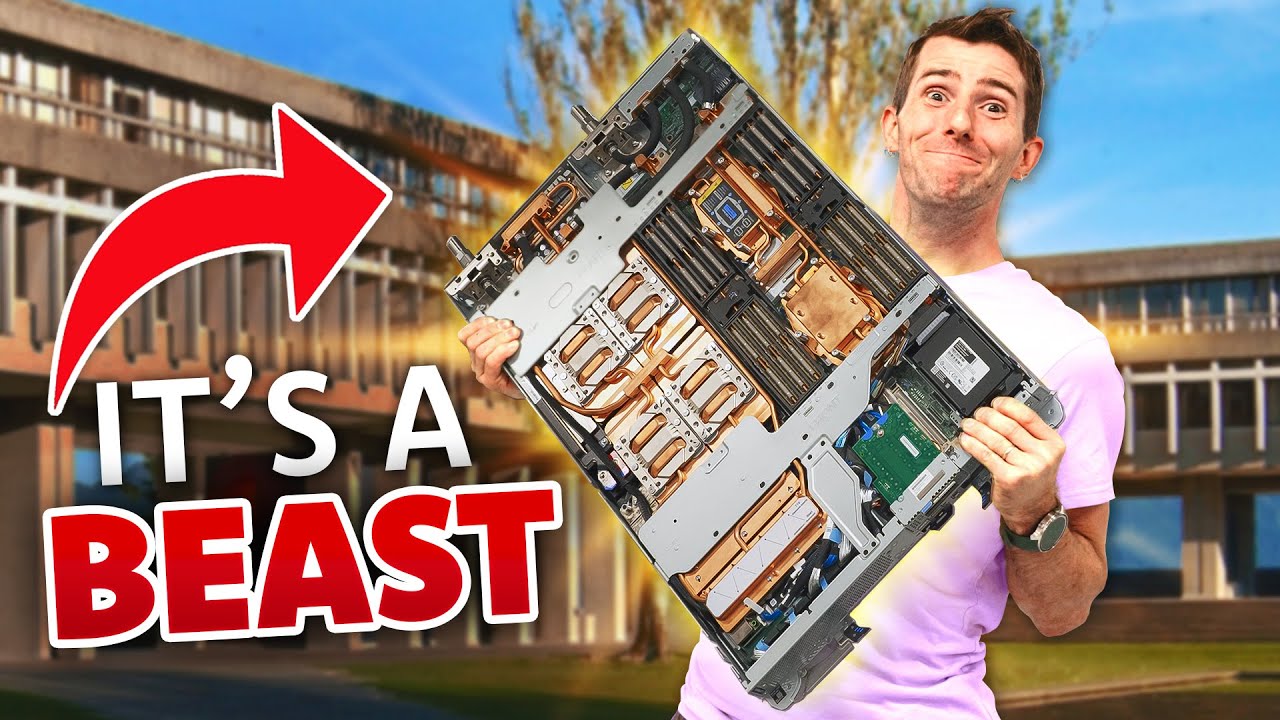
They let me take apart a SUPER COMPUTER
0 up · 0 down · 0 ratings
Description
Thanks to MSI for sponsoring this video! Head over to lmg.gg and
check out the MSI MAG B850 TOMAHAWK MAX WIFI!
Promos
Check out vessi.com to enter Vessi's October giveaway for a chance to win over $6,000 in prizes! You can also enjoy 20% off at checkout for this month only using our link! Giveaway Details: - 7 Prizes. 7 Winners. Over $6,000 in Prizes - Ends Oct 31, 2025 - Enter your email for a chance to win, no purchase necessary Dive deep into the heart of Canada's fastest academic supercomputer, this $82 CAD million powerhouse is redefining cutting-edge research in AI, genomics, and more. Join us as we go behind the scenes at Simon Fraser University's new data center, showcasing the incredible direct die liquid cooling system that achieves up to 95% heat capture. See the EPYC Genoa CPUs, 1.152TB RAM nodes, and learn how HBM3 memory delivers 3.36TB/s bandwidth. Explore the Aquatherm tubing, 600KW cooling distribution units (CDU), and massive evaporative cooling towers. We'll crack open a GPU node, reveal the intricacies of a 192-core CPU node, and uncover the networking secrets of 800Gbit NDR interconnects. Discover how 49PB of spinning rust and 2PB of NVMe storage support groundbreaking projects, including data from the Large Hadron Collider. This video uncovers the unparalleled engineering behind Canada's top supercomputing infrastructure. Get ready for an in-depth look at high-performance computing, liquid cooling, data center technology, and the future of scientific discovery! Discuss on the forum: linustechtips.com ► GET OUR MERCH: lttstore.com ► GET EXCLUSIVE CONTENT ON FLOATPLANE: lmg.gg ► GET A VPN: piavpn.com ► SPONSORS, AFFILIATES, AND PARTNERS: lmg.gg Purchases made through some store links may provide some compensation to Linus Media Group. Affiliate links powered in part by affilimate.com Linus Sebastian is an investor in Framework Computer, Inc CHAPTERS --------------------------------------------------- 0:00 Intro 1:13 Sponsor 1:38 640 Nvidia GPUs and power demands 2:25 Cracking open a liquid-cooled node 4:33 How the cooling loop works 8:27 Storage, networking, and power delivery 9:52 Touring the cooling distribution system 12:55 CPU nodes and 400-core servers 15:37 Security measures 16:12 Evap cooling towers and pumps 18:14 Who paid for all of this? 18:54 Sponsor 19:44 Credits
The video dives into Simon Fraser University’s new data center, showcasing a state of the art, liquid cooled supercomputer designed for vast HPC workloads. It begins with a broad overview of the machine’s scale, highlighting the enormous CPU and GPU density, the unique direct die liquid cooling approach, and the potential impact on AI and genomics research across Canada. The presenter then moves into the hardware specifics, revealing the use of 640 Nvidia H100 GPUs, each with 80 GB of VRAM, and the staggering 3.36 TB/s bandwidth delivered by HBM3 memory. He emphasizes that every component, from CPUs and GPUs to RAM and network interfaces, is cooled directly by a liquid-cooling loop, eliminating visible fans and enabling extreme performance. The segment transitions into a tour of the cooling infrastructure, the cooling distribution units, and the evaporative towers that make the data center resilient to heat while maintaining energy efficiency. The discussion wraps with a look at the security measures, the power delivery architecture, and the broader context of who funded and built the facility, underscoring its role in enabling groundbreaking scientific discovery and large-scale data analysis. The middle sections provide a hands-on look at a GPU node and a CPU node, detailing the internal layout, the cooling channels, and the way warm water is extracted from hot components. The host explains the anatomy of the GPU block, including the direct liquid cooling plates and the routing that feeds four GPUs per node, while noting the absence of fans and the tight integration of Lenovo’s system with Nvidia’s GPUs. They discuss the primary and secondary cooling loops, how RAM is cooled, and the clever plumbing that keeps temperatures stable across dense configurations. The narration emphasizes the high power demands and how the cooling loop is designed to manage up to roughly 700 W per GPU, illustrating the engineering trade-offs with tight bends and flow control, all while ensuring reliability through sensors and antimicrobial coolant. The CPU nodes are described as 192-core Zen 5 Epic configurations, with massive RAM and high-speed interconnects, showing how compute resources are distributed across racks and islands to achieve non-blocking bandwidth and sustain performance. Towards the end, the video examines the broader data center ecosystem: the evaporative cooling towers outside, the six-zone security setup, and the telemetry system that feeds data into Kaizen for monitoring and maintenance. The host reflects on the total budget of around 82 million Canadian dollars, the collaboration among vendors like Lenovo, DDN, and Vertiv, and the role of government and academic funding in enabling this petascale system. Viewers get a sense of the scale, from 49 PB of spinning rust to 2 PB of NVMe storage, and the potential to support large scientific endeavours including data from the Large Hadron Collider. The closing notes reiterate the fascination with high-performance computing, liquid cooling, and the future of scientific research powered by such infrastructure, inviting viewers to explore related content and sponsor offers. Overall, the video blends technical depth with accessible commentary, offering a rare, up-close look at a cutting-edge data center that blends hardware, cooling science, and real-world research impact into a cohesive, educational tour.
Topics · science and technology · data centers · high performance computing · cooling technology · artificial intelligence · research infrastructure
Questions answered
- What cooling method is used in SFU's supercomputer and why is it significant?
- The system uses direct die liquid cooling for CPUs and GPUs, significantly increasing cooling efficiency and allowing higher performance by removing heat more effectively than traditional air cooling.
- How many GPUs are in the system and what is their memory bandwidth?
- The system hosts 640 Nvidia H100 GPUs, each with 80 GB of VRAM and a bandwidth of 3.36 terabytes per second using HBM3 memory.
- What is the total estimated power demand per GPU node, and how is cooling managed?
- Each GPU node has high power demands around hundreds of watts per GPU, managed by a robust liquid cooling loop with primary and secondary circuits routed through a cooling distribution unit and evaporative towers.
- Who funded and built the facility, and what is its purpose?
- The $82 million facility is funded through a mix of government, academic, and vendor contributions, aimed at advancing AI, genomics, and other data-intensive research.