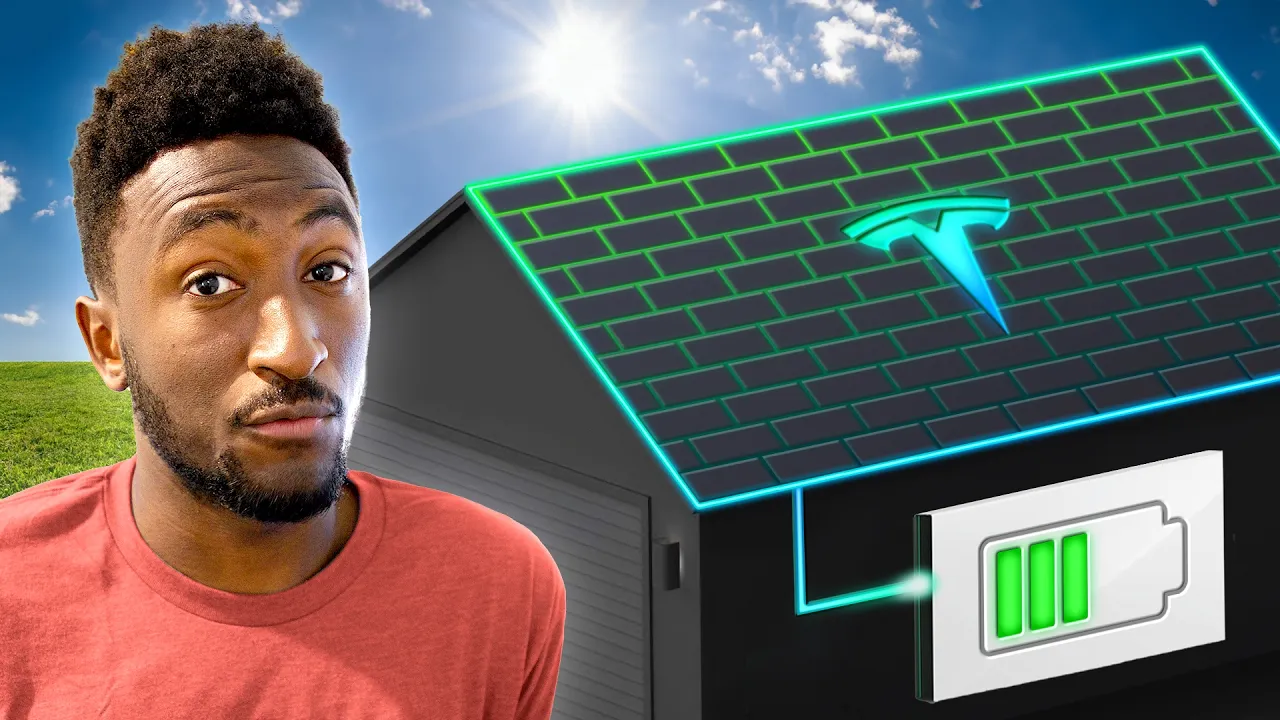
Tesla Solar Roof Review: Was It Worth It?
0 up · 0 down · 0 ratings
Promos
1 year with the Tesla solar roof Get $350 off your EightSleep Pod Cover with code MKBHD at eightsleep.com MKBHD Merch: shop.mkbhd.com Get discounts off any Tesla product with my affiliate link: ts.la The full snow falling off the roof video: youtu.be Tech I'm using right now: amazon.com Playlist of MKBHD Intro music: goo.gl ~ twitter.com @MKBHD @MKBHD 0:00 I have not paid for electricity in a year 1:15 How does solar work 4:56 Why I picked the Tesla solar tiles 7:28 Numbers/specs time! 11:06 Summer 13:01 Fall 13:59 Winter 16:25 Spring 17:17 Eight Sleep 18:39 The money question 22:35 Quirks and Features 27:11 Conclusion
The video provides a detailed, year-long deep dive into Marques Brownlee’s experience with the Tesla Solar Roof paired with Powerwalls, framed around the question: was it worth it? It begins with a primer on how solar systems work, including the role of the grid, net metering, and the difference between grid-tied solar and off-grid storage. Marques emphasizes the importance of batteries in achieving real energy independence and explains why he chose a fully integrated Tesla solution for simplicity, compatibility, and monitoring through the Tesla app. He walks through the decision to use solar tiles rather than conventional panels, highlighting aesthetics, roof preservation, and maximum roof coverage as the main drivers, even though it carried a premium price. The installation process is described in stages, from initial estimates and satellite roof assessments to measurements, quotations, and the on-site installation, noting that the actual process spanned about eight months from purchase to activation. He then shifts to the numbers, unpacking a 29.313 kW solar array with three Powerwall 3s totaling 40.5 kWh, and shows how the Tesla app visualizes real-time production, consumption, and battery state. The video dives into seasonal performance, illustrating how the system behaves in summer with high solar production and heavy air conditioning load, in fall with strong excess generation, and in winter where cloudiness and heating demand pressure the system, and how the Powerwalls buffer the day’s needs. Marques also discusses how snow, weather, and climate affect performance, including special cases like snow melt on the solar tiles and backup power during outages, and he shares practical notes about maintenance, outages, and storm readiness. Finally, he analyzes the economics, declaring an all-in cost around $120,948 before tax credits and about $93,000 after a 30 percent New Jersey solar investment tax credit, with a payback period near 9.6 to 10 years based on his yearly consumption and avoided electricity costs. He also explores the potential for shorter payback with a cheaper array, the value of full roof coverage, and the possibility of future tech like bi-directional charging from Tesla or vehicle-to-home use, while acknowledging the current bleeding-edge status and evolving economics of this system. In closing, Marques reflects on the broader implications for sustainable energy, the dream of energy independence, and the peace of mind that comes from reliable backup power, while inviting viewers to share experiences and questions in the comments.
Topics · renewable energy · solar power · home energy storage · electric vehicles · consumer technology · energy efficiency · home improvement
Questions answered
- What is the approximate total installed cost after tax credits for Marques' Tesla Solar Roof setup?
- The all-in installed cost was about $120,948 before tax credits, and after the New Jersey solar investment tax credit of 30%, the net cost came down to roughly $93,000.
- How long did the payback period estimate take according to Marques’ calculations?
- Marques estimates a payback period of just under 10 years, around 9.6 years, based on his annual 54 MWh of electricity usage and the avoided costs.