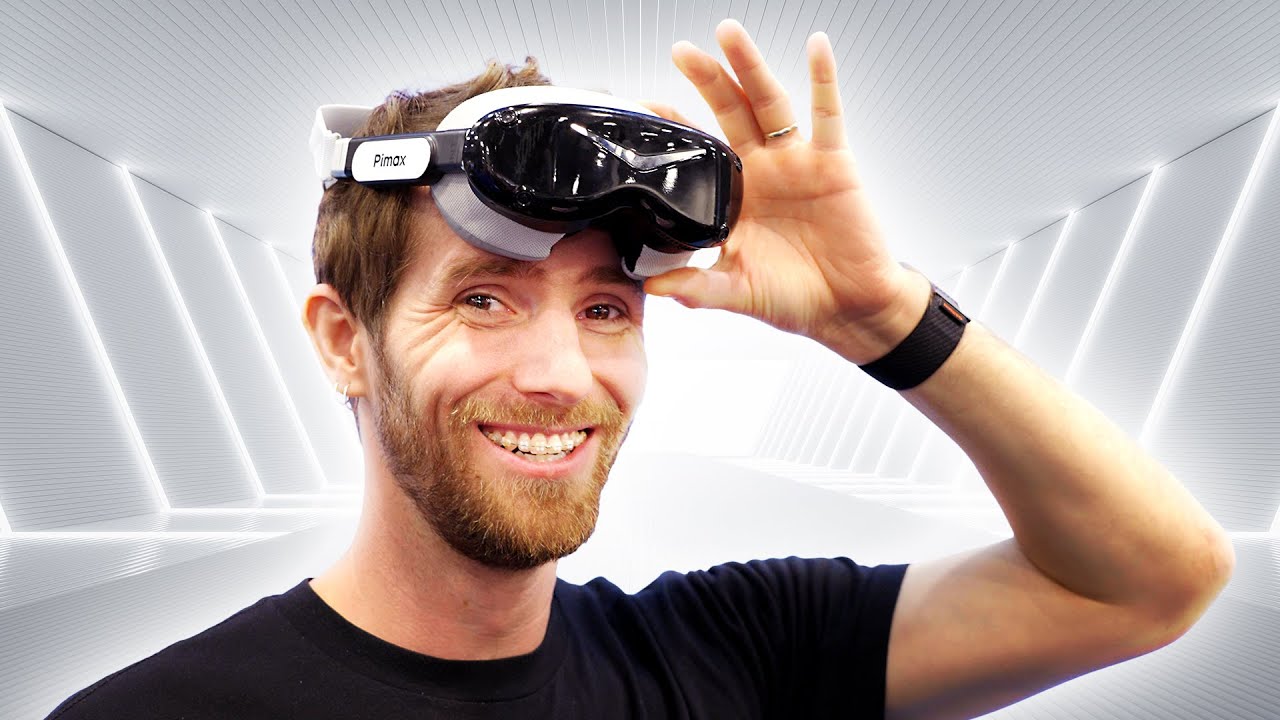
Steam Frame Image Quality is ALREADY Falling Behind - Pimax @ CES 2026
0 up · 0 down · 0 ratings
Promos
Thanks to dbrand for sponsoring our CES 2026 coverage. Buy some stickers or whatever at: emergencysponsor.com Pimax is showcasing a SICK new VR headset here at CES 2026. It's lightweight, can fit prescription lenses for us four-eyes of the world, and a resolution of 3840 x 3552 PER EYE. Oh yeah, and it has an up to 90Hz refresh rate. Want us to unbox something? Make a suggestion at lmg.gg ► GET MERCH: lttstore.com ► GET A VPN: piavpn.com ► GET EXCLUSIVE CONTENT ON FLOATPLANE: lmg.gg ► SPONSORS, AFFILIATES, AND PARTNERS: lmg.gg Purchases made through some store links may provide some compensation to Linus Media Group. Affiliate links powered in part by affilimate.com Studio lighting by Aputure: aputure.com Linus Sebastian is an investor in Framework Computer, Inc and HexOS by Eshtek. CHAPTERS --------------------------------------------------- 0:00 Newer Pimax Crystal Super 0:17 Pimax Dream Air 2:10 dbrand 2:39 It has infrared lights 3:06 Head feel 3:58 Testing it out 5:22 Other bits and bobs 6:59 Outro
The video presents Pimax’s Dream Air headset as a compact, lightweight option designed for high visual clarity, targeting PCVR with an attached cable. The host explains that the Dream Air uses the same optical engine as the larger Crystal headset but trims the form factor to under 170 grams, while retaining features like motorized IPD adjustment and magnetic lens inserts for prescription wearers. Key engineering decisions include pancake-style concave optics intended to widen the field of view to around 110 degrees and reduce glare and bloom around bright objects. The host highlights that the display resolution is a native 3840 by 3552 per eye, with two displays and relevant cooling via dual fans to support sustained performance at up to 90 Hz. Display stream compression is used to achieve high refresh rates without upscaling, preserving native resolution and image fidelity. The lenses are presented as a major differentiator, with real-world testing showing strong sharpness for reading gauges and buttons, and notable improvements in glare reduction compared to prior pancake implementations. Additional practical aspects discussed include a split cable design for reduced head movement strain, standard USB-C for connectivity, and modular anchor points for alternative strap configurations, reflecting Pimax’s intent to cater to a range of user preferences and use cases. The host also touches on future options for tracking, noting Valve’s base station changes and Pimax’s plan to offer lighthouse-style and front-camera inside-out tracking variants, ensuring continued versatility across different tracking ecosystems. The segment closes with a casual look at the user experience and a nod to the ongoing evolution of Pimax’s hardware lineup, emphasizing a balance between weight, optical performance, and practical features for a premium PCVR experience.
Topics · technology · virtual reality · hardware · electronics
Questions answered
- What is the native per-eye resolution of the Dream Air and how does it relate to upscaling in the headset?
- The Dream Air uses a native resolution of 3840 by 3552 per eye, and the headset relies on display stream compression to achieve high refresh rates without performing inside-headset upscaling.
- What lens technology does the Dream Air use and what are the claimed benefits?
- The Dream Air uses concave pancake lenses designed to maintain a wide field of view around 110 degrees and reduce glare and bloom near bright objects, improving overall image quality.