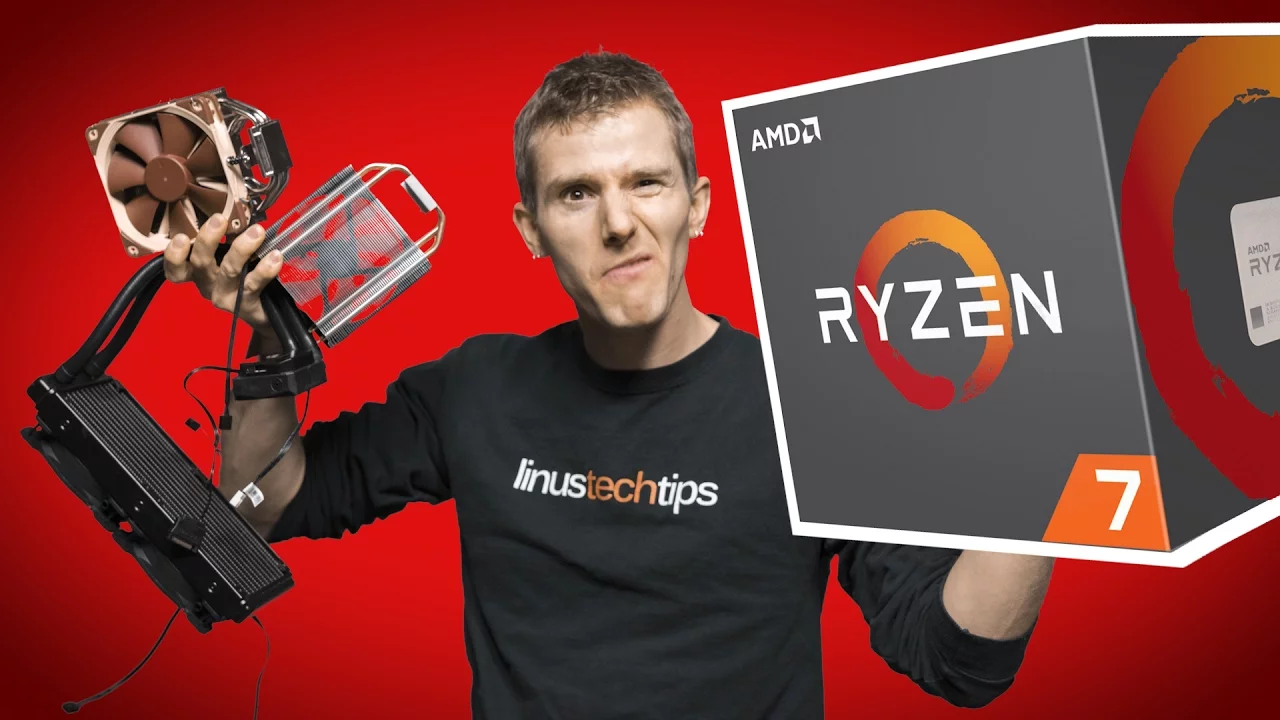
OVERCLOCKED AMD RYZEN 7 PERFORMANCE GUIDE
0 up · 0 down · 0 ratings
Promos
AMD Ryzen 7 overclocking discussion and guidelines. Get the most performance out of your CPU! Save 10% on G-FUEL using offer code LINUS at geni.us Android G-FUEL App: play.google.com iOS G-FUEL App: itunes.apple.com Buy Ryzen 7 gear on Amazon: Ryzen 7 1700X: geni.us ASUS Crosshair VI Hero: geni.us Buy Ryzen 7 gear on Newegg: Ryzen 7 1700X: geni.us ASUS Crosshair VI Hero: geni.us Discuss on the forum: linustechtips.com Our Affiliates, Referral Programs, and Sponsors: linustechtips.com Linus Tech Tips Merch Store: designbyhumans.com Linus Tech Tips Posters: crowdmade.com twitter.com @LinusTech Intro Screen Music Credit: Title: Laszlo - Supernova Video Link: youtube.com iTunes Download Link: itunes.apple.com Artist Link: soundcloud.com Outro Screen Music Credit: Approaching Nirvana - Sugar High youtube.com Sound effects provided by freesfx.co.uk
The video opens by addressing the enthusiasm around AMD Ryzen and sets the premise that unlocked multipliers on Ryzen 7 CPUs allow for potential performance gains, albeit with caveats. The host explains that you can use any motherboard with an AMD X370 or B350 chipset to explore overclocking, and notes that Ryzen’s automatic turbo features can complicate manual tuning because Precision Boost and XFR lock in both clock and voltage once you begin adjusting settings. The guide then walks through practical steps for a non X-series chip, focusing on a 1700X to determine if saving money by avoiding the higher-end 1800X is viable through overclocking. The segment contrasts simple multiplier changes with base clock adjustments, highlighting that base clocks can affect other system frequencies and that Ryzen’s memory subsystem strongly influences stability and performance. Practical recommendations are given about motherboard features like AI Overclock Tuner and DOCp profiles, while warning that RAM compatibility and timing control remain critical factors for real-world gains. By the end of the initial analysis, the host consolidates the plan to test a 1700X at higher clocks and measure outcomes with a 1080Ti in a standard Ryzen bench setup, aiming to quantify whether the 1700X can approach the 1800X in performance. The middle portion delves into the hands-on overclocking process. The video demonstrates setting a CPU core ratio of 40 and Vcore around 1.375V in the BIOS, achieving a stable 4.0 GHz on the 1700X, a noticeable improvement over stock speeds but still shy of a full 4.1 GHz target under all conditions. It discusses the limits of Ryzen overclocking, noting that pushing voltage too high yields diminishing returns, with 1.375V presenting a sweet spot for air cooling and 1.35V often being used with higher-end cooling solutions. The guide emphasizes that memory speed and timings play a crucial role, highlighting that RAM rated for Ryzen generally benefits from higher speeds but that many modules available at the time are tuned for Intel platforms, requiring manual timing adjustments to reach the best stability. Additional BIOS knobs such as Vtt, memory termination, and skew settings are described, though the presenter counsels caution and acknowledges that some advanced options may not yield meaningful performance improvements. In the final analysis, the host reports temperature data across multiple cooling solutions, noting temps around the low 80s Celsius under load for air coolers and substantially cooler results with an AIO setup. The 4.0 GHz overclock on the 1700X is shown to produce competitive performance in both synthetic benchmarks and real gaming scenarios, often approaching or matching the 1800X and occasionally rivaling mid-range enthusiast CPUs in performance per dollar at 1080p. The narrative draws a parallel to historical CPU eras, suggesting that while Ryzen did not deliver a dramatic overclocking leap akin to older architectures, the combination of a reasonable overclock and balanced pricing offered a compelling option for a broad audience of gamers and creators. The conclusion reiterates that users can expect solid gains with careful tuning, but caution is advised due to platform variability, RAM dependence, and the evolving BIOS landscape, leaving viewers with actionable steps and the sense that Ryzen overclocking remains a practical, if nuanced, path to better performance without breaking the bank.
Topics · hardware · overclocking · performance-analysis · computer-parts
Questions answered
- What is the safe Vcore sweet spot for a Ryzen 1700X when overclocking with air cooling?
- About 1.375 V was found to be the sweet spot for high-end air cooling in this guide.
- Can a 1700X overclock to 4.1 GHz reliably without aggressive cooling or risky voltage?
- Stable 4.0 GHz was achievable, but 4.1 GHz depended on cooling and silicon quality, and further voltage increases did not always yield meaningful gains.