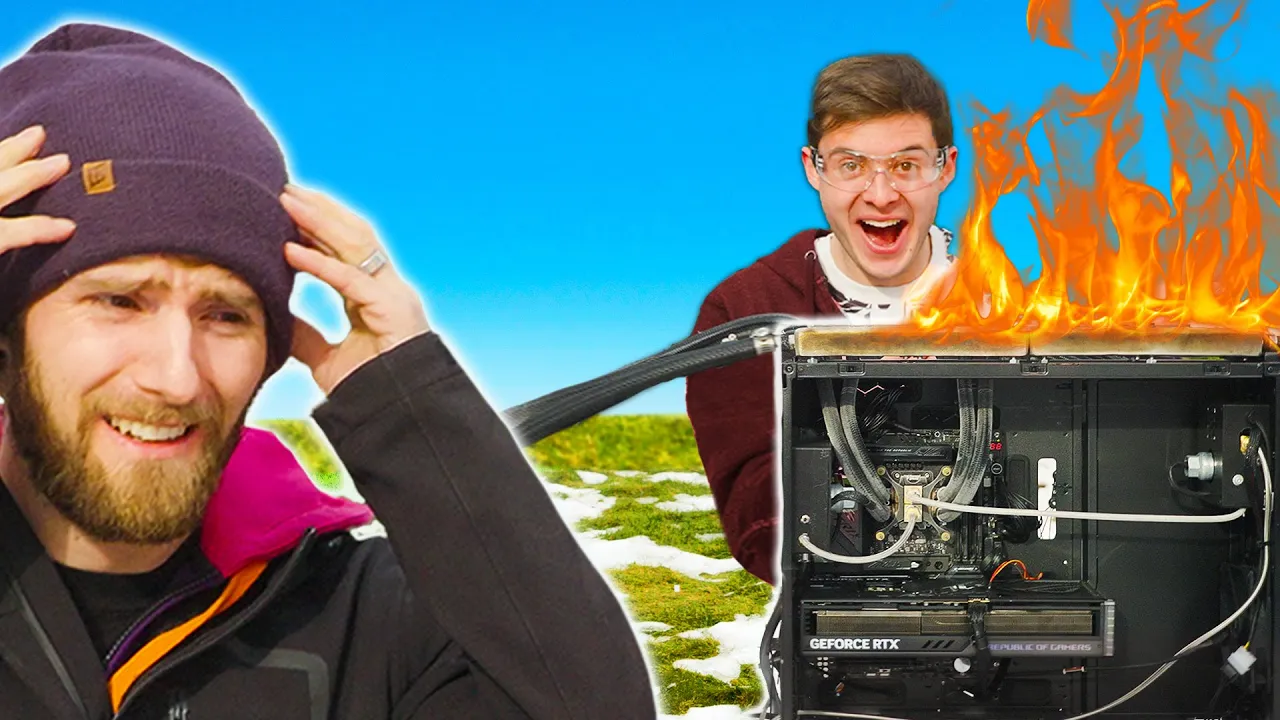
We Cooled a Computer with FIRE - Hacksmith Collab
0 up · 0 down · 0 ratings
Description
Get Exclusive NordSecurity deals here ➼ nordsecurity.com All products are risk-free with Nord's 30-day money-back guarantee! The Radeon RX 7900 XTX and XT are advanced graphics cards for gamers and creators for under $1000. Click on the link to learn more: amd.com
Promos
Check out Hacksmith's video building the cooler!! - youtu.be The Hacksmith are here and they want to subzero cool a computer using..... Fire??? Yes that is correct, by using liquid propane this computer should be wicked fast. Discuss on the forum: linustechtips.com Purchases made through some store links may provide some compensation to Linus Media Group. ► GET MERCH: lttstore.com ► SUPPORT US ON FLOATPLANE: floatplane.com ► AFFILIATES, SPONSORS & REFERRALS: lmg.gg ► PODCAST GEAR: lmg.gg FOLLOW US --------------------------------------------------- Twitter: twitter.com Facebook: @LinusTech Instagram: @linustech TikTok: @linustech Twitch: twitch.tv MUSIC CREDIT --------------------------------------------------- Intro: Laszlo - Supernova Video Link: youtube.com iTunes Download Link: itunes.apple.com Artist Link: soundcloud.com Outro: Approaching Nirvana - Sugar High Video Link: youtube.com Listen on Spotify: spoti.fi Artist Link: youtube.com Intro animation by MBarek Abdelwassaa @mbarek_abdel Monitor And Keyboard by vadimmihalkevich / CC BY 4.0 geni.us Mechanical RGB Keyboard by BigBrotherECE / CC BY 4.0 geni.us Mouse Gamer free Model By Oscar Creativo / CC BY 4.0 geni.us CHAPTERS --------------------------------------------------- 0:00 Intro 0:56 Simple Setup 3:34 More Complex Setup 9:05 Braving the Winter 9:39 Hit It 11:40 A terrible idea 12:15 How It Works 13:10 Marshmallows 15:14 Outro
This collaboration pulls off one of Hacksmith’s most audacious cooling experiments by attempting to subzero cool a high end PC using propane flames. The setup starts with a simple, apparent two-part system: a liquid propane feed that cools the electronics in an inline expander, and then a flame expander that creates visible heat while the propane gas helps pull heat away from the CPU. The team demonstrates a baseline test with a standard cooling configuration, then progressively ramps up to more aggressive cooling arrangements, including external voltage control and multi-radiator mounting. They also introduce safety measures such as a fire extinguisher and deliberate checks to avoid direct liquid propane contact with critical components. The narration and on-screen teamwork emphasize practical engineering tradeoffs, like condensation management, dielectric protection, and bracket design to fit heavy cooling hardware onto a consumer motherboard. Overall, the episode blends high entertainment value with genuine engineering experimentation as the crew pushes beyond conventional cooling methods while tracking performance with Cinebench scores and thermal behavior. The video underscores that while flames can boost heat transfer, there are significant safety and reliability concerns that limit practical usage in everyday PCs, even as spectators enjoy the spectacle and the learning opportunity from the process.
Topics · science & technology · engineering · experimentation · hardware · collaboration · extreme cooling
Questions answered
- What is the basic principle behind the propane based cooling used in the setup?
- Propane is expanded and evaporated inside the cooling loop, absorbing heat from the CPU, and then returned as a gas that is vented; the process relies on the cold liquid propane to draw heat away from the CPU before it is burned in the flame expander for visualization.
- What hardware components were cooled in this experiment?
- The build features an Intel i9-13900K processor, a Strix Z790 motherboard, and a GeForce RTX 4090 GPU, with additional cooling hardware including dual radiator assemblies and a flame expander to increase heat transfer.
- What safety measures were in place during the test?
- A fire extinguisher was kept nearby, dielectric protection and careful insulating materials were used, and the team monitored for condensation and overheating to prevent unintended ignition or equipment damage.
- What was the outcome in terms of performance during the test run?
- Baseline Cinebench scores were achieved before aggressive tuning, and then both CPU frequency and score increased under the flame assisted cooling, with the system reaching multi-gigahertz operation, though at times triggering thermal or safety related warnings and requiring careful control.