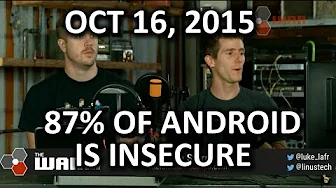
The WAN Show - 87% of Android Devices are "Insecure" - October 16, 2015
0 up · 0 down · 0 ratings
Promos
linustechtips.com Sponsors! Lynda.com Link: lynda.com for a 10 day free trial Squarespace: squarespace.com offer code LINUS to save 10%. TunnelBear: tunnelbear.com - Browse privately and get your first 500MB for free! Logitech: geni.us - G633 headset Soundcloud Link: soundcloud.com Timestamps courtesy of JJMC89 and Sam Tilling. 00:09:52 - University of Cambridge finds that 87% of Android devices are insecure 00:14:15 - Microsoft on Windows 10 Mobile: We "will decide when to send the updates out" 00:18:38 - IPhone 6S 'Chipgate' 00:33:15 - Latest Nvidia drivers to be locked behind Geforce Experience 00:39:50 - Tesla cars can drive themselves (October 15) 00:43:20 - AMD Q3 revenue report & news 00:45:00 - Intel reports a profit decrease 00:46:05 - "PC Does What" campaign wants you to upgrade 00:49:36 - Bell Canada gets slapped for fake App Store reviews 00:53:15 - Sponsor: Logitech 00:55:20 - Sponsor: Squarespace 00:58:20 - Sponsor: TunnelBear 01:00:55 - Uber takes on Postmates with Uber-rush 01:06:50 - Build logs 01:11:20 - Skarp Lazer Razor pulled off Kickstarter 01:15:00 - SuperMHL is on it's way with 8K support 01:16:10 - DiCaprio buys film rights about VW scandal 01:20:00 - Apple updated peripherals 01:22:50 - Humble Bundle lets go of 20% of it's staff 01:24:45 - AMD's Phil Rogers leaves after 21 years
The WAN Show episode from October 16, 2015 covers a wide range of technology topics with a focus on mobile security, platform updates, and hardware discussions. The hosts begin by addressing their production schedule and recent moving efforts, sharing how they buffered content and planned upcoming videos. They tease several major topics and sponsor segments, including a ruggedized tablet from Dell and a high curiosity item about a water-resistant touchscreen. The format then shifts into a rapid-fire news segment, where the hosts anticipate a multi-part deep dive into ongoing tech issues and industry trends. This episode establishes a cadence of brisk topic shifts, each anchored by Linus and Luke’s commentary and banter. The opening also frames the show as a return to a buffered content schedule after a hectic moving period, signaling a renewed production rhythm. They hint at upcoming content in the Tech Yard and a dual-headed gaming box, illustrating their ongoing hardware projects and testing philosophy. The first major topic is a university study asserting that 87% of Android devices are insecure due to update fragmentation, a point they unpack with nuance around OEM and Nexus update responsibilities. The segment explains that Nexus devices tend to be the most secure due to Google's direct control over updates, while broader Android devices suffer from inconsistent update policies. They discuss the two-year security update window and the realities of carrier plans, which frequently lag behind in delivering timely patches. The hosts contrast security update practices across Android, iOS, and Windows 10, highlighting the centralization strategy of Apple and Microsoft as a potential advantage for device security. They emphasize Android's flexibility as a double-edged sword: it enables manufacturer customization but complicates timely, universal security updates. The discussion delves into the practical implications for consumers, such as the risk of using older devices within contract cycles that no longer receive security updates. They connect these security concerns to real-world exploits that have made headlines, underscoring the urgency of reliable patch delivery. The conversation then pivots to a broader stance on how Google, OEMs, and carriers should respond, with a preference for centralized, carrier-independent update mechanisms. They compare this Android update challenge to Apple’s iOS and Microsoft’s Windows update models, noting the potential security benefits if Android could adopt a more centralized approach. The panel explores the tension between device manufacturers’ profit margins and the obligation to support devices post-sale, arguing that deeper, earlier updates require either better economics for manufacturers or higher device prices. They acknowledge the real-world complexity of upgrading existing large device fleets and the trade-offs involved for major Android players like Samsung. The discussion broadens to user experience enhancements across Android OEMs, praising features such as Motorola’s quick camera launch and LG’s clipboard tray as examples of beneficial but non-security-related improvements. They mention how such OEM-level innovations can coexist with robust security, provided updates remain timely. The Microsoft update story is revisited, with details from the Windows Insider program and carrier collaboration, illustrating a model where operators contribute to update timing while Microsoft maintains control over distribution. The hosts argue that Windows Mobile could gain traction if security updates were timely and predictable, with insider feedback and operator input shaping the release cadence. The segment then transitions to a critique of marketing and product narratives around chip fabrication, using the iPhone 6s chipgate controversy as a focal point. They explain the concept of multi-sourcing for processors and how chip fabrication nodes (14nm vs 16nm) from TSMC and Samsung can affect battery life and performance, based on third-party tests. They compare lab tests with real-world usage and discuss the variance in battery life observed by different testers, noting that no single test perfectly captures everyday device behavior. The hosts stress that even within the same manufacturer, chip yields and binning can yield noticeable differences in performance and power consumption. They address Apple’s dual sourcing strategy for the A9 chip and how independent tests have shown slight battery life advantages for one supplier in certain scenarios. They caution against oversimplified conclusions from single tests and encourage viewers to consider broader testing contexts, including real-world usage and multiple test methodologies. The conversation touches on the broader issue of device reviews and how the presence of different production processes can influence perceived performance, while also acknowledging potential reviewer influence or testing bias. They debate consumer expectations around advertising and actual performance, suggesting that price and choice often determine how consumers react to perceived discrepancies between marketing and reality. They reflect on personal experiences with battery life and whether to return devices based on post-purchase performance, noting that Apple’s return policy can mitigate some risk but cannot guarantee a perfect match to expectations. The WAN Show continues with a deeper dive into Nvidia’s driver distribution strategy, where game-ready drivers are increasingly gated behind GeForce Experience and a sign-up requirement, provoking a critique of the added friction for end users. They acknowledge Nvidia’s rationale for consolidating driver updates while also recognizing the frustration with the extra steps required to access the latest software. The discussion includes a debate about the impact of such practices on enthusiast users, the balance between convenience and features, and how AMD’s competitive positioning affects Nvidia’s strategies. The hosts compare the software delivery approach to the hardware cadence, arguing that driver distribution decisions can influence consumer buying behavior and perceived value. They conclude with broader reflections on how aggressive product roadmaps and software strategies shape the user experience and market dynamics in PC hardware. The episode closes with teasers for upcoming content on the Vessel platform and other projects, and a quick recap of previously discussed topics, leaving viewers with a sense of ongoing, rapid innovation in the tech landscape. Throughout, the hosts maintain their characteristic blend of technical insight, humor, and candid discussion about industry practices, consumer experience, and the future of device security and updates.
Topics · technology · cybersecurity · mobile · hardware · cars
Questions answered
- What was the main security claim about Android devices discussed on the show?
- The hosts discussed a University of Cambridge study claiming that 87% of Android devices are insecure due to update fragmentation and inconsistent security updates across OEMs.
- What is chipgate in relation to the iPhone 6s?
- Chipgate refers to the controversy around which fabrication plants (TSMC vs Samsung) produced Apple's A9 processors and how this could affect battery life and performance.
- Why do some viewers criticize Nvidia GeForce Experience for driver downloads?
- Viewers criticized the requirement to use GeForce Experience and provide an email address to access game-ready drivers, calling it time-consuming and invasive.