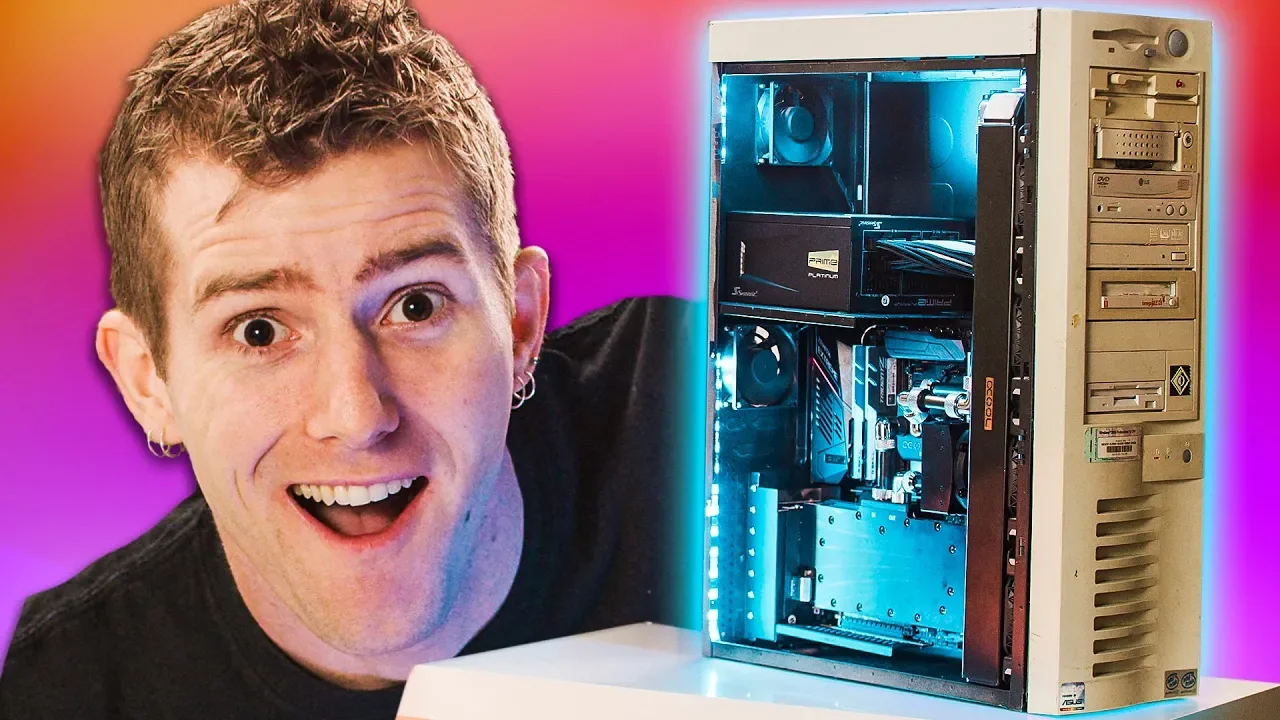
The ULTIMATE Powerhouse Sleeper PC
0 up · 0 down · 0 ratings
Description
Thanks to Seasonic for sponsoring this build!
Promos
Check out their power supplies at: lmg.gg Buy a Seasonic Power Supply On Amazon: geni.us On Newegg: geni.us Margaret, oh Margaret. Potentially the build that caused the most stress ever, taking over a month to complete due to every step having loads of strange complications. But in the end.. oh she's a beauty. CAD files for those that are interested: grabcad.com Discuss on the forum: linustechtips.com Our Affiliates, Referral Programs, and Sponsors: linustechtips.com Get Private Internet Access today at geni.us Linus Tech Tips merchandise at lttstore.com Linus Tech Tips posters at crowdmade.com Our Test Benches on Amazon: amazon.com Our production gear: geni.us Twitter - twitter.com Facebook - @LinusTech Instagram - @linustech Twitch - twitch.tv Intro Screen Music Credit: Title: Laszlo - Supernova Video Link: youtube.com iTunes Download Link: itunes.apple.com Artist Link: soundcloud.com Outro Screen Music Credit: Approaching Nirvana - Sugar High youtube.com
The video opens with a clear objective to build the ULTIMATE sleeper PC, a project that pushes both gaming power and workstation capabilities while staying true to the sleeper aesthetic. The host introduces the sponsor, Seasonic, and presents the Prime Platinum 1300 watt power supply as a core, reliable backbone for the build, emphasizing silence and long-term durability. We see a rapid-fire overview of ambitious goals: to cram high-end hardware into a nontraditional chassis, and to explore extreme cooling challenges that would keep the system stable under heavy workloads. Early on, the team reveals their target components, such as the Threadripper 2990X and an RTX 2080 Ti, and they outline the plan to support both gaming performance and workstation-grade workloads with multi-threaded tasks like rendering. The mood is a mix of excitement and caution as they acknowledge that this build is a personal milestone that forced them to rethink chassis design and cooling architecture. The opener closes with a promise to push the limits of air cooling first, before committing to water cooling and custom fabrication. As the project unfolds, the team dives into major layout decisions, including whether the water chiller would physically fit inside the case. They salvage and repurpose hardware from a previous project, and they carefully measure and adjust the chassis to accommodate a complex cooling loop. The narrative foregrounds the engineering challenges: bending copper tubes, designing a bracket for a vertical GPU mount, and crafting a back panel to hide cables. They experiment with aluminum CNC fabrication, initially attempting a vintage, service-chassis aesthetic and then pivoting to a more refined, modern execution. The segment emphasizes problem solving, from porting the cooling system to ensuring the motherboard and CPU could be mounted securely without sacrificing accessibility. Throughout, the team interleaves playful banter with the seriousness of the build, underscoring both the artistry and the meticulous engineering required. Midway, the focus shifts to the water cooling hardware and aesthetic decisions, including the use of carbon fiber tubing, Acetal blocks, and a stealthy blacked-out look. They document mounting challenges, leak testing, and iterative fixes such as replacing inner o-rings to seal carbon fiber fittings properly. The crew candidly discusses the frustrations of leaks and misfits, highlighting how every small fitment decision impacts reliability. As the build progresses, they demonstrate how careful alignment simplifies the hard-line routing and reduces potential failure points, while also showing off their custom mounting solutions and cable management tricks. The video culminates in a dramatic set of final tests and a triumphant overclock, with Cinebench and Blender benchmarks illustrating a performance lead over typical high-end laptops. Viewers are left with a sense of accomplishment and a respect for the craft, as the Marg argaret sleeper PC proves capable of gaming at 1440p 144 Hz and delivering workstation-grade throughput under sustained load. The closing moments celebrate the finished machine, acknowledge sponsor support, and invite viewers to explore further through links and merch. The finale recaps the performance milestones, noting Cinebench scores around 6,000 points with 4.1 GHz overclock across all 32 cores, and Blender BMW test times on the order of 1 minute 22 seconds. They compare Margaret’s performance to a modern laptop, underscoring the remarkable multi-core efficiency and thermal headroom achieved with careful tuning and cooling. The team emphasizes that the sleeper PC can game at high settings while also handling demanding rendering tasks, effectively blurring the line between a desktop workstation and a gaming rig. They attribute the success to disciplined assembly, precise cable management, and the robust power delivery from the Seasonic PSU. The video closes with thanks to sponsors and a call to action to like, subscribe, and check out affiliate links, while acknowledging the project’s long, stressful journey and ultimate fulfillment. Margaret is celebrated not just as a pretty case, but as a powerhouse capable of real, practical performance under load.
Topics · computing · pc-build · hardware · overclocking · water-cooling
Questions answered
- What CPU and GPU power the Margaret sleeper PC and why were they chosen?
- The build uses a Threadripper 2990X for its 32 cores and 64 threads to maximize multi-threaded workloads, alongside an Nvidia RTX 2080 Ti for strong gaming performance. They were chosen to balance high-end gaming with workstation-grade tasks such as rendering.
- What cooling approach is used and what challenges did the builders face?
- The team explores air cooling initially, then transitions to a water cooling system with carbon fiber tubing. They face fitting challenges inside a large chassis, leaking issues with carbon fiber fittings, and alignment problems that affect routing and accessibility.
- How was the chassis prepared to accommodate the water loop?
- A vertical GPU mount bracket was designed to free space behind the card for the pump and tubing, and a CNC-fabricated aluminum holder was built to manage cables. They also modified the front case to improve radiator airflow and mounted a radiator, reservoir, and related components.
- What were the final performance results shown for Margaret?
- Margaret achieves about 6,000 Cinebench points with a 4.1 GHz all-core overclock, Blender BMW render in 1 minute 22 seconds, and maintains CPU temperatures around 75 degrees under load while gaming at 1440p 144 Hz.