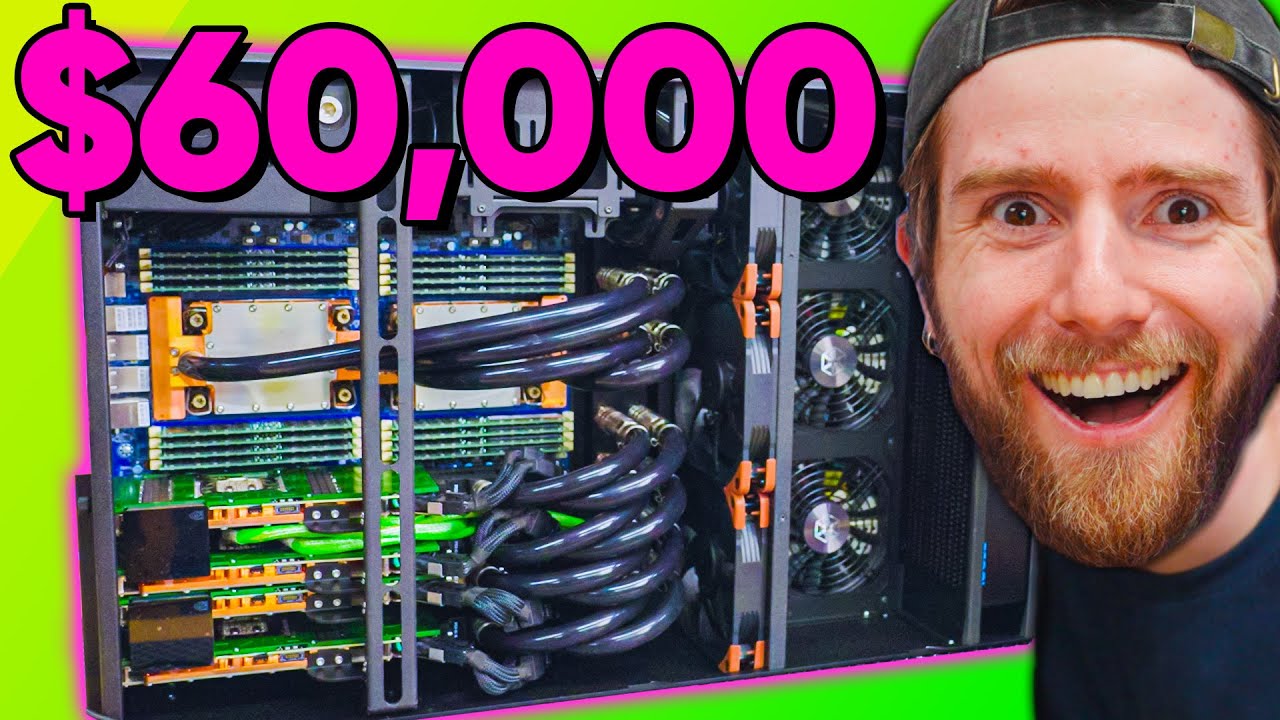
The God of Computers - Comino Grando RM
0 up · 0 down · 0 ratings
Description
Receive a $25 credit for Ting Mobile today when you sign up at linus.ting.com
Check out SignalRGB and sync all your RGB peripherals at bit.ly In today's video two idiots play with over $60,000 of computer parts. Discuss on the forum: linustechtips.com
Promos
Check out the Comino Grando RM: lmg.gg Purchases made through some store links may provide some compensation to Linus Media Group. ► GET MERCH: lttstore.com ► AFFILIATES, SPONSORS & REFERRALS: lmg.gg ► PODCAST GEAR: lmg.gg ► SUPPORT US ON FLOATPLANE: floatplane.com FOLLOW US --------------------------------------------------- Twitter: twitter.com Facebook: @LinusTech Instagram: @linustech TikTok: @linustech Twitch: twitch.tv MUSIC CREDIT --------------------------------------------------- Intro: Laszlo - Supernova Video Link: youtube.com iTunes Download Link: itunes.apple.com Artist Link: soundcloud.com Outro: Approaching Nirvana - Sugar High Video Link: youtube.com Listen on Spotify: spoti.fi Artist Link: youtube.com Intro animation by MBarek Abdelwassaa @mbarek_abdel Monitor And Keyboard by vadimmihalkevich / CC BY 4.0 geni.us Mechanical RGB Keyboard by BigBrotherECE / CC BY 4.0 geni.us Mouse Gamer free Model By Oscar Creativo / CC BY 4.0 geni.us CHAPTERS --------------------------------------------------- 0:00 Intro 1:01 Unboxing 5:12 Opening and Powering it up 7:17 The internals 8:47 Powering it up - Take 2 9:37 Linus breaks it (again) 10:01 It lives! 10:43 Benchmarking 13:46 Insane results 16:18 4-way SLI?! 18:00 Swappability 18:55 Ting Mobile and Conclusion
The video opens with Linus and the team introducing a high-end workstation build that is claimed to be the second fastest server they have ever handled. They highlight that this machine is designed for scientific applications and machine learning, and it features water cooling and a multi-GPU setup. The hosts note the shipment came in two large wooden crates and describe a level of complexity that goes beyond typical consumer hardware, emphasizing a heavy emphasis on cooling infrastructure and custom components. They also tease the branding of Comino Grando RM and discuss the practicalities of mounting a system with rack-friendly design, including the potential to place it on a desk due to its cooling layout. Throughout the unboxing segment, the team references the scale of the project, comparing it to a petabyte-scale storage effort nearby and joking about the cost and the luxury nature of the build, while repeatedly transitioning into the technical specifics of the cooling loop and chassis design. The atmosphere remains light and humorous, balancing awe at the hardware with curiosity about how it will perform in tests. As they dive into the internals, the crew identifies the core components, noting six GPUs and dual Xeon processors, with discussion about NVLink compatibility and the possibility that the GPUs might be A6000 class, alongside the question of pricing and availability. They examine the custom water-cooling distribution plate, multiple power supplies, and the unusual cabling arrangements that come with a machine designed for extreme compute workloads. The team spends time on assembly details, including how the system is designed to be rack-mountable but also potentially desk-friendly due to its cooling approach, and they marvel at the heavy-duty radiator configuration that uses multiple fans and a Delrin distribution plate to manage heat across devices. The segment also covers the branding touches from Comino, the modularity of the components, and the overall sense that this is a very specialized, purpose-built system rather than a generic workstation. The tone remains exploratory yet amused as Linus and Alex narrate each discovery, including the moment they realize how compact and contained the coolant loop appears relative to the bulk of the hardware. In the benchmarking portion, the team runs Cinebench on the system and reports impressive results highlighting the CPU multi-core performance and the substantial graphical processing throughput. They observe that the CPUs deliver strong multi-threaded performance, with notes about core counts and memory configurations that could justify the scale of the build. The GPU benchmarking includes V-ray CUDA rendering and Blender renders, with surprising findings about power usage and heat dissipation, including a dramatic readout of nearly 2000 watts during peak GPU load and a radiator that becomes hot to the touch. They experiment with four-way NVLink or SLI configurations and test swapping GPUs to demonstrate ease of replacement and coolant pre-fill, while acknowledging some driver and compatibility caveats for four-way configurations in practice. The results reveal the system's remarkable render speed, with moments where Blender renders complete in surprisingly short times, reinforcing the idea that this machine is specialized for rapid, large-scale rendering tasks. The segment closes with reflections on the practicality of such a machine for real-world workloads and the sponsor break introducing Ting Mobile, alongside a nod to further high-end builds suggested by the hosts. Overall, the video blends spectacle with technical curiosity, celebrating extraordinary hardware while candidly showing the challenges of testing and validating a system at the edge of consumer and enterprise capabilities. The hosts communicate both admiration and humor, acknowledging that while the machine is impressive, it is not a practical everyday PC for most viewers. The dialogue repeatedly touches on the balance between performance, power draw, cooling, and cost, and it leaves the audience with a clear takeaway: this is a showcase of what extreme compute hardware can accomplish when engineered for professional workloads, even as the casual tone and banter keep the content accessible and entertaining.
Topics · technology · hardware · computing · server-workstation · benchmarking
Questions answered
- What makes the Comino Grando RM workstation notable for machine learning workloads?
- It combines multi-GPU capability with advanced water cooling and a high-end Xeon CPU setup to enable intensive rendering and scientific computing, offering high RAM and VRAM capacities and a distribution block for efficient cooling across devices.
- How many GPUs and CPUs are present in the system, according to the video?
- The system is described as having six GPUs and dual Xeon Platinum 8368Qs.
- What is a key feature that the presenters highlight about the cooling system?
- The custom Delrin distribution plate and the multi-heat-source liquid cooling loop are highlighted as a core feature for managing heat across GPUs and CPUs.
- Did the four-way GPU configuration perform reliably during testing?
- The team observed some driver and stability issues with four-way NVLink/SLI configurations, including a crash, indicating that driver support and compatibility can be a challenge for such setups.