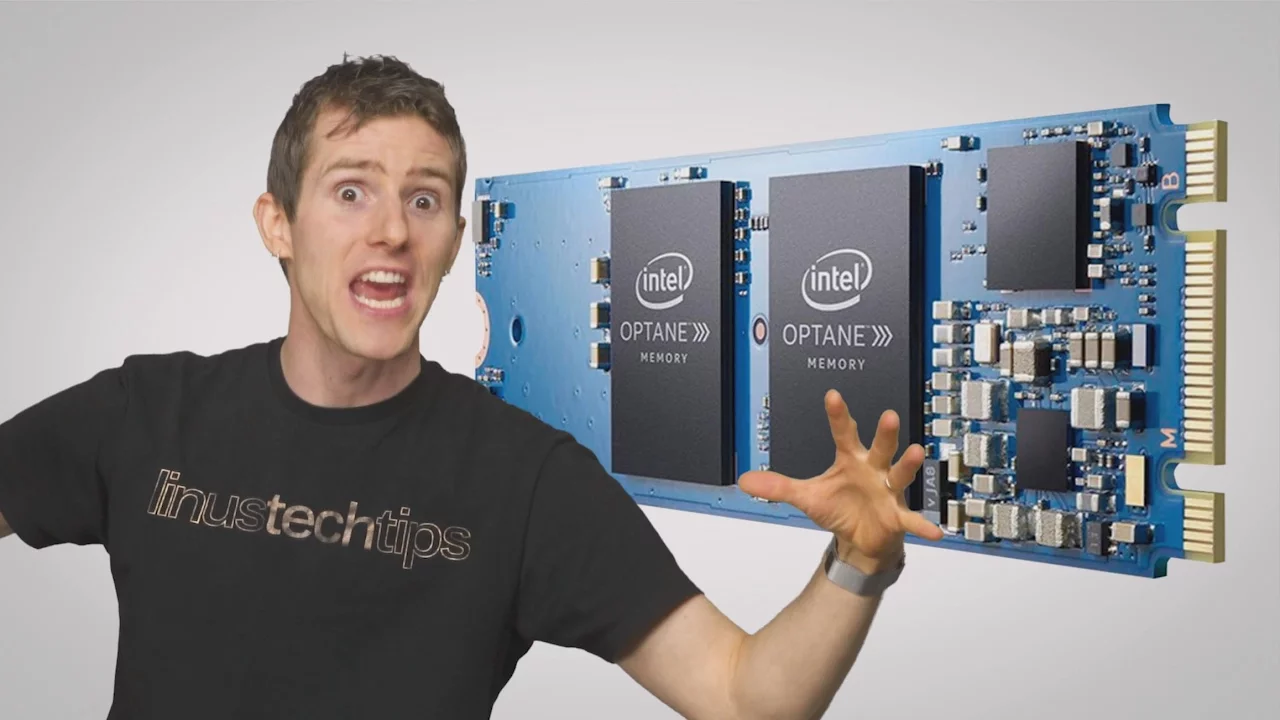
What is Intel Optane?
0 up · 0 down · 0 ratings
Promos
Intel Optane is a new storage technology that can be used as either a super-fast SSD or additional system RAM! Learn all about it right here. Squarespace link: Visit squarespace.com and use offer code TECHQUICKIE to save 10% off your first order. Techquickie Merch Store: designbyhumans.com Techquickie Movie Poster: shop.crowdmade.com Leave a comment with your requests for future episodes, or tweet them here: twitter.com Follow: twitter.com Join the community: linustechtips.com Image at 3:58 credit Julian Herzog. Used with permission under Creative Commons Attribution 4.0 International.Julian Herzog. Used with permission under Creative Commons Attribution 4.0 International. creativecommons.org
Intel Optane is presented as a fundamentally different storage technology designed to address the bottlenecks of traditional NAND flash. The video explains that NAND flash, while common and fast for an SSD, has age-old limitations that impede handling large numbers of simultaneous requests, which are increasingly important for cloud services and data centers. Optane is introduced as based on 3D Cross Point, offering lower latency than conventional storage while delivering higher data density, enabling it to function as either fast system memory or higher-capacity nonvolatile storage. The host explains that Optane does not replace mechanical hard drives immediately, but its nonvolatile nature means data is retained without power and it outperforms even the fastest NAND-based SSDs on small, random reads and writes. The discussion covers latency, quality of service, and transaction throughput, highlighting how Optane maintains performance under heavy I/O loads, which is especially valuable for servers and cloud workloads. The video notes consumer uses, including an M.2 Optane cache that accelerates frequently accessed data by transparently caching OS files and save games, and clarifies platform requirements such as Intel Kaby Lake or newer CPUs and specific chipsets. Finally, the host speculates about future interconnects and protocols that could fully exploit Optane’s potential and mentions that powerful storage solutions may eventually be available as PCIe based drives or U.2 options, with some caveats about power and thermal constraints for high-capacity models.
Topics · technology · storage · computer-hardware · cloud-computing · servers · nonvolatile-memory
Questions answered
- What is the main advantage of Intel Optane over traditional nand-based storage?
- Intel Optane offers lower latency and higher data density, enabling faster access and the ability to function as either fast memory or high-capacity nonvolatile storage, with better quality of service under heavy load.
- Can Optane replace a hard drive in consumer PCs?
- Not immediately; Optane complements existing drives and can accelerate a mechanical hard drive via cache, but does not replace hard drives as a general rule.