I Solved Nvidia's Melting 5090 Problem...But YOU Shouldn't
0 up · 0 down · 0 ratings
Promos
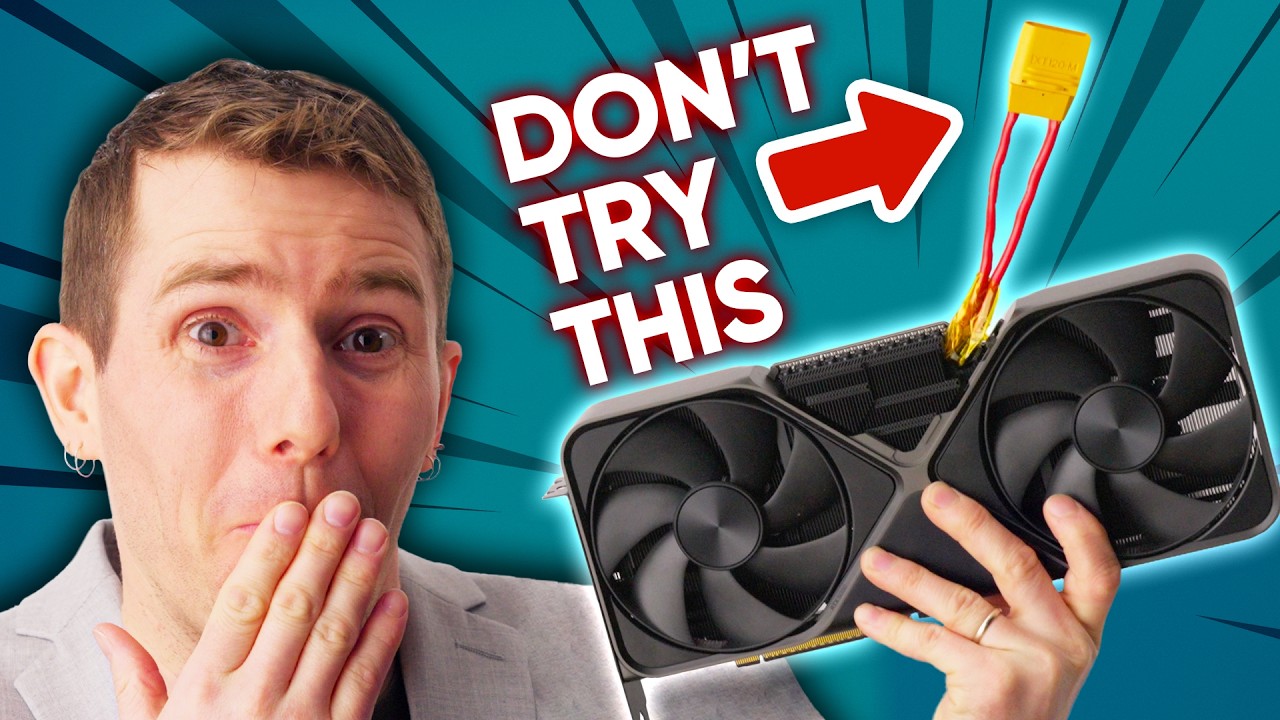
Visit squarespace.com and use offer code LTT for 10% off Get the most out of your graphics card and monitor with Silkland's VESA certified DisplayPort 2.1 cables using our links! Silkland DP80 Cables: lmg.gg Silkland Store: lmg.gg It’s no wonder GeForce RTX 50-series Founder’s Edition power connectors are melting, what with nVidia insisting on using tiny little connectors, and THEN making matters worse by wiring them up in a way sure to make an electronics engineer cringe. We joked on the WAN show that someone should just use an XT60 connector to solve the problem! Then helpful viewer erg142 reminded us that we make videos where we do stupid things like that all the time, so here we are. Thanks erg142! For more on the 12VHPWR connector,
check out this reddit post: reddit.com Discuss on the forum: linustechtips.com Buy a NVIDIA RTX 5090 graphics card: geni.us Buy XT120 60A Large Current Battery Connectors: geni.us ► GET OUR MERCH: lttstore.com ► GET EXCLUSIVE CONTENT ON FLOATPLANE: lmg.gg ► GET A VPN: piavpn.com ► SPONSORS, AFFILIATES, AND PARTNERS: lmg.gg Purchases made through some store links may provide some compensation to Linus Media Group. CHAPTERS --------------------------------------------------- 0:00 Intro 1:35 THAT's the plan? 3:23 Here's the problem... 6:36 This might be tricky 9:10 I'm sorry you have to see this 11:40 PSU Mods? 13:06 Beep Equals Bad 14:09 It keeps getting worse 15:25 I can't watch, you guys are on your own... 21:00 Credits
I Solved Nvidia's Melting 5090 Problem...But YOU Shouldn't walks viewers through a hands-on engineering workaround for the GeForce RTX 5090 power connector meltdown issue. The video opens with a historical framing: Nvidia introduced new 12VHPWR variants across recent generations, culminating in the 12V 2x6 design on the 5090 that appears to overheat under less-than-ideal conditions. The host then outlines a bold plan to replace the problematic connector with a commodity XT120, arguing that the standard’s design and manufacturing costs favored thinner conductors and a single point of failure. The team emphasizes that their approach is a proof-of-concept and not a consumer recommendation, while repeatedly acknowledging the inherent risks of modifying high-power GPU hardware. They perform feasibility steps, including a CT scan to diagnose how the stock connector fails under load, and a series of careful modifications to wire and reattach sense pins. The video chronicles the build, the challenges of soldering and crimping, and the test bench results, concluding that their modified setup is safer than the original in their lab context, while also highlighting real-world constraints such as warranty risk and safety concerns. Finally, the host discusses broader industry implications, including cost pressures and the potential for per-pin monitoring in certain boards like ASUS's Astral variants, and closes with a plug for Squarespace while reflecting on the limits of their experiment and the responsibility to viewers.
Topics · technology · hardware · gaming · gpu hardware · safety · electronics · manufacturing · industry trends
Questions answered
- What is the core problem with Nvidia's 12VHPWR/12V2x6 connector on the RTX 5090 as discussed in the video?
- The core problem is that the stock 12V2x6 connector uses a single power rail design with a shared contact strip, making it difficult for the card to detect a poor connection in individual pins, which can cause extra pins to overheat and melt under high load.
- What modification does the video experiment propose to address overheating?
- The video proposes replacing Nvidia's 12V2x6 connector with a commodity XT120 connector, effectively using two larger conductors to carry the load and improve mechanical and electrical robustness.
- Is the modification presented as a general recommendation for all RTX 5090 owners?
- No, the modification is presented as a proof-of-concept and lab demonstration, not a safe or recommended practice for typical users, due to safety, warranty, and reliability concerns.
- What testing method is used to validate the modification?
- The team performs a CT scan to observe how the stock design behaves, then reassembles and tests the modified wiring while monitoring GPU temperature, power draw, and stability during a benchmark.
- What broader implications do they discuss beyond the specific hardware hack?
- They discuss industry cost pressures, the move toward single-rail power designs, and the potential for per-pin monitoring or alternative implementations from other manufacturers, suggesting Nvidia’s design choices were partly cost-driven.