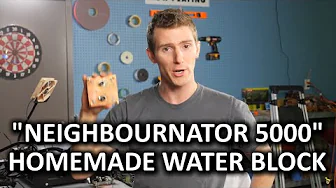
Homemade Water Block Review - My Scrapyard Wars 2 Cooling Solution!
0 up · 0 down · 0 ratings
Promos
Is making your own water block feasible? I decided to test that out using my Scrapyard Wars 2 water block made on my neighbor's CNC machine. Squarespace link: squarespace.com and use offer code LINUS to save 10% off your first purchase. Logitech link: linustechtips.com Pricing & discussion: linustechtips.com Support us: linustechtips.com Join our community forum: bit.ly twitter.com @LinusTech Intro Screen Music Credit: Title: Laszlo - Supernova Video Link: youtube.com iTunes Download Link: itunes.apple.com Artist Link: soundcloud.com Outro Screen Music Credit: Approaching Nirvana - Sugar High youtube.com
The video documents Linus Tech Tips' process of evaluating a DIY water block built during Scrapyard Wars 2, aimed at cooling a high-end CPU. The host begins by recapping the motivation behind the project, noting that the previous Scrapyard Wars 2 build mixed metals and used a copper coil which might have influenced cooling results. He compares the homemade block to a commercially available EK Supremacy MX block, explaining the test rig, the motherboard clearance considerations, and the mixed-metal construction choices made for ease of fabrication. The assembly sequence is shown in detail, including a bolt-through mounting method, the need to avoid over-tightening to protect the motherboard, and the temporary nature of the bench test with a test reservoir to catch spills. As the install proceeds, he also shares a surprising side update about new Noctua fans arriving for a future radiator upgrade. The testing phase follows with idle temperatures around 29 to 33 Celsius, and a stress test using Ida64 to observe load temps, which settle in the mid-50s, suggesting the homemade design struggles to beat a commercial block under load. The comparison continues as he swaps to the EK Predator for a direct performance matchup, noting that the DIY unit initially trails by about 6 degrees and that the gap is likely to widen with higher processor heat output, reinforcing the conclusion that the DIY water block, while inventive, is not a practical replacement for a professional solution. Ultimately, the host concludes that the DIY approach is a commendable effort but not worth the time, cost, and corrosion risk when weighed against a commercial block, and he broadens the takeaway to acknowledge that DIY cooling has fallen out of fashion in recent years. The video then pivots to a plug for Squarespace, tying the project to content creation and showcasing how viewers can build their own sites with templates, support, and starter plans, before closing with calls to action to like, subscribe, and join the community forum. The overall message emphasizes experimentation and learning, with a candid assessment that selling the concept as a practical thermal solution is not advisable for most builders, but the project remains a fun exploration of DIY hardware design and as a storytelling vehicle for the channel.
Topics · hardware · do-it-yourself · pc hardware · reviews · technology · science_and_tech · cooling · computing
Questions answered
- What was the main purpose of building a homemade water block in Scrapyard Wars 2?
- The main purpose was to evaluate whether constructing a DIY water block could provide adequate cooling and potentially outperform a commercially available block, given the time and resources invested in the build.
- What were the key factors affecting the DIY block's cooling performance?
- Key factors included the metal choice and mixing, the base plate and fin channel optimization, mounting pressure on the CPU, and how well the flow paths were designed inside the block.
- How did the DIY block compare to a commercial block under load in this test?
- Under load, the DIY block lagged behind the commercial block by about 6 degrees Celsius initially, and the gap was expected to widen as heat output increased.