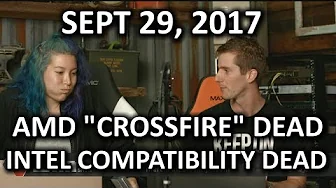
AMD Killing Crossfire! Intel Killing Compatibility! - WAN Show September 29, 2017
0 up · 0 down · 0 ratings
Promos
For your unrestricted 30 days free trial, go to freshbooks.com and enter in “The WAN Show” in the how you heard about us section. Use offer code LTT to save 10% on Savage Jerky at geni.us Forum link: linustechtips.com Soundcloud link: soundcloud.com Timestamps by JJMC89. 00:03:45 - CrossFire brand being phased out 00:16:31 - New Polaroid camera 00:23:30 - Microsoft Teams replacing Skype for Business 00:28:31 - SNES Mini uses the same hardware as the NES Mini 00:35:33 - Sponsor: Freshbooks 00:36:42 - Sponsor: Savage Jerky 00:47:12 - New Amazon Echos 00:53:58 - USB 3.2 spec published 00:58:54 - Swollen iPhone 8 Plus batteries 01:00:37 - Razer confirms development of gamer-oriented mobile device 01:05:53 - Elon Musk wants to use his rockets for transportation on Earth Timestamps by Beezohh 3:42 - AMD killing Crossfire 12:00 - WeChat confirms that it makes all private user data available to the Chinese government 16:37 - Polaroid's New Camera 23:36 - Microsoft officially kills off Skype for Business 28:37 - SNES Mini is just an updated NES Mini? 35:33 - Sponsor: Freshbooks 36:48 - Sponsor: Savage Jerky 47:39 - Amazon announced SIX new Hardware Products 54:00 - USB group announces USB 3.2 1:00:42 - Razer Confirms Development of Gamer-Oriented Mobile Device
The WAN Show episode from September 29, 2017 opens with a lighthearted host banter and a preview of the topics to come, setting the stage for a broad hardware and tech discussion. The first major topic tackles AMD’s branding shift away from Crossfire, explaining how multi-GPU implementations are being rebranded rather than eliminated, and how DirectX 12 and Vulkan introduce new paradigms for multi-GPU rendering that rely more on game developers than on proprietary card-level hacks. The discussion covers how historically Crossfire and SLI required game support or driver workarounds, and why the industry may be moving toward a developer-driven, API-based approach for multi-GPU usage going forward. The panelists debate the practicality and effectiveness of multi-GPU setups in modern titles, noting that only a handful of games have strong mgpu support and that benchmarks often serve as marketing rather than representative experiences. The conversation lines between the hosts and guests explore how this branding change signals broader industry trends rather than a clean technical discontinuity, highlighting the shift from brand-specific solutions to more standardized, API-based support. The second thread focuses on consumer electronics news, including a Polaroid camera revival and the SNES Mini’s hardware equivalence to the NES Mini, framing each as an example of resurgence in classic tech with modern twists. The team also touches on Microsoft Teams replacing Skype for Business, emphasizing the strategic positioning of Teams to compete with Slack and the implications for corporate communications ecosystems. Sponsor segments punctuate the show, including FreshBooks, emphasizing the value of simple invoicing for small businesses, and Savage Jerky, offering a lighthearted palate cleanser between tech takes. Throughout the broadcast there are frequent banter and on-screen jokes among Linus, Luke, James, and Max, balancing technical depth with fan-friendly humor and personal anecdotes about gear, cameras, and pop culture. In later segments the hosts dive into USB 3.2 specification announcements and the broader USB ecosystem, considering how new standards affect peripheral design and compatibility across devices. The WeChat privacy discussion introduces a global data governance angle, with Linus outlining the Chinese government’s data access policies and the potential personal privacy implications for hundreds of millions of users. The show then returns to hardware conversations with the Polaroid camera’s renaissance, including a debate about the practicality and cultural appeal of instant film in 2017, and a mock setup exploring modern instant photography workflows via phone-linked printers. As the program progresses, the crew evaluates Microsoft’s Skype for Business strategy, detailing Teams’ feature set such as calls, voicemail, and interoperability, and weighing the risk of customer lock-in versus improved collaboration features. The SNES Mini debate returns, with a close look at whether Nintendo is updating the shell while reusing core hardware, and whether this strategy satisfies nostalgia while balancing production realities and regulatory processes. The episode closes with renewed sponsorship plugs and a final poll mechanic, inviting audience input on topics like Nintendo nostalgia and hardware refresh cycles, while the team keeps up the rapid-fire cadence and humor that fans expect. Overall, the WAN Show provides a multi-faceted snapshot of late-2010s tech culture, weaving together GPU technology, consumer devices, enterprise software, policing of personal data, and retro gaming nostalgia with a signature mix of humor and practical insight. The show demonstrates how tech discourse travels across hardware realities, software ecosystems, and consumer-facing products, without losing sight of the community and personalities that drive Linus Tech Tips content. By the end, viewers are left with a nuanced understanding of multi-GPU viability in modern games, the evolving landscape of collaboration tools, and the ongoing appeal of classic gaming hardware wrapped in current tech narratives.
Topics · technology · gaming · business and productivity · consumer electronics
Questions answered
- What is the core idea behind AMD rebranding of Crossfire and mgpu
- AMD is moving away from the Crossfire brand, reframing multi-GPU support as mgpu and aligning it with newer APIs like DirectX 12 and Vulkan that enable developers to implement multi-GPU rendering in a more standardized way.
- How does DirectX 12 change multi-GPU usage compared to DirectX 11
- DirectX 12 shifts multi-GPU responsibilities toward game developers, allowing more flexible, in-game orchestration of multiple GPUs rather than relying on driver- or hardware-specific crossfire/sli bridges.
- Why is the SNES Mini discussion relevant to the WAN Show audience
- The SNES Mini topic highlights nostalgia-driven hardware revivals and how modern production realities influence classic hardware re-release decisions, including shell updates and regulatory considerations.
- What is the stance on Skype for Business and Microsoft Teams
- Microsoft is transitioning from Skype for Business to Teams, offering new collaboration features, voicemail, and interoperability while winding down the Skype branding over a defined period.