Ultimate Overclocked Hackintosh Workstation Build Guide
0 up · 0 down · 0 ratings
Channels and socials
I'd like to begin by thanking the folks in the Hackintosh community who made this possible Rampage Dev - x79 Development Conti - myHack Slice - Bootloader and other development Netkas - FakeSMC Rampage Dev in particular was amazing throughout the process and very helpful in setting us on the right path in terms of component selection and installation of the necessary software. It's my understanding that he does consulting work on projects like this, and you can reach him at his blog: rampagedev.wordpress.com Sponsor link: linustechtips.com Pricing & discussion: linustechtips.com Support us: linustechtips.com Join our community forum: bit.ly twitter.com @LinusTech Intro Screen Music Credit: Adhesive Wombat -
Check out his channel here: youtube.com Outro Screen Music Credit: Approaching Nirvana - Sugar High youtube.com The Zero Punctuation episode we referred to: youtube.com
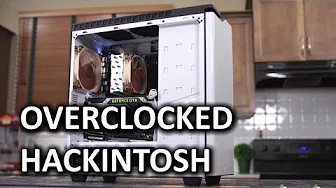
The video presents a detailed, hands-on guide to building a high-performance Hackintosh workstation designed to rival a Mac Pro in raw performance and quiet operation, but at a much lower cost. It begins by outlining core motivations for choosing a Hackintosh over buying an Apple machine, including price competitiveness, upgradability, and the ability to tailor hardware for sustained performance. The presenters explain the rationale behind their component choices, highlighting a six-core Core i7 4930K, a 64 GB DDR3 RAM kit, and a Gigabyte X79 motherboard as a package that balances performance, overclocking headroom, and compatibility with macOS Mavericks. They emphasize careful hardware selection, noting potential pitfalls with video card firmware revisions and motherboard BIOS updates that can complicate Hackintosh setups. The video then shifts to practical steps, starting with preparing boot media using a Mac, installing Mavericks with MyHack, and applying motherboard-specific drivers (DSDT/SSD patches) to enable essential features like bootloading and audio. Throughout, the presenters stress testing and tuning, including power management aspects, to approach the Mac Pro’s performance while acknowledging that some Mac Pro-specific features, such as Thunderbolt, may be sacrificed or require additional tinkering. By the end of the guide, they compare benchmark results to Marcus Brownlee’s Mac Pro review to illustrate the near-parity in raw performance and discuss real-world tradeoffs such as storage strategy, networking, and future expansion via PCIe. The overall message is that a well-chosen Hackintosh can deliver high performance, expandability, and lower cost, with the caveat that it requires ongoing tweaking and community support. The presenters also reflect on the broader Hackintosh community and the value of guidance from experienced builders, inviting viewers to engage and share their own configurations and improvements. Finally, they invite further discussion on whether such a rig should be used in a professional context or kept as a high-end enthusiast setup.
Topics · Technology · Computer Hardware · Tutorials · Science & Technology
Questions answered
- What was the main motivation for building a Hackintosh workstation rather than buying a Mac Pro?
- The main motivations were cost savings, upgradability, and the ability to tailor hardware for similar performance at a lower price, especially when considering overclocking and PCIe expansion.
- Which core components were selected for the build and why?
- A six-core Core i7 4930K, 64 GB of DDR3 RAM, a Gigabyte X79 motherboard, a GTX 780 GPU, and an SSD were chosen to balance performance, compatibility, and future upgrade potential while keeping noise and power usage reasonable.
- What is a key caveat when building a Hackintosh as described in the video?
- Hackintosh builds require careful hardware selection, firmware and BIOS considerations, and ongoing tweaks, with some features like Thunderbolt or advanced CPU power management potentially not working out-of-the-box.
- How do the builders assess performance relative to a real Mac Pro?
- They benchmark against a Mac Pro review and show that, in raw performance, a well-configured Hackintosh can approach Mac Pro levels at a fraction of the cost, though it is not an exact apples-to-apples comparison due to form factor and feature differences.