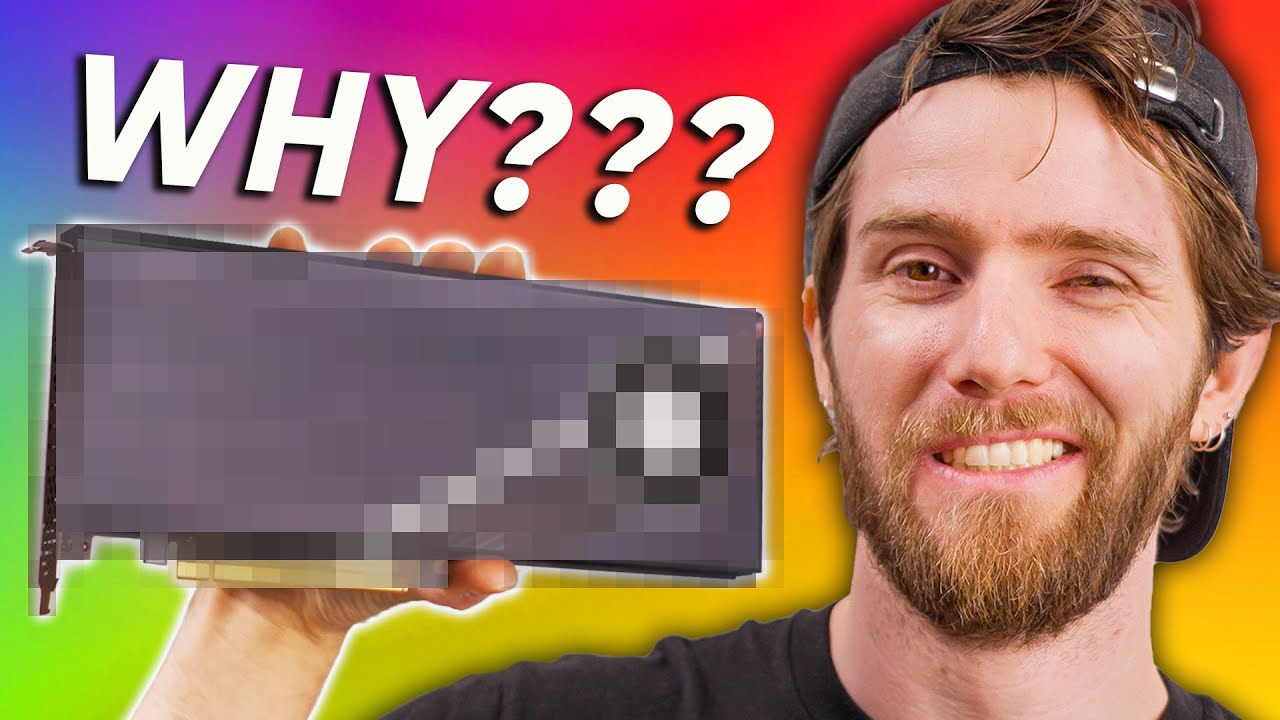
I Make Questionable Choices Sometimes... - Linus Personal Rig Update Early 2023
0 up · 0 down · 0 ratings
Description
Check out SignalRGB and sync all your RGB peripherals at bit.ly Linus hasn't gone all AMD in YEARS, but now that AM5 and RDNA 3 are here it's time for a change. There's just a few problems to sort out first, like the RAID card he HAD to use, and the custom loop that has already changed since he built it. Discuss on the forum: linustechtips.com Buy a SABRENT Rocket Q 8TB NVMe PCIe M.2 SSD: geni.us Buy an AMD Ryzen 9 7950X Processor: geni.us Buy an ASRock X670E PG Lightning Motherboard: geni.us Buy an EK-Quantum Velocity2 D-RGB AM5 Full Nickel Water Block: geni.us
Promos
Visit squarespace.com and use offer code LTT for 10% off
Check out the EK-Quantum Vector² RX 7900 XTX D-RGB AMD Radeon Edition: lmg.gg Buy an ASRock Thunderbolt 4 AIC: geni.us Buy an OWC 10G Ethernet PCIe Network Adapter Expansion Card: geni.us Purchases made through some store links may provide some compensation to Linus Media Group. ► GET MERCH: lttstore.com ► LTX 2023 TICKETS AVAILABLE NOW: lmg.gg ► GET EXCLUSIVE CONTENT ON FLOATPLANE: lmg.gg ► SPONSORS, AFFILIATES, AND PARTNERS: lmg.gg ► OUR WAN PODCAST GEAR: lmg.gg FOLLOW US --------------------------------------------------- Twitter: twitter.com Facebook: @LinusTech Instagram: @linustech TikTok: @linustech Twitch: twitch.tv MUSIC CREDIT --------------------------------------------------- Intro: Laszlo - Supernova Video Link: youtube.com iTunes Download Link: itunes.apple.com Artist Link: soundcloud.com Outro: Approaching Nirvana - Sugar High Video Link: youtube.com Listen on Spotify: spoti.fi Artist Link: youtube.com Intro animation by MBarek Abdelwassaa @mbarek_abdel Monitor And Keyboard by vadimmihalkevich / CC BY 4.0 geni.us Mechanical RGB Keyboard by BigBrotherECE / CC BY 4.0 geni.us Mouse Gamer free Model By Oscar Creativo / CC BY 4.0 geni.us CHAPTERS --------------------------------------------------- 0:00 Intro 1:35 The Raid Card 4:45 The CPU 6:10 The Motherboard 8:03 The CPU Cooler 9:50 The Memory 12:04 We Figured It Out 13:50 Water Cooling Montage 14:50 The GPU 15:55 The Thunderbolt Card 17:45 The Network Card 18:40 Will It Boot? 20:00 Conclusion 21:44 Outro
Linus presents a highly ambitious personal rig update that frames a bold shift in platform choice and component strategy as early 2023 hardware evolves. He begins by acknowledging past missteps, including a cramped storage setup and a nontraditional RAID approach, and explains why he is downgrading in some areas to pursue a more sensible overall configuration. The raid card decision becomes the first focal point, where he describes how the AORUS Gen4 AIC SSD uses four independent drives via PCIe lane bifurcation, and why software RAID was required to make them bootable. He uses this as a setup for a broader platform rethink, driven by a desire to leverage the new AM5 and RDNA 3 ecosystem while addressing bottlenecks from the previous hardware. Throughout, he emphasizes practical constraints like motherboard PCIe lane topology and the need for a Gen4 x4 M.2 slot that is CPU-lanes direct, which informs his choice of motherboard and CPU. The narrative then shifts to the CPU upgrade trajectory, moving from Threadripper to Ryzen 9 7950X, highlighting Zen 4 performance benefits in single-threaded gaming tasks and real-world benchmarks that narrows his choice against Intel when factoring price and platform maturity. The video contrasts performance with cost, noting AMD’s price reductions and the evolving competitive landscape, which ultimately nudges Linus toward an AM5-based build with a new memory and cooler strategy. By the midsection, the emphasis broadens to memory and the distinctive DDR5 modules Mich on how Micron engineered memory with engineering-sample chips, and the constraints of making such memory work in an AM5 system that requires compatible platforms and heat spreaders to fit the unique packaging. Linus then dives into the prototype memory solution, explaining how fully-buffered DIMMs, historical blue heat spreaders, and PMIC considerations influence his approach to memory mounting, while acknowledging the risk of space conflicts due to DDR5’s different dimensions. The water cooling montage follows, with EK’s Velocity 2 D-RGB AM5 block presented as a centerpiece, including the challenge of mounting, backplate compatibility, and the complexity of torques and disassembly during install. He candidly notes that water cooling remains visually stunning but questions the price-performance balance, contrasting aesthetics with functional value. The GPU choice is discussed with a renewed interest in AMD, specifically a Radeon RX 7900 XTX, framed as part of the AMD challenge and a test of how driver stability has improved over the years. Toward the end, Linus covers peripheral expansion like Thunderbolt add-in cards and 10 Gb networking, explaining bandwidth and interface tradeoffs on a multi-slot board, and recounts the boot drama involving NVMe RAID migration and a rough but educational troubleshooting sequence. The video closes with a reflection on the excitement of building in 2023, the satisfaction of achieving a cohesive system despite hiccups, and a sponsor segue that maintains the playful, meme-friendly tone that characterizes much of Linus Tech Tips content.
Topics · technology · computing · hardware · gaming
Questions answered
- Why did Linus choose the Ryzen 9 7950X for the AM5 upgrade?
- Because it offers strong single-threaded performance improvements over previous AMD generations, competitive gaming performance versus Intel, and a favorable price point after recent reductions, making it a practical upgrade in the AM5 transition.
- What was the main issue with the 8TB RAID card setup?
- The AORUS Gen4 AIC SSD card relies on software RAID and PCIe lane bifurcation, which means it won’t boot in many systems and makes the setup less elegant and more error-prone.
- Why is Thunderbolt being added on an AMD platform in this build?
- The Thunderbolt add-in card provides high-speed IO extensions for peripherals over long distances, enabled by an Intel Thunderbolt controller that some AMD boards support via a special header, enabling practical IO expansion.
- What is the rationale behind using fully-buffered memory in this AM5 build?
- The memory modules required a compatible heat spreader due to PMIC and form-factor constraints, and the FB-DIMM style spreader helps physically accommodate the buffer chip on legacy memory while fitting DDR5 constraints.
- What challenges were faced during water cooling installation?
- The water block installation proved tricky due to mounting hardware, backplate fitment, and disassembly requirements, with concerns about alignment, threading, and ensuring a secure seal, which Linus and the team documented step by step.
- What is the overall takeaway of this build update?
- The video highlights a bold upgrade path with a mix of downgrades and optimizations to balance new platform capabilities with practical constraints, ultimately aiming for a cohesive, high-performance PC that is both technically interesting and entertaining to watch.