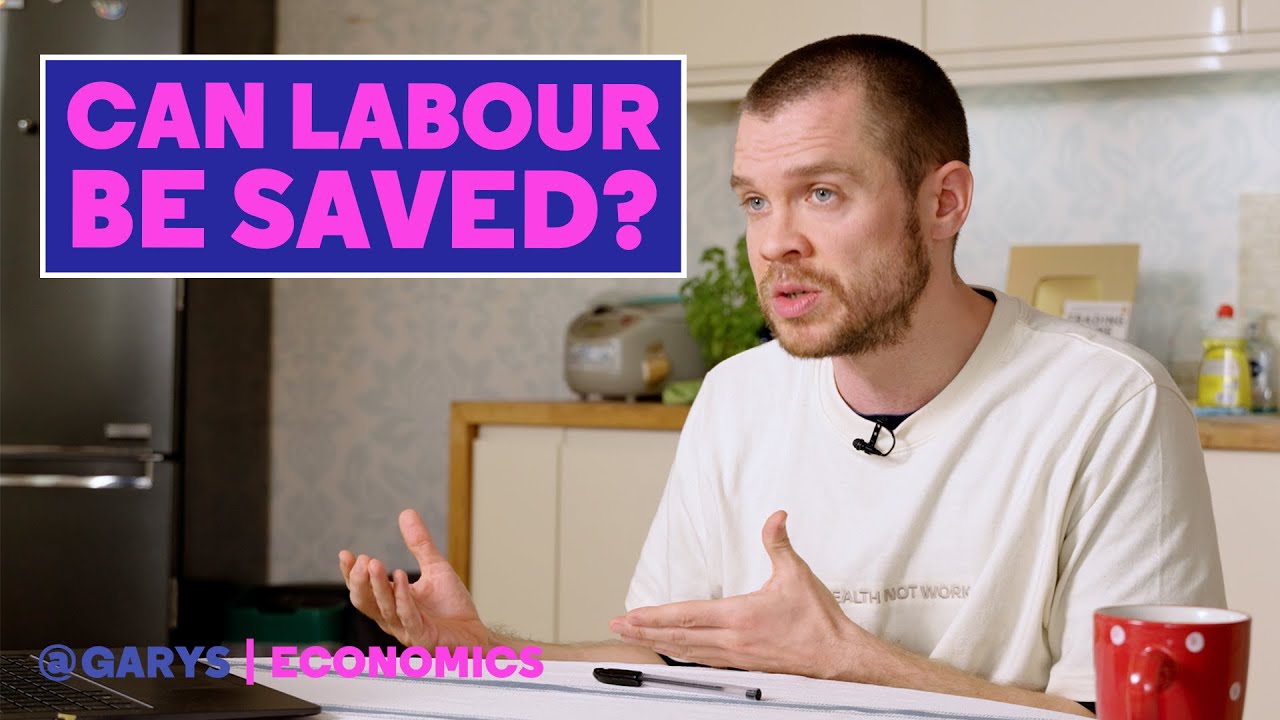
Can Labour be Saved?
0 up · 0 down · 0 ratings
Description
The Labour government refuse to acknowledge and deal with the rising tide of inequality in the UK. Will this doom them to fail, or can we get through to them?
Promos
TAX WEALTH NOT WORK t-shirt: shop.garyseconomics.org ––––––––––– 00:00 Intro 03:20 How they view the world 10:00 Why they won’t listen to me 24:20 They’re stuck in a bubble 26:50 Reform are the reckoning 30:35 Is Labour doomed to fail? 32:12 My message to Labour MPs ––––––––––– MAKE A DONATION TO OUR CAMPAIGN – buy.stripe.com SUPPORT US ON PATREON – patreon.com JOIN GARY'S MAILING LIST – subscribepage.io GET THE TRADING GAME – penguin.co.uk ––––––––––– Follow Gary on other channels: LINKEDIN – linkedin.com SPOTIFY – open.spotify.com INSTAGRAM – @garyseconomics TIKTOK – @garyseconomics BLUESKY – bsky.app X – twitter.com FACEBOOK – @garyseconomics DISCORD – discord.gg WEBSITE – garyseconomics.org
Gary’s Economics returns with a deep dive into whether Labour can be saved by reframing the debate around inequality and economic policy. The video opens by reframing Labour’s challenge as a structural, worldwide economic problem rather than a uniquely UK Labour misstep. Gary argues that the real crisis is rising wealth inequality driving falling living standards, and that mainstream economics has historically neglected inequality as a driver of macro outcomes. He then explores why Labour has failed to make inequality its central message, linking academic economics culture to political inertia and a misalignment between elite perceptions and the lived experiences of ordinary people. The host presents a taxonomy of theories about why policy makers resist wealth taxes and redistribution, ranging from branding and class dynamics to bubble effects in elite spaces. Throughout, he emphasizes that the solution is not to abandon Labour or reform entirely, but to de-radicalize the message and broaden the coalition for wealth taxation and redistribution. In the first major section, Gary critiques the discipline of economics for its heavy focus on mathematical modelling with little explicit attention to inequality. He argues that thousands of hours in algebra and calculus, often in isolation from real-world distributional data, train economists to overlook inequality as a central cause of economic distress. He cites examples of economists who have argued for inequality-aware policies but face professional marginalization within academia. The narrative then shifts to the political arena, where he claims centre-left parties like Labour face structural barriers to adopting wealth taxes due to branding and donor dynamics. He discusses personal experiences of being perceived as far-left and the challenge of communicating ideas to a politically resistant elite. The segment ends with a plan to disentangle policy proposals from partisan branding, arguing that broad public support for wealth taxation could trump party allegiance if communicated effectively. Gary then lays out a series of theories about why elites resist these ideas, including the far-left branding, the donor influence of the rich, and the so-called Brahmin or bubble theory. He discusses how wealth and education influence who gets heard in politics, media, and economics, and he argues that the elite bubble creates a mismatch between elite lived realities and ordinary citizens’ needs. The discussion moves to solutions: infiltrating elite networks, broadening the base of support for wealth Taxes, and building cross-partisan coalitions that can push for serious reforms. He emphasizes that reforms are not merely about one party seizing power but about shifting the Overton window so that wealth taxes and redistribution become mainstream options. He also acknowledges the risk of reform losing momentum and frames the stakes as the long-term health of living standards for the British public. In the next section, Gary contrasts different trajectories for Labour if they adopt wealth tax policies and stronger redistribution. He argues that if Reform UK or another party gains power, wealth taxes on the rich could still be realized in some form, or alternatively, the economy could deteriorate further before any real reform occurs. He articulates a strategic stance: even if Labour loses, the movement can endure by continuing to push ideas in multiple political spaces, including the Greens and liberal Democrats, and by leveraging international examples like Gabriel Zucman’s wealth tax work in France. The video emphasizes that the goal is not personal victory but systemic improvement in living standards and poverty reduction. He closes with a direct appeal to Labour MPs to engage and consider open-minded, pragmatic approaches to inequality rather than fixed ideological positions. The concluding segment returns to a hopeful, action-oriented pitch. Gary stresses that the next Labour leader could be decisive for whether wealth taxes ultimately pass, and he frames political victory as contingent on economic outcomes rather than party branding alone. He argues that ongoing inequality will fuel support for far-right movements unless Labour and its potential allies push credible policy solutions. He calls on viewers to help spread the message, de-emphasize personality clashes, and push for substantive wealth taxation that can raise living standards. The video ends with a personal pledge to keep fighting for reform, urging Labour MPs to engage openly and to work with diverse groups across the political spectrum to prevent economic collapse and to safeguard future generations. The closing message echoes a famous Labour reformist sentiment: there is no final victory, only ongoing battles to improve people’s lives and economic fairness.
Topics · politics · economics · inequality · public_policy
Questions answered
- What is the core problem Gary identifies as driving economic decline in the UK and many other countries?
- The core problem is rising wealth inequality which reduces living standards and fuels economic distress.
- Why does Gary think economists and politicians resist inequality-focused analysis?
- Because of an academic culture that undervalues inequality, rewards conventional thinking, and because elite networks resist ideas that threaten their positions.
- What strategic path does Gary propose to advance wealth taxation despite political obstacles?
- Build broad coalitions that de-brand wealth taxes from being a left-right issue, infiltrate elite institutions to push ideas, and accelerate reform via cross-party collaboration and international examples.