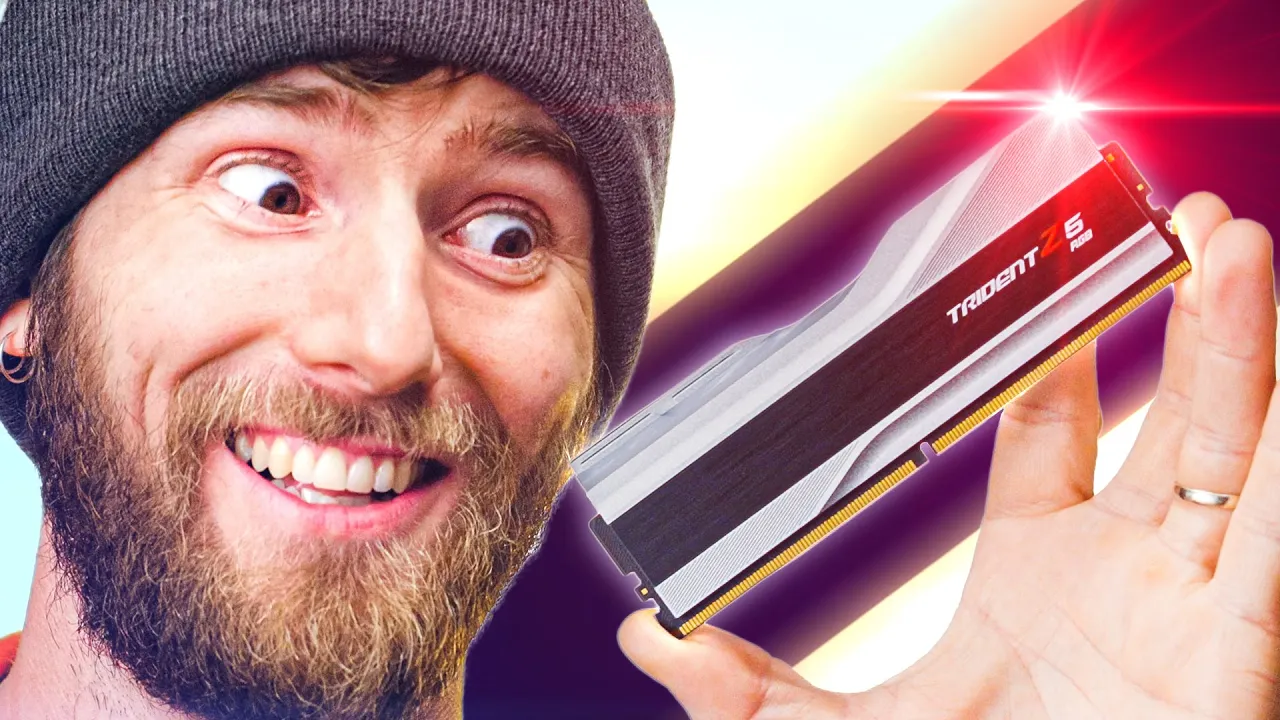
DDR5 is FINALLY HERE... and I've got it
0 up · 0 down · 0 ratings
Promos
New Customers Exclusive – Get a Free 240gb SSD at Micro Center: micro.center Micro Center X ASUS PC Builder: micro.center Use code LINUS and get 25% off GlassWire at lmg.gg You might think DDR5 is just another iteration on the same memory concept we've had since the beginning, but THIS is unlike any RAM you've ever used. Let's see what makes it tick, and how it can power the next generation of motherboards and CPUs. Buy G.Skill Trident Z5 RGB on Amazon: geni.us Buy G.Skill Trident Z Royal Elite on Amazon: geni.us Purchases made through some store links may provide some compensation to Linus Media Group. Discuss on the forum: linustechtips.com ► GET MERCH: lttstore.com ► AFFILIATES, SPONSORS & REFERRALS: lmg.gg ► PODCAST GEAR: lmg.gg ► SUPPORT US ON FLOATPLANE: floatplane.com FOLLOW US ELSEWHERE --------------------------------------------------- Twitter: twitter.com Facebook: @LinusTech Instagram: @linustech TikTok: @linustech Twitch: twitch.tv MUSIC CREDIT --------------------------------------------------- Intro: Laszlo - Supernova Video Link: youtube.com iTunes Download Link: itunes.apple.com Artist Link: soundcloud.com Outro: Approaching Nirvana - Sugar High Video Link: youtube.com Listen on Spotify: spoti.fi Artist Link: youtube.com Intro animation by MBarek Abdelwassaa @mbarek_abdel Monitor And Keyboard by vadimmihalkevich / CC BY 4.0 geni.us Mechanical RGB Keyboard by BigBrotherECE / CC BY 4.0 geni.us Mouse Gamer free Model By Oscar Creativo / CC BY 4.0 geni.us CHAPTERS --------------------------------------------------- 0:00 Intro 0:57 DDR5's physically different 2:29 DDR cash money 3:10 Advantages over DDR4 4:04 Why not just go faster? 5:25 Getting around the bottlenecks 7:07 This isn't dual channel 7:51 In-chip bit flip protection (no, it's not "real" ECC) 8:40 DDR4 is FASTER??? Overclock time! +RGB
The video opens with a recap of the long wait since DDR4, setting the stage for the arrival of the fifth generation memory, DDR5. The presenter introduces the key architectural shift by moving the PMIC from the motherboard to the RAM module itself, explaining how this enables the higher signal integrity needed for much faster transfer rates. He notes that while DDR5 operates at lower voltages than DDR4, the on-module PMIC will not be perfectly efficient, so some heat is still expected per module. The discussion then explores the cost implications of new memory designs, PCB complexity, and the early adopter tax, while setting expectations that platform costs may not always drop with new generations. The segment also emphasizes that DDR5 brings tangible advantages beyond raw frequencies, such as better efficiency and improved data handling at high speeds, which depend on CPU memory controllers and motherboard support. In the middle section, the host dives into how DDR5 achieves higher bandwidth. He explains that DDR5 reorganizes internals by doubling the number of bank groups from four to eight, which allows more time for each bank to cool and recover between bursts. The memory interface is redesigned from a single 64-bit bus to two independent 32-bit sub channels, effectively increasing burst capacity to 16 and delivering 64 bytes per burst without stalling the CPU. He clarifies that this does not mean DDR5 is simply a dual-channel upgrade; multi-module configurations are still needed to exploit multi-channel bandwidth, while the real gains lie in efficiency and reduced latency thanks to the new sub-channel structure. The segment also touches on the built-in ECC-like protection within DDR5 chips, improving stability at high speeds and contributing to reliability in the new generation. The discussion closes with expectations for higher capacities per module and the potential for more advanced, cooling-intensive configurations as the ecosystem evolves. The final portion covers real-world considerations and practical takeaways. The host outlines that DDR5 is not a magic upgrade and that, at base specifications, faster DDR4 overclocking can outperform some DDR5 kits, depending on voltage and controller limits. He discusses two types of PMICs, including programmable variants that can handle higher voltages, hinting at exotic modules and cooling needs in the future. The video also notes an SPD redesign for DDR5, which will influence how memory sticks report their timing and power characteristics, potentially enabling more dynamic lighting and controller signaling. A sponsor segment with Micro Center is included, presenting a PC builder service and a three-base starter option to simplify custom builds, with a promotional offer for new customers. The host wraps with a forward-looking stance on DDR5 as a platform enabler for next-gen CPUs and GPUs, while acknowledging the current cost and adoption hurdles. Finally, the video points viewers to related content on memory speed impacts and performance, inviting ongoing exploration of the DDR5 transition.
Topics · technology · hardware · computer_memory · memory
Questions answered
- What is the major architectural change in DDR5 compared to DDR4?
- DDR5 moves the power management IC from the motherboard to the memory module and doubles bank groups from four to eight, while introducing two independent 32-bit sub channels to increase burst capacity and efficiency.
- Why might DDR5 be more expensive at launch?
- Because of the on-module PMIC, more complex PCBs, and the initial design and production costs, plus the current semiconductor shortage and platform integration challenges.
- Is DDR5 simply a faster version of DDR4?
- Not exactly; although base speeds are higher, real gains come from architectural changes like bank group restructuring, dual sub channels, and on-die ECC like features that improve stability and latency.