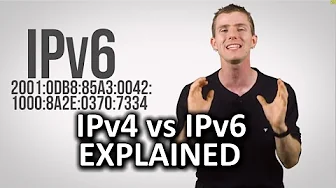
Internet Protocol - IPv4 vs IPv6 as Fast As Possible
0 up · 0 down · 0 ratings
Description
IPv4 vs IPv6... Why do we need to transition from the Internet Protocol that's served us so well for all these years? Maybe because we're completely running out of IP addresses! Audible Message: Give Audible's monthly audiobook service has more than just audiobooks! - use audible.com to get the first one for free!
The video introduces the Internet Protocol as the fundamental set of rules that enables data exchange between devices on different networks, using an analogy to a mail system. It explains two core jobs of IP: addressing hosts so every device can be uniquely identified, and routing to determine the best path for data to travel across networks. The presenter highlights IPv4’s age and its limitations, notably the 32-bit address space that yields about 4 billion unique addresses, which is no longer sufficient for all devices. It then contrasts IPv4 with IPv6, a 128-bit addressing scheme that provides roughly 304 trillion addresses, effectively eliminating address exhaustion and enabling more scalable addressing for everything from smartphones to sensors. The discussion proceeds to address common mitigation strategies like network address translation (NAT) which uses private addresses behind public ones, and how NAT has influenced security, performance, and peer-to-peer connectivity. The video also covers the trade-offs of moving to IPv6, including the current hurdles of backward compatibility, the role of ISPs, and the potential impact on features like carrier-grade NAT and net neutrality. Throughout, the speaker emphasizes that IPv6 enables simpler direct device communication and auto-configuration, while reducing header overhead relative to IPv4, and explains why a complete transition has been slow, largely due to cost, compatibility, and incentives for providers to upgrade. The segment closes by underscoring the importance of understanding IPv6 as networks evolve, while briefly promoting Audible as a sponsor and inviting viewer engagement with future topic ideas.
Topics · technology · networking · internet · protocols · computing · telecommunications
Questions answered
- What is the primary purpose of the Internet Protocol in data transmission?
- The IP's primary purposes are to provide unique addressing for devices so packets reach the correct destination and to route packets efficiently across network boundaries.
- Why is IPv6 address space so much larger than IPv4, and what practical benefit does that offer?
- IPv6 uses a 128-bit address, giving about 304 trillion addresses, which allows unique addressing for vastly more devices and simplifies direct device communication and auto configuration.