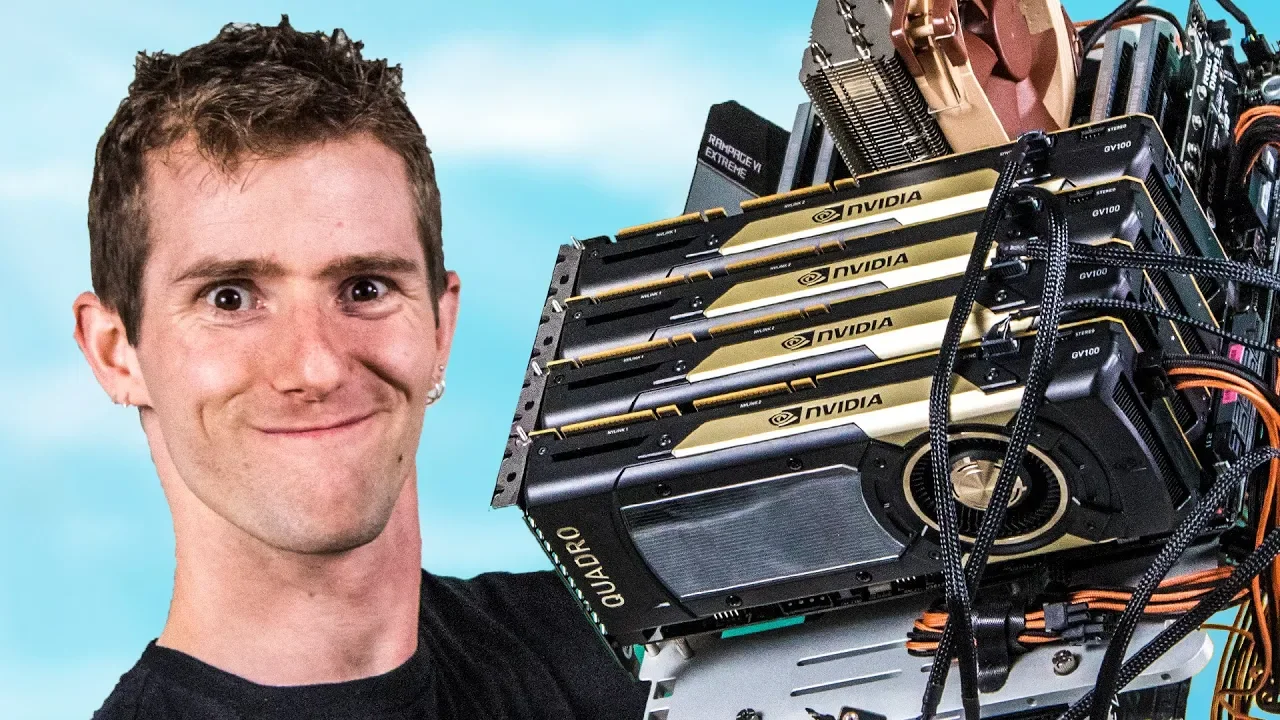
We THOUGHT this $40,000 PC would break records...
0 up · 0 down · 0 ratings
Description
Check out CORSAIR STRAFE MK.2 Mechanical Keyboard on Amazon at geni.us
Promos
Check out the Thermaltake Level 20 series cases on Amazon at geni.us Buy Nvidia Quadro On Amazon: geni.us Buy RTX 2080 Ti On Amazon: geni.us On Walmart: geni.us On Newegg: geni.us Buy GTX 1080 Ti On Amazon: geni.us On Newegg: geni.us Discuss on the forum: linustechtips.com Linus Tech Tips merchandise at designbyhumans.com Linus Tech Tips posters at crowdmade.com Our Test Benches on Amazon: amazon.com Our production gear: geni.us Twitter - twitter.com Facebook - @LinusTech Instagram - @linustech Twitch - twitch.tv Intro Screen Music Credit: Title: Laszlo - Supernova Video Link: youtube.com iTunes Download Link: itunes.apple.com Artist Link: soundcloud.com Outro Screen Music Credit: Approaching Nirvana - Sugar High youtube.com Sound effects provided by freesfx.co.uk
In this episode, Linus Tech Tips explores a bold and expensive hardware experiment that aims to topple 3DMark Extreme leaderboards using a monster setup. The plan centers on an Asus C621e Sage workstation loaded with 56 CPU cores and four Nvidia Quadro GV100 GPUs, each costing around $9,000, in an attempt to outpace a competing system that relies on fewer high-end components. He openly acknowledges the obstacles, including SLI limitations on quadros and the need to find a workaround to make the GPUs work together for gaming. The episode then delves into the practicalities of making this dream rig function, including an unconventional 2x2 4K monitor grid using LG 43UD79 displays and active DisplayPort to HDMI adapters to line up all displays with the Quadro Sync 2 board. The narrative threads through the setup grind, the mounting of radiators for cooling, and the constant tradeoffs between theoretical performance and real-world gaming results, culminating in a candid assessment of whether the $40,000 configuration actually breaks any records. By the end, Linus reflects on the learning experience, noting that while the idea was undeniably impressive, the actual performance in games like GTA V exposed multiple bottlenecks that prevent the rig from delivering the promised gaming supremacy. The video also showcases the Corsair Strafe MK2 keyboard as part of the hardware ecosystem, highlighting its features and how such peripherals complement high-end builds, even when the main star is a sprawling, multi-GPU rig.
Topics · technology · hardware · gaming · benchmarks · pc_builds · graphics_cards
Questions answered
- Why did Linus attempt to use four Nvidia Quadro GV100 GPUs for a gaming benchmark with SLI limitations?
- Because the team wanted to maximize raw GPU compute and memory bandwidth and test whether a quadro-based setup could outperform traditional gaming GPUs, despite SLIs limitations. They used a Quadro Sync 2 to make multi-GPU output coherent for a shared 4K display grid, aiming to demonstrate feasibility and explore bottlenecks.
- What workaround did the video crew employ to enable multi-GPU gaming on the quadros given SLI restrictions?
- They used a Quadro Sync 2 board and active DisplayPort to HDMI adapters to create a 4K 2x2 display grid, with each card driving its own display segment while maintaining synchronization, so the system could render across four GPUs as a composite display.
- What was the final takeaway about the rig’s gaming performance in GTA V, despite the high cost and complexity?
- In GTA V, the rig showed that even with many GPUs, CPU bottlenecks and cross-card coordination limited real-world performance, resulting in lower-than-expected frame rates and indicating that the setup could not deliver the promised level of gaming performance in practice.
- What peripherals were highlighted as part of the build, and why are they relevant to high-end rigs?
- The Corsair Strafe MK2 keyboard was highlighted for its enhanced switches, anti-ghosting, macro storage, and USB passthrough, illustrating how quality peripherals complement extreme builds by offering reliable input precision and convenient customization for power users.