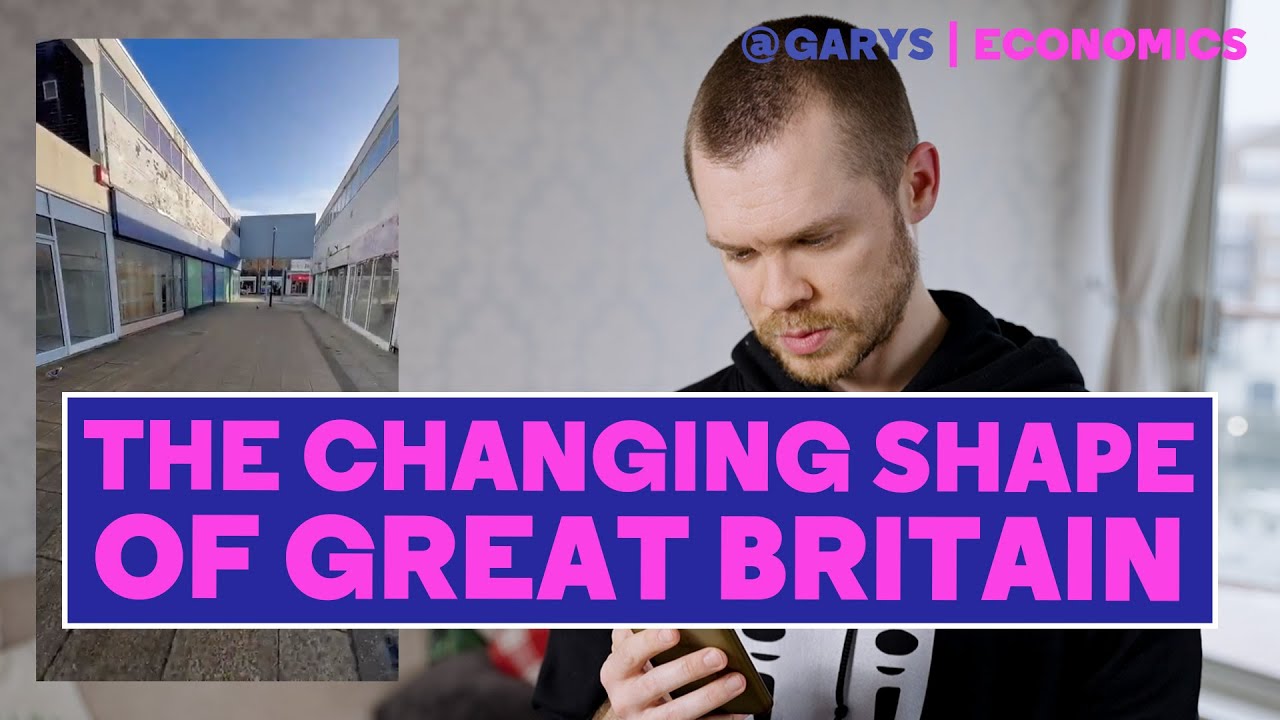
The Changing Shape of Great Britain
0 up · 0 down · 0 ratings
Channels and socials
How's your local high street doing? This is how inequality affects the shape of a country. UNDERSTAND, SHARE & PUSH BACK WEBSITE - garyseconomics.org TWITTER - twitter.com FACEBOOK - @garyseconomics INSTAGRAM - @garyseconomics TIKTOK - @garyseconomics YOUTUBE - youtube.com PATREON - patreon.com DISCORD - discord.gg BLUESKY - bsky.app SUBSCRIBE, SHARE & START A CONVERSATION Performed by Gary Stevenson @garyseconomics
The video begins with Gary Stevenson reflecting on the changing shape of Great Britain, anchored by a personal visit to his hometown and a reflection on how small towns are shrinking in the face of rising inequality. He contrasts the UK with other countries, notably Colombia, to illustrate how wealth concentration around a rich core produces large, vibrant urban centers surrounded by extensive, impoverished peripheries. He argues that in highly unequal economies, the number of viable, self-sustaining smaller settlements declines as people migrate toward wealthier hubs, leaving countryside areas underpopulated and towns devoid of broad economic bases. Stevenson then reframes the issue in terms of capitalism and wealth distribution, suggesting that the physical form of a country mirrors its wealth distribution: in equal economies, diverse towns and cities thrive, whereas in unequal economies, entire regions become dependent on a few wealthy centers and small towns degrade. He uses examples from London and Ilford to describe how housing density increases and the quality of life in ordinary towns deteriorates as housing is built rapidly to accommodate demand but without addressing underlying income disparities. The discussion expands to view the UK, the US Rust Belt, and some European countries as moving toward a model where ordinary people must live near the rich, creating large slums around wealthy centers. Stevenson emphasizes that simply building more houses will not solve the problem unless wealth and income are more evenly distributed, and he argues for policies that directly increase ordinary people's purchasing power to allow them to live where their families have lived for generations. The conclusion centers on a hopeful but urgent call to address inequality through policy changes, including taxing the rich, to prevent the future from resembling a landscape dominated by slums around wealthy centers rather than balanced, diverse communities.
Topics · inequality · urbanization · economics · housing · regional development
Questions answered
- What is the central argument about the changing shape of Great Britain in the video?
- The central argument is that rising wealth inequality leads to a physical transformation of the country, with wealth concentrating in a few large urban centers and vast areas around them becoming underpopulated and economically fragile, effectively creating slum-like conditions around wealthy cores.
- What solutions does the presenter propose to prevent this outcome?
- The presenter advocates policies that reduce inequality, such as taxing the rich and increasing money in ordinary people's pockets, which would allow people to live in communities where their families have lived for generations rather than being forced toward wealthier centers.
- Why does the speaker argue that simply building more houses is not enough?
- Because without addressing wealth distribution, new housing tends to create or reinforce slum-like environments around rich centers, failing to improve living standards for the majority and sustaining the unequal city-country dynamic.