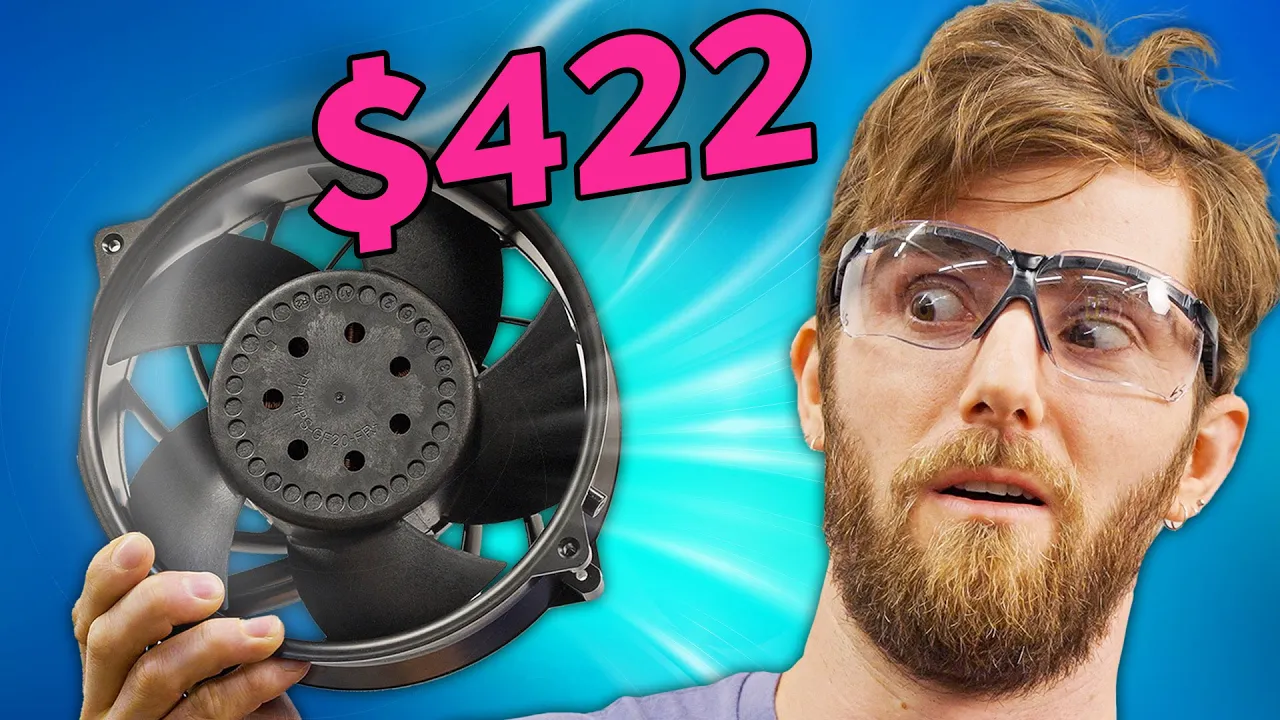
The God of Computer Fans
0 up · 0 down · 0 ratings
Promos
Get $25 off all pairs of Vessi Footwear with offer code LinusTechTips at vessi.com Being Delta Electronic's most powerful fan we had to try the THD2048HT - aka Blowzooka - out. Discuss on the forum: linustechtips.com
Check out the Blowzooka: delta-fan.com ► GET MERCH: lttstore.com ► SUPPORT US ON FLOATPLANE: floatplane.com ► AFFILIATES, SPONSORS & REFERRALS: lmg.gg ► PODCAST GEAR: lmg.gg FOLLOW US --------------------------------------------------- Twitter: twitter.com Facebook: @LinusTech Instagram: @linustech TikTok: @linustech Twitch: twitch.tv MUSIC CREDIT --------------------------------------------------- Intro: Laszlo - Supernova Video Link: youtube.com iTunes Download Link: itunes.apple.com Artist Link: soundcloud.com Outro: Approaching Nirvana - Sugar High Video Link: youtube.com Listen on Spotify: spoti.fi Artist Link: youtube.com Intro animation by MBarek Abdelwassaa @mbarek_abdel Monitor And Keyboard by vadimmihalkevich / CC BY 4.0 geni.us Mechanical RGB Keyboard by BigBrotherECE / CC BY 4.0 geni.us Mouse Gamer free Model By Oscar Creativo / CC BY 4.0 geni.us CHAPTERS --------------------------------------------------- 0:00 - Your computer fan's Daddy 0:54 - Zoho CRM! 1:10 - LTT Intro 1:18 - Unboxing and specs 3:10 - Power supply 7:15 - Powering it on 8:00 - Saftey Test feat. Carrots 10:10 - Speed check 12:20 - Installing into case 15:04 - Running in computer 18:12 - Test Results 19:29 - Vessi! 20:10 - Outro
The video presents a deep dive into Delta Electronics' THD2048HT, nicknamed the Blowzooka, touted as the most powerful PC cooling fan. The hosts frame it as a high-end industrial product with a cast aluminum frame and a massive hub to house its powerful motor, underscoring the high cost and the specialized power requirements. They start with unboxing, noting the packaging is minimal and that the frame design signals a server-grade component rather than a consumer product. The setup section explores power challenges, revealing that the fan runs at 48 volts and can draw substantial current, which pushes the team to experiment with unconventional power solutions including a 24V 60A supply and a boost converter. They emphasize safety considerations early on, joking about finger safety and describing the risk of injury from the blades, while also demonstrating how the team evaluates the unit with improvised hardware like clamps and M4 stands. The testing phase focuses on airflow, noise, and safety, with an improvised tachometer using tape on a blade and a multimeter to monitor voltage and current, all while wearing protective eyewear and conducting cautious safety checks. As the tests progress, the team measures real-world performance inside a case, comparing the Blowzooka’s massive airflow against standard 180 mm fans and assessing whether the increased air movement translates to meaningful temperature drops. They report surprising results, including a substantial reduction in CPU temperatures when the Blowzooka operates behind the CPU cooler, and they explore how the system’s power budget evolves under heavy airflow conditions. The video also documents practical constraints such as wiring, mounting, and potential turbulence that could affect other components, and ends with a brief sponsor plug and a teaser about future improvements to their cooling experiment. Throughout, the presenters balance humor with technical detail, sharing hard data, practical lessons, and the broader implication that extreme air movers can dramatically alter cooling dynamics in high-performance setups. Overall, the segment emphasizes experimentation over elegance, highlighting that with enough power and careful integration, even a single oversized fan can redefine thermal performance in a computing rig, while also acknowledging the risks and trade-offs involved in pushing hardware to extreme limits.
Topics · technology · hardware · engineering · computer cooling
Questions answered
- What is the THD2048HT and why is it considered the most powerful PC cooling fan?
- The THD2048HT is Delta Electronics' high-end server-style fan with a large hub and heavy blades designed for extreme airflow, capable of moving hundreds of liters per second and operating at 48 volts, which supports its claim of high cooling capacity.
- What were the main power and safety challenges encountered when powering the Blowzooka for testing?
- The fan requires 48 volts and high current, so the team experimented with different power solutions including a 24V supply and boost converters, while implementing safety measures such as protective eyewear and careful handling due to sharp blades and high spin speeds.
- How did the Blowzooka perform in real-world CPU cooling tests compared to stock fans?
- In the tests, placing the Blowzooka behind the CPU cooler significantly reduced CPU temperatures and improved thermal headroom, sometimes enabling higher power budgets, though the setup required careful mounting and power considerations.
- What are some practical considerations when integrating such a fan into a PC build?
- Practical considerations include ensuring a compatible mounting structure, avoiding interference with other components, managing high power requirements, and accounting for potential turbulence and noise while securing wiring and ensuring safety during operation.
- What is the overall takeaway about using extreme cooling like the Blowzooka in PCs?
- The takeaway is that extremely powerful fans can dramatically alter cooling performance in high-end builds, but they come with significant engineering, safety, and power challenges that must be managed to realize any real-world benefit.