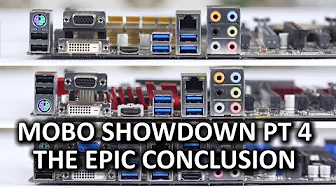
Bang for the Buck Z97 Motherboard Showdown Part 4 - The Epic Conclusion
0 up · 0 down · 0 ratings
Channels and socials
So, when the dust settles and we compare these four motherboards head to head, is there a clear winner? Crunchyroll link: crunchyroll.com Sponsor link: linustechtips.com Pricing & discussion: linustechtips.com Support us: linustechtips.com Join our community forum: bit.ly twitter.com @LinusTech Intro Screen Music Credit: Adhesive Wombat -
Check out his channel here: youtube.com Outro Screen Music Credit: Approaching Nirvana - Sugar High youtube.com
The fourth and final installment of the Bang for the Buck Z97 Motherboard Showdown continues the deep dive into affordable Z97 motherboard options, focusing on the finished system experience and the practicality of OneTouch overclocking. The hosts recount the performance results from each board, noting that general overclocking achieved around 4.4 GHz on the Intel G3258 CPU, with attempts at higher clocks on the ASRock board that showed instability at 4.7 GHz and 4.6 GHz in manual tests, underscoring the trade-offs present in budget boards. They also analyze driver download speeds across the tested boards, highlighting MSI as first in download speed at 7.7 MB/s, with ASRock trailing and AzRock the slowest, while cautioning that network conditions can skew these results. The video emphasizes that while driver bloatware should be avoided, basic monitoring utilities offered by the motherboards can be useful, whereas Windows itself handles most tasks adequately without extra software. The hosts then distill practical guidance for potential buyers, stressing the importance of IO, PCI layout, fan header availability, and cable management, and noting that Intel’s shifting architecture has reduced performance differences between boards in this price range. Throughout, they compare each brand’s strengths: Asus for UEFI usability, ASRock for fan headers and features, MSI for broad compatibility, and Gigabyte for aesthetics and dual-BIOS, urging viewers to consider their own needs when choosing. The conclusion invites community input on which board best fits individual use cases and teases continued discussion on affordable motherboards in future content. Lastly, the episode closes with a reminder to use official channels for BIOS and driver updates, to check forum discussions, and to participate in the broader Linus Tech Tips community for ongoing guidance and feedback on builds and hardware choices.
Topics · computer_hardware · tech_entertainment · pc_building · hardware_review · consumer_electronics