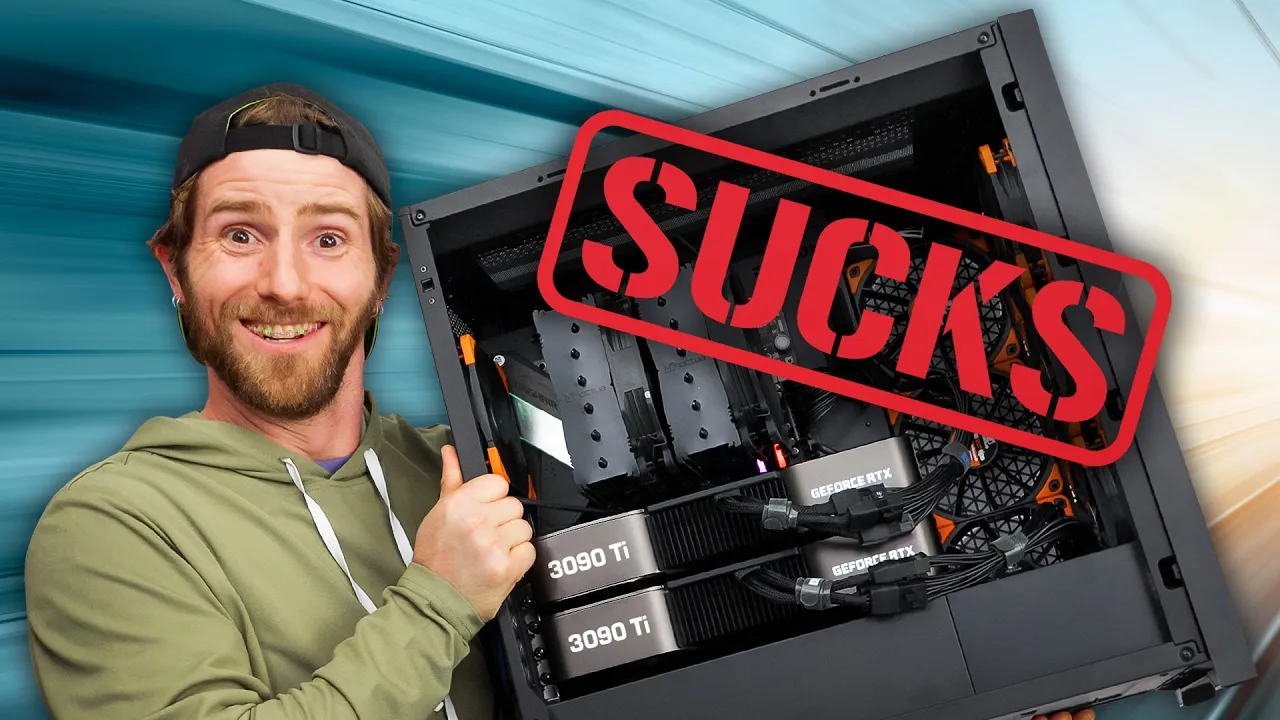
This $5000 PC From Just Four Years Ago SUCKS
0 up · 0 down · 0 ratings
Description
Thanks to Ridge for sponsoring this video! Head to ridge.com and get something nice for your dad! Just because Nvidia killed SLI, that doesn't mean it's over. With two RTX 3090 Tis in hand, we once again seek answers to questions like "just how bad was SLI?" and "should I buy a second RTX 3090 Ti?". Discuss on the forum: linustechtips.com NVIDIA RTX 3090 Ti Founders Edition: geni.us NVIDIA RTX 5090 Founders Edition: prsm2.com ASUS ROG X570 Crosshair VIII Hero: geni.us Samsung 990 EVO Plus: geni.us Seasonic Prime TX 1600W: geni.us
Channels and socials
Check out our Channel Partners: Secretlab - Grab a TITAN Evo ergonomic gaming chair: lmg.gg PIA - Get the VPN of our choice: piavpn.com dbrand - Buy a "Circuit" series skin for your device: dbrand.com ► SHOP LTT PRODUCTS: lttstore.com ► GET EXCLUSIVE CONTENT ON FLOATPLANE: lmg.gg ► DIVE DEEPER ON THE LTT LABS WEBSITE: lmg.gg ► SPONSORS, AFFILIATES, AND PARTNERS: lmg.gg Purchases made through some store links may provide some compensation to Linus Media Group. Affiliate links powered in part by affilimate.com Linus Sebastian is an investor in Framework Computer, Inc and HexOS by Eshtek. CHAPTERS --------------------------------------------------- 0:00 Intro 1:42 One 3090 Ti 2:30 SLI 5:16 Troubleshooting 6:30 Gaming 10:40 RTX 5090 12:50 Conclusion 15:15 Outro
This video revisits an old high-end dual GPU concept by pairing two RTX 3090 Ti cards in an SLI configuration and evaluating whether this vintage monster can still meaningfully compete with a newer model like the RTX 5090. The host starts by grounding the experiment in history, explaining SLI’s origins and how multi-GPU setups were meant to boost rendering power, before acknowledging that Nvidia effectively killed SLI for consumer cards. A baseline is established with a single 3090 Ti Founders Edition, noting its memory, bus width, and clock speeds, and then the plan to test a second 3090 Ti to measure real-world gains and the practical downsides. The video proceeds to demonstrate the setup process, including driver quirks, broken control panel features, and per-application SLI visibility issues, which creates a navigational challenge despite the nostalgia for multi-GPU configurations. Throughout, there is a careful emphasis on empirical testing: synthetic benchmarks are contrasted with real games, and the team documents critical bottlenecks like micro stuttering, delayed frame assembly, and the heavy power draw that can approach 1000 watts under load. The host then compares this SLI rig against a single RTX 5090, highlighting architectural differences, memory bandwidth, and VRAM pooling realities under multi-GPU conditions, and concludes that the two-ship SLI approach remains technically interesting but practically inferior for gaming today. The discussion naturally broadens into the economics and design decisions behind modern GPUs, noting that NVLink has shifted toward professional and AI-centric use while consumer SLI remains largely unsupported by developers. In closing, the video reinforces the takeaway that SLI, while sometimes impressive in idealized conditions, is effectively dead for gaming, and suggests that hardware enthusiasts may still experiment in home labs for AI workloads or nostalgia, with a nod to Ridge for sponsor support and a practical Fathers Day offer. The sponsor segment then leans into Ridge’s products and the value of durable, reliable gear, pitching wallets and accessories as gifts, and urging viewers to check the linked deals while leaving the door open for future content that revisits legacy hardware.”
Topics · technology · hardware · gaming · reviews · ai_and_compute
Questions answered
- Why did SLI die for consumer GPUs and is there any scenario where it makes sense today?
- SLI died for consumer GPUs because real-world gains were limited, power and thermal penalties were high, and game support dwindled. Today, it mainly makes sense in specialized workflows or home labs for AI or large-scale rendering where NVLink or similar interconnects are used professionally.
- How does the RTX 5090 compare to two RTX 3090 Ti in this test?
- The RTX 5090 offers higher bandwidth, newer architecture, better software support, and lower overall power usage, resulting in better or comparable gaming performance with far less heat and space than two 3090 TIs in SLI.
- What were the key practical hurdles of getting SLI to work in this setup?
- Key hurdles included missing per-application SLI controls in the driver, compatibility issues with DirectX 11, driver repository instability, and micro-stuttering due to the need for precise, constant inter-GPU coordination.
- Is there any value left in multi-GPU setups for gaming or content creation?
- For gaming, the value is largely gone except in niche scenarios; for content creation or AI workloads, NVLink-style pooling and memory sharing across GPUs can still offer benefits in professional or lab settings.